
Are you a dedicated doctor watching a few negative online reviews sabotage your practice? It's incredibly frustrating when comments about wait times or billing overshadow years of medical expertise. You know that for every unhappy comment, there are hundreds of satisfied patients, but their silence is costing you new appointments and stalling your growth.
You've built a practice on trust and exceptional care, but your online reputation is telling a different story. This isn't just about hurt feelings; it's about losing patients to competitors with better star ratings. You need a simple plan to fix this, one that doesn't take time away from your patients.
At Review Overhaul, we provide a clear, 3-step plan to help doctors like you take back control. We act as your guide, giving you the tools to repair your online image, attract more patients, and get back to focusing on what you do best. Let us handle the noise so you can handle the care.
Your Reputation Is Now Your #1 Asset
A strong online reputation isn't a "nice-to-have" anymore; it's the foundation of a thriving practice. When your online presence truly reflects the quality of your care, you'll see a dramatic shift.
- Attract More High-Value Patients: A 5-star reputation makes you the obvious choice for patients seeking the best care.
- Build Unshakeable Trust: Positive reviews act as powerful social proof, building confidence before a patient even calls your office.
- Achieve Peace of Mind: Stop worrying about what a bad review will do and feel secure in your practice's growth and stability.
This is what success looks like: a full schedule, a stellar reputation, and the freedom to focus on patient outcomes instead of online comments.
Real Doctors, Real Results
"We were struggling with some unfair reviews that were really hurting us. Review Overhaul's system helped us get a flood of positive feedback from our actual patients. Our star rating shot up, and so did our new patient calls." – Medical Practice Owner
| Statistic | Impact on Your Practice |
|---|---|
| 84% of people trust online reviews as much as a personal recommendation. | Your online reputation is the new word-of-mouth. |
| 72% of patients use online reviews as their first step in finding a new doctor. | A weak online profile means you’re not even in the running. |
| 40% of patients have canceled or changed appointments based on reviews. | Negative reviews directly lead to lost revenue. |
Letting your reputation slide means continuing to lose patients and revenue. Taking control means growth, stability, and renewed confidence in your practice.
Ready to see how your online reputation is impacting your bottom line?
Step 1: Polish Your Online Profile
Your online profiles are the new front door to your practice, and most are neglected. A polished, professional profile is the first step to building trust before a patient ever meets you.
We help you optimize every critical listing, starting with your Google Business Profile. Our team ensures your contact information is accurate, your services are clearly described, and your photos convey professionalism and warmth.

This foundational step makes your practice the clear, trustworthy choice for patients searching online.
Step 2: Build a 5-Star Reputation
Waiting for reviews to trickle in leaves your reputation to chance. Our plan helps you proactively generate positive reviews from your happiest patients.
We implement a simple, automated system to ask for feedback at the perfect time. This creates a steady stream of authentic, positive reviews that buries any negative comments and showcases the true quality of your care.

Step 3: Monitor and Respond Professionally
How you handle feedback is critical, especially with HIPAA rules. Our plan includes monitoring and responding to all reviews quickly and compliantly.
You'll get alerts for new reviews, and we provide HIPAA-safe templates for responding. This turns every review—good or bad—into a public display of your commitment to patient satisfaction.

Stop letting a few negative voices define your life's work. It’s time to build a reputation that reflects your true standard of care and brings more patients through your door.
The Problem Is Costing You Patients
Every day you wait, you risk losing more patients to competitors with stronger online profiles. The cycle is simple but damaging: a single bad review can trigger a chain reaction of cancellations and lost opportunities.
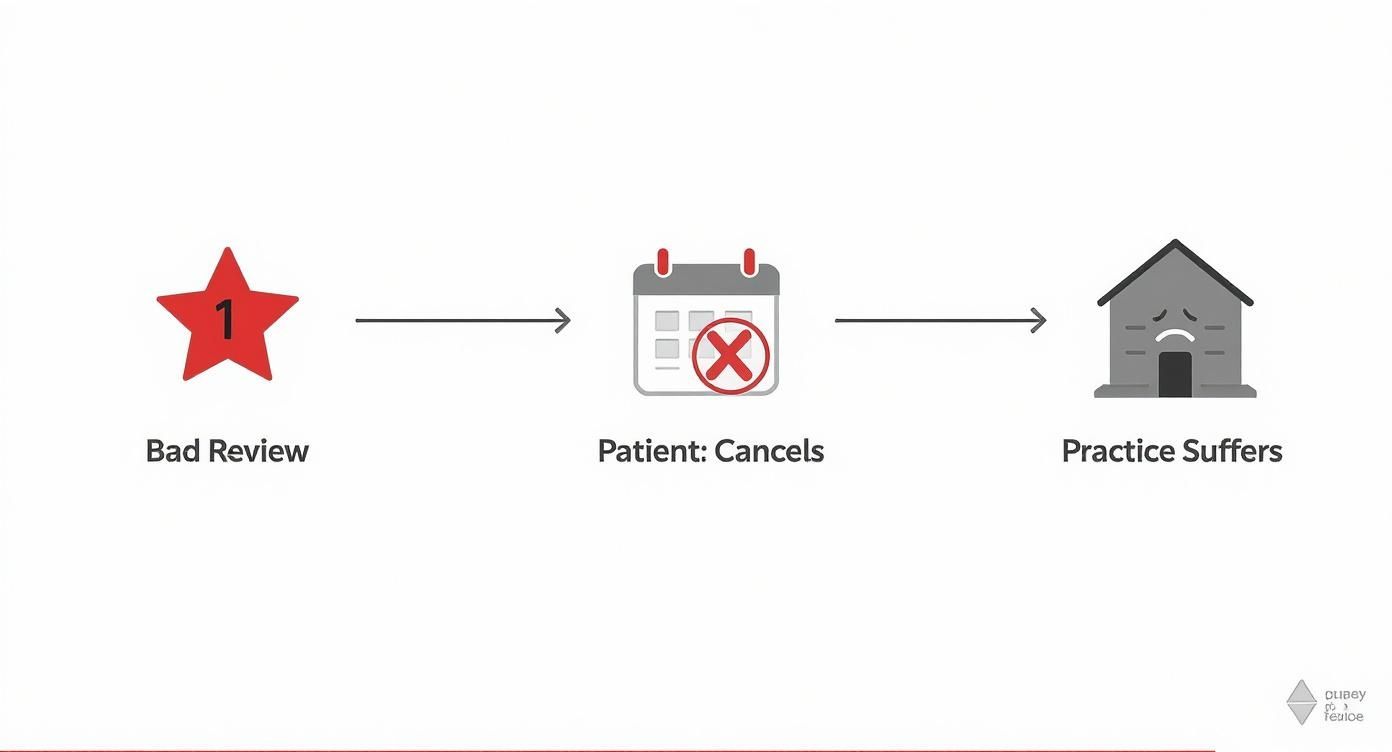
You can continue stressing about a reputation you don't control, or you can follow a proven plan that leads to growth and peace of mind.
Why Your Online Reputation Is Costing You Patients
You spend years honing your craft, but a single one-star review can unravel all that hard work in the mind of a new patient. Suddenly, a comment about parking or wait times—things often out of your direct control—becomes the first thing people see. It’s frustrating because it completely overshadows the countless positive outcomes you deliver every day.
This isn't just a perception issue; it directly impacts your bottom line. Every time a potential patient searches for a doctor and sees a low star rating, they make an instant decision. They don't know about your expertise or your compassionate care—they just see the negative feedback and click on a competitor with a better online profile.
The Real-World Impact of Digital Trust
The stakes in doctor reputation management are sky-high. Think about it: patients are now consumers, and they do their research. They expect quick, professional engagement and are easily swayed by what they find online.
To put it in perspective, here’s a quick look at how online ratings are shaping patient choices. For a more detailed look, check out our complete guide on healthcare online reputation management.
Crafting Your Digital First Impression
Let's be honest: your online profiles are the new front door to your practice. Long before a potential patient reads your credentials or even calls your office, they're forming an opinion based on what they find with a quick Google search. It's a make-or-break moment that happens in seconds.
For a lot of busy doctors, this digital first impression is an afterthought. The result? Outdated information, sparse details, and a huge missed opportunity to connect with patients. This is exactly where you can get a leg up and start building trust from the very first click. It all begins with seeing your practice through a patient's eyes.
Optimizing Your Google Business Profile
When a patient needs a new doctor, their journey almost always starts and ends on Google. In fact, an estimated 77% of patients now use online reviews to find a new physician, and your Google Business Profile (GBP) is where the action happens. A fully built-out profile isn't just about showing up in search results; it's about making your practice the obvious, trusted choice.
An incomplete or inaccurate profile can do more damage than no profile at all. It sends a subtle signal that you might not be attentive to detail—a perception that can easily bleed over into how they view your patient care. Let's make sure that's not the story your profile is telling. Getting these details right is fundamental, and you can see just how deep the rabbit hole goes by exploring a professional Google Business Profile optimization service to see how every single element can be fine-tuned.
Responding To Reviews With Confidence
The way you handle reviews—both glowing and critical—is where your reputation is truly forged. For doctors, this process has an extra layer of complexity: HIPAA. One wrong move in a reply can spiral into a serious privacy violation, turning a simple attempt to connect with a patient into a major legal headache.
This critical part of doctor reputation management often leaves practice owners feeling paralyzed, but it doesn't have to be that way. Once you understand the rules and have a solid plan, you can engage with patient feedback confidently and professionally. The real key is to turn every single review into a public display of your practice's commitment to patient care.
The HIPAA Tightrope Of Review Responses
The Health Insurance Portability and Accountability Act (HIPAA) is crystal clear: you cannot acknowledge that someone is a patient or disclose any Protected Health Information (PHI). This rule stands firm even if the reviewer openly shares their own medical details. Something as simple as, "Hi Jane, we're sorry about your experience during your visit last Tuesday," is a direct violation.
The golden rule of HIPAA-compliant responses is to never confirm, deny, or discuss any specifics. Your goal is to show you are listening without ever acknowledging a patient-provider relationship in a public forum.
Online reputation has a massive influence on how patients choose their doctors. You can discover more insights about how online ratings impact patient choice.
Building a Proactive 5-Star Reputation
Just waiting for reviews to trickle in is a passive, defensive game. It basically leaves your practice's reputation up to pure chance. A much smarter approach to doctor reputation management is to flip the script entirely. Stop just reacting to feedback and start building a system that consistently brings in positive reviews from your happiest patients.
This isn't about being pushy or bending ethical rules. Far from it. It’s simply about recognizing a basic human truth: most satisfied patients just forget to share their great experiences unless you give them a gentle nudge. The goal is to create such a strong current of authentic, positive feedback that it drowns out the noise from any random negative comment, giving prospective patients a true picture of your quality of care.
To really get this engine running smoothly, some practices find it helpful to work with experts like AI reputation management consultants. This kind of strategic offense is the heart of modern doctor reputation management, turning your digital presence from a source of anxiety into your most powerful asset for growth.
How To Monitor And Measure Your Success
Here's a hard truth: doctor reputation management isn't something you can set up once and then walk away from. It's a living, breathing part of your practice that needs real, consistent attention to pay off. The biggest mistake I see practices make is putting in all that initial effort, only to let new feedback pile up unanswered.
You need a simple system to stay on top of your reputation without it turning into another full-time job. This means getting alerts the moment a new review goes live, which lets you provide the prompt, professional responses patients now expect. This is how you stop anxiously checking review sites and start confidently managing your online story.
Setting Up Your Monitoring System
First things first: stop manually searching for your practice online. You can easily automate this process so new mentions and reviews come straight to you. This kind of proactive monitoring ensures nothing slips through the cracks.
Most major review platforms, including Google, have built-in notification settings. Just by enabling email alerts for your Google Business Profile, you'll get a message as soon as a patient leaves feedback. It's a simple setup but it's the foundation of timely engagement and a responsive online presence.
Key Metrics That Truly Matter
Once you have feedback coming in, you need to measure what’s actually working. Vague goals like "improving our reputation" are impossible to track. You have to connect your efforts to real business outcomes that justify the time and money you're putting in.
Here are the essential metrics to start with:
- Overall Star Rating: Track your average rating across key sites like Google and Healthgrades every month to see how you're trending.
- Review Volume and Velocity: A steady flow of new reviews (velocity) shows your system is working and keeps your profile looking fresh and relevant.
- Response Rate and Time: Aim to respond within 24 hours to show patients you’re engaged and you care.
Connecting Reputation To Revenue
Ultimately, the goal is to draw a straight line from your online reputation to your bottom line. The right metrics show how your hard work directly contributes to practice growth, making it easy to see a clear and powerful ROI.
| Metric (KPI) | What It Measures | How to Track It |
|---|---|---|
| New Patient Bookings | The number of new patients who found you online. | Use "how did you hear about us?" questions on intake forms or track appointment requests from your Google Business Profile. |
| Website Traffic | The volume of visitors coming from your online profiles. | In Google Analytics, monitor referral traffic from Google, Healthgrades, and other key review sites. |
| Local Search Rankings | Your practice's visibility for crucial search terms. | Use a simple rank tracking tool to see where you show up for searches like "doctor near me" or "cardiologist in [your city]." |
| Phone Call Volume | The number of direct calls made from your online listings. | Track calls from the "click-to-call" button in your Google Business Profile insights dashboard. |
If you're looking for inspiration on how to build that demand, it's worth seeing what's working in the broader health and wellness space. You can find some great examples of health and wellness marketing strategies that show how others are successfully attracting more patients.
Answering Your Top Doctor Reputation Questions
Getting your head around online reviews and digital profiles can feel like a whole other job. It's a critical part of running a modern practice, though. Let's clear up some of the most common questions doctors ask when it comes to building and protecting their online reputation.
How Long Does It Take To See Real Improvement?
This is one of the first things everyone wants to know. The truth is, fixing an online reputation isn't an overnight thing—it's more of a marathon than a sprint. While you can make immediate tweaks to your online profiles in just a few hours, seeing a real, noticeable shift in your overall star rating and what patients are saying usually takes about three to six months of steady, consistent work.
The whole game is about generating a constant flow of new, positive reviews. This does two things: it pushes down any older negative feedback and shows both potential patients and Google that you're actively committed to a great patient experience.
Can I Just Get A Bad Review Deleted?
The short answer is, unfortunately, no. You generally can't just delete a negative review from Google or Healthgrades simply because you don't like it or disagree with it. These platforms have strict rules and will only take down reviews that clearly violate their policies—things like hate speech, obvious spam, or a review from a disgruntled ex-employee.
Instead of trying to get it zapped, a much better strategy is to:
- Always respond professionally with a HIPAA-compliant reply. This shows everyone you're listening.
- Flag it for removal only if it genuinely breaks the platform's rules.
- Bury it with positivity. The most effective tactic is to launch a campaign to get a wave of new, positive reviews from all your happy patients.
Which Platform Should I Focus On The Most?
It's smart to keep an eye on healthcare-specific sites like Healthgrades and Vitals, but if you have to pick one place to put your energy, make it your Google Business Profile. It's easily the most critical piece of the puzzle.
Why? Because that's where the overwhelming majority of patients start when they're looking for a new doctor. Your Google star rating, the number of reviews you have, and how complete your profile is all directly impact how you show up in local search and on Google Maps. It's the highest-impact platform, bar none.
Is Asking Patients For Reviews A HIPAA Violation?
This is a big one, and thankfully, the answer is clear: No, it is not a HIPAA violation to ask your patients for a review. HIPAA is all about protecting a patient's personal health information (PHI). A simple, general request for feedback doesn't involve sharing any of those protected details.
That said, you have to be smart about how you ask. If you're using an automated system to send review requests by email or text, it absolutely must be through a HIPAA-compliant platform. This keeps patient data secure. The request itself should always be generic—never, ever mention a specific condition, treatment, or visit.
Your online reputation is far too important to leave up to chance. At Review Overhaul, we give you the expert guidance and straightforward tools you need to take back control of your narrative, build trust with new patients, and grow your practice. We'll handle the day-to-day grind of review management so you can focus on what you do best—caring for your patients.
Ready to see exactly where your practice stands online?
