
It’s a frustrating feeling. You pour your heart into creating amazing guest experiences, but a few old, negative reviews are telling a different story online. They sit there, silently costing you customers and revenue.
As a hotel owner, this is a painful problem. You know your service is excellent, but your online reputation doesn't reflect it. This disconnect is actively steering potential guests—and their money—to your competitors.
We have a simple plan to fix this. Review Overhaul provides the strategy and tools to help you, the hotelier, take back control of your narrative. We'll guide you through turning your online reputation into your most powerful booking engine.
Imagine a future where a steady stream of positive reviews showcases your true quality, filling your rooms and boosting your bottom line. You'll trade the constant stress of managing negative feedback for the peace of mind that comes with a stellar reputation.
Success is closer than you think. One independent hotel used this approach to jump from a 2.5-star rating to a 4.7-star rating in just six months, leading to a 30% increase in direct bookings. A Harvard Business School study confirms this, showing a 1-star rating increase can boost revenue by 5-9%.
Ready to see how your reputation is impacting your bookings?
The Problem: When Empty Rooms Speak Louder Than Words
It's a familiar and frustrating scenario for any hotel owner. You see your top competitor is completely sold out on a random Tuesday, while you're staring at an empty reservation calendar, wondering what went wrong.
You and your staff work incredibly hard to provide exceptional service. Yet, a handful of old, negative online reviews on Google and TripAdvisor are painting a completely different picture, silently steering potential guests away.
Bad Reviews Are Costing You Customers
This isn't just a small problem; it's actively draining your revenue. These reviews create just enough doubt to push travelers toward competitors who appear more trustworthy online.
The real issue isn't your quality of service—it's that your online presence isn't reflecting it. If this continues, it means more empty rooms, falling revenue, and the constant stress of seeing your hard work get buried.
The Stakes: What This Really Costs You
This table illustrates the direct financial and operational impact of negative reviews versus the benefits of a strong online presence for your hotel.
| Reputation Factor | Impact of a Negative Reputation (1-2 Stars) | Impact of a Positive Reputation (4-5 Stars) |
|---|---|---|
| Direct Bookings | Travelers avoid booking directly, leading to lower occupancy rates and revenue loss. | Increased direct bookings, higher occupancy, and improved RevPAR. |
| OTA Commissions | Heavy reliance on OTAs to fill rooms, resulting in high commission fees (15-30%). | Reduced dependency on OTAs, saving thousands in commission fees. |
| Pricing Power | Forced to lower rates to compete, eroding profit margins. | Ability to command premium rates and attract higher-value guests. |
| Guest Trust | Potential guests are skeptical and hesitant, often choosing competitors instead. | Builds instant trust, making your hotel the preferred choice in the area. |
| Staff Morale | Negative feedback can demotivate staff and increase employee turnover. | Positive reinforcement boosts team morale, leading to better guest service. |
A poor reputation is an active expense. A great one is a powerful asset that pays dividends every single day.
The Guide: A Path to a Sterling Reputation
Imagine a future where positive reviews come in automatically, showcasing the fantastic experiences your team delivers every day. We, as your guide, provide a simple plan to make that happen.
This process turns your hotel online reputation from a source of stress into your most effective marketing tool. Data shows that by 2025, over 90% of travelers will check reviews before they book. You can dig into more stats over at GetHostAI.com.
Success is building an online presence so strong that it becomes the deciding factor for travelers, consistently filling your rooms and boosting your bottom line.
This delivers the satisfaction of seeing your hotel celebrated for the amazing hospitality you’ve worked so hard to provide. For more strategies on getting seen, check out our complete guide on local SEO for hospitality businesses.
The Plan: A Simple Way to Reclaim Your Reputation
Feeling buried under bad reviews is a tough spot, but digging your way out is simpler than you think. You don't need a massive marketing budget or complex software, just a clear, actionable plan to get back in control.
We break this down into three simple steps. First, we'll centralize all your reviews. Then, we'll show you how to get a steady stream of new, positive feedback. Finally, we’ll show you how to respond in a way that gets you more bookings.
Step 1: Centralize Your Review Monitoring
First, you can't manage what you can't see. Trying to keep up with Google, Expedia, and TripAdvisor all at once is a surefire way to miss important feedback.
- The Goal: Pull every review from every platform into one dashboard.
- The Benefit: This saves time and ensures no comment slips through the cracks.
- The Result: You get a crystal-clear snapshot of your hotel online reputation.
This clarity is the foundation for everything that follows. You can start spotting trends and fixing recurring issues before they become bigger problems.
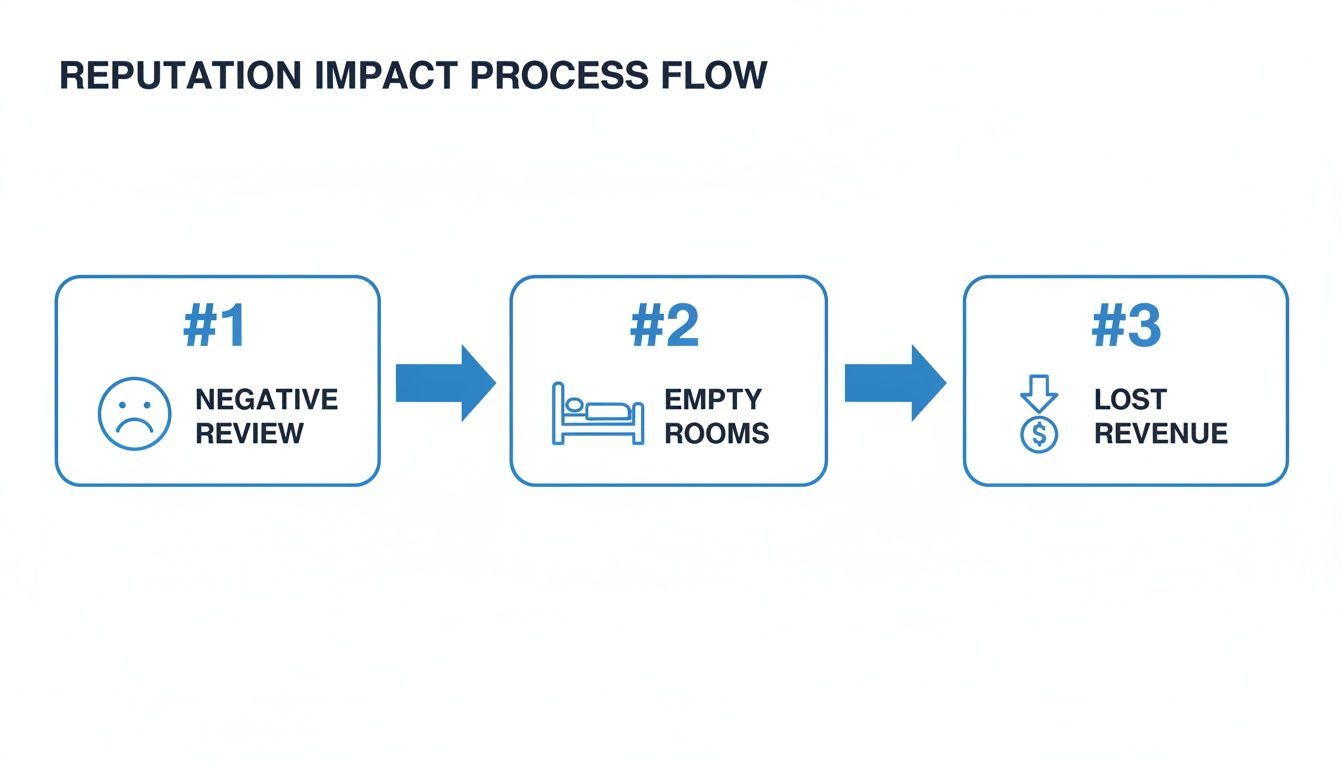
A negative review isn't just an opinion; it's a trigger that can lead directly to empty rooms and lost revenue.
Step 2: Automate Your Review Generation
Next, you need to build a fresh wave of authentic guest reviews. The truth is, most of your guests have a great stay—they just need a gentle nudge to share their experience.
A simple, automated system can send a polite email or text to guests right after checkout, catching them while the great experience is still fresh.
The trick is to make it ridiculously easy for them. A single click that takes them straight to your Google or TripAdvisor profile removes all friction.
This constant flow of new, positive feedback pushes older, negative reviews down the page. This keeps your profile looking fresh and active, which search engines and OTAs love. A solid developing a solid business plan should always include a guest feedback strategy.
Step 3: Craft Strategic Human-Written Responses
How you reply to reviews is where you can seriously stand out. Remember, you're writing for every single potential guest who will read it later.
A thoughtful, human response shows you're an engaged owner who genuinely cares. This builds tremendous trust with people considering booking with you.
For example, when someone leaves a glowing review:
- Generic: "Thanks for the review."
- Strategic: "We're so glad you enjoyed the complimentary breakfast and that our front desk team made you feel welcome! We hope to see you again soon."
This personalization transforms a review into powerful marketing. Find more tips in our deep dive into https://reviewoverhaul.com/review-management/. By following this simple three-step plan, you can proactively build a stronger brand and let your happy guests do the selling for you.
Turn Your Online Profiles Into Booking Magnets
It’s no longer enough to just have a profile on Google or the big OTAs. As a hotel owner, you need to treat these listings like interactive storefronts. For most travelers, this is their first impression of your property.
When a potential guest is stuck between two similar hotels, a fully optimized profile is the ultimate tie-breaker. It’s your chance to show off your hotel's personality and turn a casual searcher into a confirmed guest.
Make Your Google Business Profile Work For You
Your Google Business Profile (GBP) is your most powerful free tool for attracting guests. The problem is, most owners set it up and then forget it, leaving a massive opportunity on the table.
To get ahead, treat your GBP as an active engagement hub. This means consistently uploading fresh photos, answering guest questions in the Q&A section, and using Google Posts for special offers.
Think of it this way: your Google Business Profile is the digital front door to your hotel. An outdated profile sends the wrong message immediately.
These consistent updates signal to Google that your business is active and relevant, boosting you in local search rankings. Learn more from a modern guide to online marketing for hotels.
Master Your OTA Listings
You can't ignore OTAs like Expedia and Booking.com. Your performance on these platforms is directly tied to your review scores and how quickly you respond to guests. A higher rating and faster response time will push your property higher in their search results.
Engaging with positive feedback shows you're an attentive host, which builds confidence in people who are still deciding where to book. Always make sure your photos are current and give an honest look at the guest experience.
For a deeper dive into optimization, check out our insights on Google My Business optimization services.
Key Platform Optimization Checklist
Here is a scannable checklist to help you audit and optimize your most important online listings.
| Platform | Action Item | Why It Matters For Bookings |
|---|---|---|
| Google Business Profile | Upload 10+ new high-resolution photos quarterly. | Visuals build trust and help guests picture their stay, making them more likely to book. |
| Google Business Profile | Answer all questions in the Q&A section within 24 hours. | Shows you are engaged and attentive, which builds confidence and answers pre-booking questions. |
| Expedia | Respond to at least 90% of all new reviews (positive and negative). | High response rates are a ranking factor on OTAs, increasing your visibility in search. |
| Booking.com | Ensure your listed amenities are 100% accurate and up to date. | Prevents negative reviews from unmet expectations and attracts guests searching for specific features. |
| All Platforms | Update your business description to highlight unique selling points. | Differentiates you from competitors and attracts your ideal guest persona. |
The influence of these platforms is impossible to overstate. By treating each online profile as a critical piece of your marketing, you build a powerful online presence that doesn't just attract attention—it converts it into filled rooms.
Navigating a Reputation Crisis with Confidence
It happens fast. A single, emotional review goes viral, or a service slip-up gets blasted across social media. For any hotel owner, it's the scenario that keeps you up at night.
When a crisis hits, the instinct is to panic or hope it goes away. The only path forward is a calm, strategic, and immediate response. Your hotel online reputation is truly defined by how you handle the bad ones.
Your Crisis Response Plan
The first 24 hours are everything. Having a clear plan before you need it is the difference between navigating the storm with confidence and reacting with emotion.
Here’s your immediate game plan:
- Acknowledge It Fast: Post a public acknowledgment within hours. This isn’t an admission of guilt; it's a statement that says, "We see this, we hear you, and we're taking it seriously."
- Move the Conversation Offline: Your first reply should offer to move the conversation to a private channel like a phone call or email. This stops a public back-and-forth.
- Get Your Facts Straight: Before making detailed statements, talk to your team. Your next move has to be based on facts, not assumptions.
This approach shows the unhappy guest—and everyone watching—that you're a responsible operator who deals with problems head-on.
Responding to Emotional Reviews
When you're faced with an angry review, you have to handle it with care. A generic, corporate template will only pour gasoline on the fire. The goal is to de-escalate with genuine empathy.
A thoughtful response does more than just appease one unhappy guest. It demonstrates to every future traveler that you are a caring and trustworthy hotelier.
Let's look at an example:
- The Bad Review: "Our anniversary trip was RUINED! The room was dirty, and the staff was incredibly rude. We will never be back."
- A Strategic Response: "Dear [Guest Name], I am so sorry to read about your experience during what should have been a special celebration. It is completely unacceptable that we failed to provide you with a clean room and the respectful service you deserve. I would appreciate the opportunity to speak with you directly to make this right. Please call me at [Direct Phone Number]. Sincerely, [Your Name], General Manager."
This response is effective because it validates their feelings and provides a clear path to a solution. This simple framework can turn a potential disaster into a masterclass in customer recovery. Our guide on list management can help ensure your contact info is consistent everywhere.
The Success: More Bookings And Peace Of Mind
Let's talk about what winning really looks like. Imagine that knot in your stomach when you think about a bad review just disappearing. This isn't about frantically putting out fires; it's about building a solid hotel online reputation that works for you.
You become the hotelier who proactively builds a brand that travelers instinctively trust. It's the relief of seeing new, positive reviews pop up on their own and knowing every piece of feedback is handled like a pro.
A Real-World Turnaround Story
Think about a small, independent hotel bogged down by a frustrating 2.5-star rating. No matter how hard their team worked, a couple of old, ugly reviews were torpedoing their occupancy rates.
They put a simple system in place to consistently ask for new feedback and committed to replying to every comment. Suddenly, happy guests started sharing their fantastic experiences online.
Within six months, their rating shot up to a stellar 4.7 stars. This led directly to a 30% jump in direct bookings. Their online presence finally reflected the quality of their hospitality.
The True Measure of Success
This kind of turnaround is about more than just a healthier bottom line. It’s about getting your passion for this business back. It's trading anxiety for the satisfaction of reading glowing comments about your staff.
The ultimate reward is a full reservation calendar paired with the priceless peace of mind that a durable online reputation brings. It’s the freedom to focus on what you love—crafting amazing guest experiences.
This shift changes the entire game. It means fewer last-minute discounts and more leverage to set rates that match your hotel's actual value. An effective voice search optimization strategy can also make it even easier for guests to find you.
Staying Ahead in a Competitive Market
The hospitality world never stands still. The industry as a whole is seeing a rise in guest satisfaction, with the global hotel industry reaching a notable Global Review Index (GRI) of 87.0% in Q3 2025.
However, the flood of new reviews has caused response rates to drop by 9.9 percentage points. This shows how vital efficient reputation management has become. You can dig into more of these hospitality trends at Shiji Group.
This isn't just about making more money; it's about building a healthier, more sustainable business. It's the difference between playing catch-up and finally achieving the growth and peace of mind you've worked so hard for.
The Call to Action: Take Control Now
This is where you make a choice. You can keep letting a handful of bad reviews define your hotel's success, or you can take the first step toward showing the world what your hotel is really about.
Your hotel's story shouldn't be told by a few unhappy guests. We're offering a free, no-obligation reputation audit to pinpoint exactly where the opportunities are for your hotel.
It's time to make a decisive move. Let's get you that peace of mind you've been looking for.
Your Top Hotel Reputation Questions, Answered
Even the sharpest hotel owners have questions when managing their online reputation. Let's clear up some of the most common questions we hear from hoteliers just like you.
How Long Does It Take To Improve My Hotel's Online Rating?
Most hotels see a measurable improvement in their overall rating within 60-90 days. This happens once you get a consistent strategy for generating a steady stream of new, positive reviews.
This fresh feedback starts to push down older, negative comments. An automated system to ask for feedback is what really speeds things up.
Should I Respond To All Reviews, Or Just The Bad Ones?
You absolutely need to respond to all of them. Answering negative ones shows you’re taking ownership. Future guests see that and know you’re accountable.
Replying to a happy guest reinforces their great experience and shows potential bookers you're an engaged host. Plus, Google’s algorithm loves to see that activity.
Think of every review response as a miniature advertisement. You aren't just talking to that one person; you're showing every future traveler your commitment to hospitality.
Can I Get a Bad Review Taken Down From Google or TripAdvisor?
Honestly, it's next to impossible. Platforms like Google and TripAdvisor will only remove a review if it clearly violates their rules, like hate speech or spam.
Your energy is better spent elsewhere. First, post a calm, professional public response. Second, launch a campaign to bury that bad review with new, positive ones.
How Much Does My Online Reputation Really Affect My OTA Ranking?
It's a huge deal. Your reputation is a massive ranking factor on OTAs like Booking.com and Expedia. Their algorithms rely heavily on what other guests are saying.
These platforms specifically reward hotels with:
- Higher overall star ratings
- A large volume of recent reviews
- Quick and consistent responses to guest feedback
Bottom line: a better reputation gets you seen by more people on these sites, which directly leads to more bookings.
