
That one-star review notification hits your phone, and your stomach sinks. It feels personal—a direct attack on all the hard work you’ve poured into your business. You immediately worry about how many potential customers will see it and decide to go elsewhere.
This is the exact problem countless small business owners face. A single negative comment can feel like it's costing you customers and revenue, creating a constant sense of anxiety about your online reputation. The stakes are high: continue losing business to a few unhappy voices, or find a way to take back control and grow.
But what if that negative review wasn't a threat, but an opportunity? At Review Overhaul, we're the guide that provides a simple plan to help you, the hero of your business, turn negative feedback into your most powerful marketing tool. With our 3-step process, you can transform customer complaints into showcases of your excellent service, building trust and winning over new clients.
Imagine feeling confident and in control of your online presence. Picture a steady stream of new customers, drawn in by a reputation for outstanding customer care. That's what success looks like—more sales, a stronger brand, and the peace of mind that comes from knowing you can handle any feedback that comes your way.
"Our online reputation has never been stronger. Review Overhaul gave us a clear plan to handle reviews, and it's directly led to more bookings. They're an essential partner for our growth." – Satisfied Client Testimonial
Don't let a few bad reviews define your business. Schedule your free reputation audit today and let us show you how to turn customer feedback into your greatest asset.
A Simple Plan for Tackling Tough Reviews
We've all been there. That notification pops up, you see a one-star review, and your stomach just drops. But what you do in that moment is what truly defines your business's reputation. You don’t need some complex, multi-page crisis management plan. All you really need is a simple, repeatable process that turns a potential fire into a showcase of your company's integrity.
This isn't about winning an argument online. It's about showing every single person who reads that review—future customers included—that you listen, you care, and you solve problems.
Pause and Investigate
The absolute worst thing you can do is fire back a reply in the heat of the moment. So, the first rule is simple: pause and take a breath. An emotional, defensive response just pours gasoline on the fire, validating the customer's complaint and scaring off anyone else who sees it.
Instead, put on your detective hat. Before you type a single word, dig into what actually happened. Talk to your team, check your order history or appointment logs, and get the complete picture. You can't craft a good response without understanding the full context.
This simple flow is your guide to taking back control of the narrative.
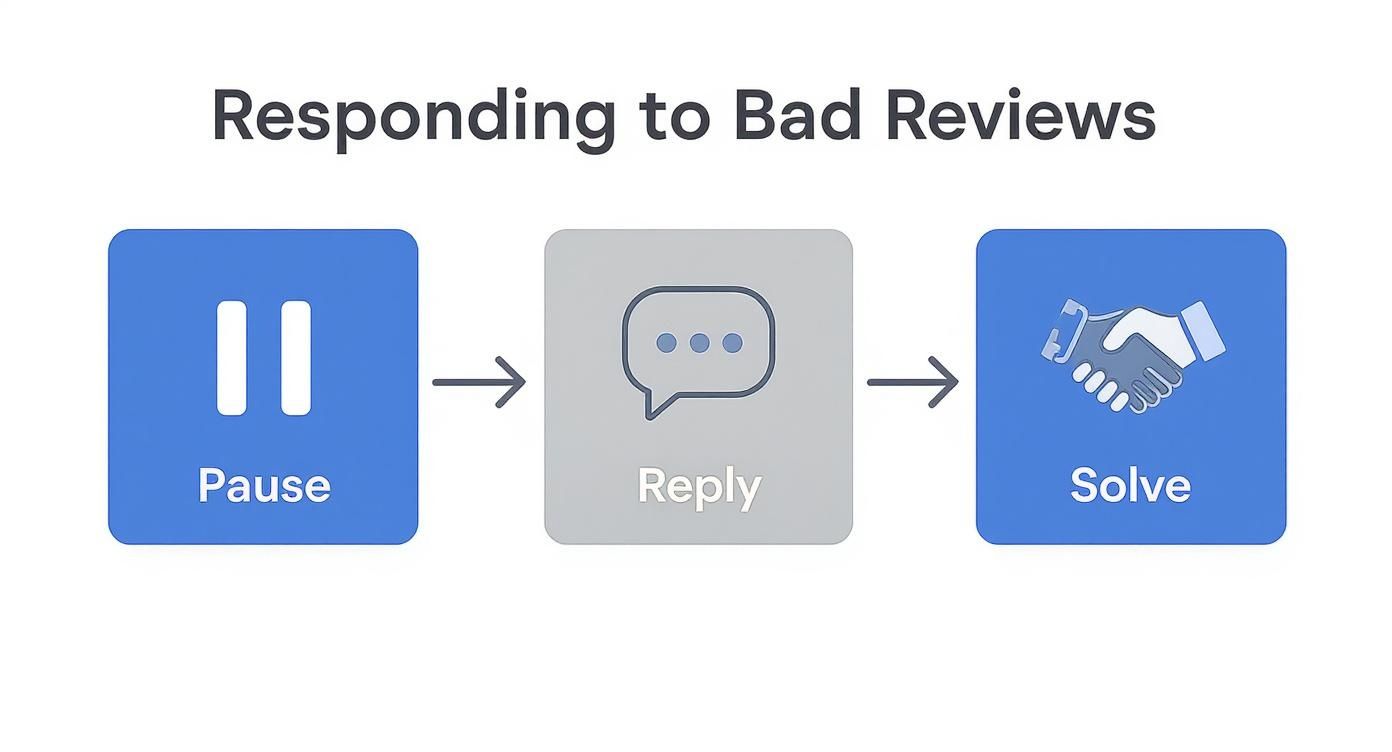
As you can see, the best responses are methodical. They move from a calm internal investigation to a thoughtful public acknowledgment, and then, most importantly, to a private resolution.
Writing Your Public Response
Once you’ve got your facts straight, it's time to draft that public reply. And here's the key: you’re not just writing for the person who left the review. You’re writing for everyone. The goal is to come across as reasonable, professional, and genuinely dedicated to making your customers happy.
A solid reply should always hit these points:
- Acknowledge Their Point of View: Start by thanking them for the feedback and specifically mentioning their frustration. Something as simple as, "I'm so sorry to hear your experience didn't meet your expectations," shows you're listening.
- Offer a Real Apology: Apologize for how the situation made them feel. This isn't necessarily admitting fault right away, but it validates their feelings, which goes a long way.
- Don't Make Excuses: Never, ever blame the customer or try to argue your side of the story in public. It just makes you look defensive and unprofessional.
Don't underestimate the power of a single bad review. Nearly 49% of consumers say they won't go back to a business after a negative experience. This means learning how to respond to a negative Google review can literally change the minds of almost half of your potential customers.
Take the Conversation Offline
This is the most crucial step. You always want to move the conversation out of the public square. Your public response should end with a clear invitation to resolve the issue privately. This shows you're serious about finding a solution, not just putting on a show for everyone else.
Key Takeaway: The public reply is for managing your brand's perception. The private conversation is for actually solving the customer's problem.
Give them a direct way to get in touch. A specific email address or phone number works best, and if you can, name a real person they can contact. For example: "My name is Sarah, and I'm the manager here. I want to personally make this right. Please email me at sarah@yourbusiness.com so I can learn more."
As you build out your process, it's a great idea to look at customer support scripts that actually work to help you craft consistent and effective replies. This keeps you from having to reinvent the wheel every time.
This simple plan—Pause, Reply, Solve—is your roadmap. It turns a negative moment into a powerful testament to your company's character.
Real-World Response Examples for Your Industry
https://www.youtube.com/embed/hVb-paK8skY
A generic, copy-and-paste response can feel just as frustrating to a customer as whatever went wrong in the first place. The best way to show you’re actually listening is to tailor your reply to their specific complaint and, just as importantly, to the unique world of your industry.
What works for a restaurant owner dealing with a complaint about a cold meal is completely different from what a roofer needs to say about a project delay.
You know your customers better than anyone. Think of these examples as a starting point—a guide to help you craft responses that sound genuine, solve problems, and turn a bad experience into a powerful display of your professionalism.
For Restaurant and Hospitality Owners
In the food and service world, emotions run high and experiences are immediate. A response has to be fast, empathetic, and offer a clear way forward. The goal is to acknowledge their specific disappointment—whether it was about the food, the service, or the vibe—and invite them back for the experience they should have had.
Bad Review Example: "The steak I ordered was completely overcooked, and our server disappeared for 20 minutes at a time. For these prices, I expected way better. We won't be back."
A Great Response:
"Hi [Customer Name], thank you for sharing this with us. I'm so sorry to hear that your steak wasn't cooked to your liking and that our service didn't meet your expectations. That is absolutely not the standard we aim for, and I sincerely apologize for the frustrating experience you had.
We want a chance to make this right. Please email me directly at [manager's email] so I can personally arrange a better experience for you on your next visit.
Sincerely,
[Your Name], Manager"
This works so well because it:
- Directly addresses both complaints—the steak and the service.
- Offers a real apology, without any excuses.
- Takes the conversation offline to find a personal solution.
For Home Service Contractors
If you're a contractor, plumber, or electrician, negative reviews often come from a mismatch in expectations around timelines, budget, or the final result. Your response needs to be professional, factual, and reassuring. It's all about showing your commitment to quality work and clear communication.
Bad Review Example: "They said the project would take two weeks, but we're heading into week four and it's still not done. Communication has been terrible, and the mess they leave every day is unacceptable."
A Great Response:
"Hi [Customer Name], thank you for your feedback. We sincerely apologize that the project timeline has extended beyond our initial estimate and for any frustration our communication has caused. We pride ourselves on clear updates and clean job sites, and it's clear we fell short here.
I am reviewing your project details with our lead technician right now to get this back on track and address the cleanup issues immediately. Please expect a direct call from me today to discuss the updated completion plan.
Best,
[Your Name], Owner"
Notice how this response doesn't argue. Instead, it:
- Validates the customer's specific frustrations (timeline, communication, mess).
- Shows immediate action ("I am reviewing your project details right now").
- Sets a clear next step ("expect a direct call from me today").
For Professional Services Like Law and Healthcare
Confidentiality is everything in fields like law and healthcare. Responses have to be worded very carefully to avoid violating privacy (like HIPAA for medical practices) while still showing you care about the patient or client experience. The golden rule? Never, ever confirm someone was a client or patient in your public reply.
For attorneys, this is a particularly tricky balancing act. We actually dive much deeper into this in our guide on reputation management for attorneys.
Bad Review Example: "I felt rushed during my appointment and my concerns were dismissed. I left without any clear answers. A very disappointing and impersonal experience."
A Great Response:
"Thank you for sharing your feedback. We are committed to ensuring every individual who visits our office feels heard and respected, and we are sorry to hear that we did not meet that standard in this case.
We take feedback like this very seriously and would appreciate the opportunity to discuss your experience privately. Please contact our office manager, [Name], at [Phone Number] at your convenience.
Sincerely,
The Team at [Your Practice Name]"
This professional response nails it because it:
- Stays general and confidential, never acknowledging the reviewer's status as a patient.
- Reinforces the practice's core values ("ensuring every individual…feels heard").
- Provides a secure, offline channel for a more detailed, private conversation.
By tailoring your approach to your industry, you show you're not just a business owner reacting to a complaint. You're a professional who listens and is truly dedicated to making things right. That builds immense trust, not just with the original reviewer, but with every potential customer who reads your thoughtful reply.
Common Response Mistakes That Hurt Your Business
We've all been there. You get that notification, your stomach drops, and you see a scathing one-star review. It feels personal. And when a review feels unfair, the temptation to jump in and set the record straight is overwhelming.
But how you handle that moment can either build trust or pour gasoline on the fire. These common missteps don't just fail to fix the original problem—they actively damage your reputation with every single person who reads them. Knowing how to respond to a negative Google review is just as much about what not to do.
Let's walk through the most common traps I see business owners fall into.
Getting Defensive or Making Excuses
This is the big one. When a review feels like an attack, your first instinct is to defend your team and your business. You want to explain your side, point out what the customer got wrong, or list all the reasons it wasn't your fault.
Resist that urge with everything you've got.
A defensive response immediately tells potential customers that you don't handle criticism well. Instead of seeing a business owner who listens and solves problems, they see someone who argues. The original reviewer feels dismissed, and anyone else reading it gets a terrible impression of your professionalism.
Key Takeaway: Remember who you're really talking to. Your public response is for your future customers, not for winning an argument with a single unhappy person. In fact, 89% of consumers say a thoughtful response to a negative review actually improves their impression of a business. Defensiveness is never thoughtful.
Using Robotic or Templated Replies
In an effort to be quick, a lot of businesses fall back on generic, copy-and-paste responses. You know the one: "We're sorry for your experience and value your feedback."
While it might seem safe, it comes across as completely insincere. Customers can spot a template from a mile away, and it makes them feel like you're just checking a box, not actually listening.
Personalization is everything here. Use the customer's name. Mention the specific issues they brought up. This simple step shows you’ve actually read their complaint and are treating them like a human being, not just another ticket to close.
Waiting Too Long to Respond
When it comes to online reviews, the clock is ticking. A negative review left hanging for days—or worse, weeks—sends a loud and clear message: you either don't care or you're not paying attention.
The longer that review sits there unanswered, the more people see it and assume the complaint is 100% valid.
Aim to respond quickly, ideally within 24 hours. This shows everyone that you're on top of things and proactive about customer care. Even if you need time to look into the issue, a quick initial reply acknowledging their review and promising a follow-up is infinitely better than radio silence.
Disclosing Private Customer Information
This one isn't just a bad look; it can land you in serious legal trouble, especially if you're in healthcare (think HIPAA violations), law, or finance. In a heated moment, you might be tempted to drop details to prove your point, like "We have no record of you as a client" or "You missed your appointment."
Don't do it. Ever.
Never confirm someone was a customer or reveal any personal details in a public forum. It's a massive breach of trust and privacy that will rightly scare off countless potential clients. Keep your public response professional and general, and always offer to move the detailed conversation offline to a private channel like email or a phone call.
To make it even clearer, I've put together a quick cheat sheet. Think of it as your guide to staying on the right track when things get heated.
Quick Guide to Response Do's and Don'ts
| Do This Instead | Avoid This Mistake |
|---|---|
| Apologize for their experience and show empathy for their frustration. | Get defensive, argue, or blame the customer publicly. |
| Personalize the reply by using their name and referencing specific issues. | Use a generic, one-size-fits-all template for every bad review. |
| Respond quickly, ideally within 24 hours, to show you're attentive. | Let the negative review sit unanswered for days or weeks. |
| Keep the public response professional and general to protect privacy. | Disclose any personal or confidential customer information. |
Simply avoiding these common mistakes puts you miles ahead of the competition. By responding with a cool head and genuine empathy, you're not just managing a single complaint; you're building a rock-solid reputation that will attract new business for years to come.
Turning Negative Feedback into Business Growth

What if that gut-punch feeling you get from a one-star review was actually a free business consultation? It’s a tough mindset to adopt, but when you reframe negative feedback from a threat into a growth tool, you start building a business that’s truly resilient.
That critical comment isn’t just noise; it’s raw, unfiltered data straight from your customers. It’s a rare chance to see your business through their eyes, uncovering blind spots you never even knew you had.
This is the perspective that separates businesses that just survive from those that truly thrive. You can either keep putting out individual fires or use the feedback to fireproof your entire operation.
Look for Patterns in the Criticism
A single complaint might just be a one-off issue, but two or three reviews pointing to the same problem? That’s a pattern. And that’s where the real gold is. Don't just read and react to reviews in isolation—start tracking them.
It doesn't have to be complicated. Just create a simple system to categorize the feedback you’re getting. Are people consistently bringing up a specific issue?
- A particular employee? This could point to a need for more training or a quick conversation about service standards.
- A certain product or service? Maybe there’s a quality issue or a disconnect between what you promise and what you deliver.
- Wait times or project delays? This could signal an operational bottleneck that needs to be fixed.
By logging these comments, you move from reacting emotionally to analyzing actual data. This process turns vague complaints into a clear roadmap for real improvements that will stop future negative reviews before they even happen.
This proactive approach has a powerful side effect on your online visibility, too. Google reviews are a big deal for local SEO, and businesses that actively manage all their feedback see incredible results. In fact, reviews make up about 10% of local search ranking factors, and proactive management can lead to conversion rate improvements of 15–20%. You can learn more about how reviews drive revenue with these valuable online review statistics.
Turning Insights into Actionable Change
Spotting the problem is just the first step. The real win comes from using that knowledge to make meaningful changes in your business. This is where you, as the owner, take full control of your reputation.
Let's say you own an auto repair shop and a few reviews pop up complaining about poor communication during repairs. The sting of those reviews is real, but the insight they provide is priceless.
Instead of just apologizing, you can build a new process.
Example of Proactive Improvement
- The Problem: Customers feel left in the dark about repair timelines and costs.
- The Insight: The core issue is a lack of proactive communication from your team.
- The Action: You introduce a new policy: a service advisor must send a text update to every customer at the end of each day, even if it's just to say there's no new information.
- The Result: Future reviews start mentioning how great the communication was, directly countering the old complaints and building a ton of trust.
You're no longer just responding to a negative review; you're fundamentally improving the customer experience. This is how you build a business that earns glowing five-star reviews naturally.
This same principle applies everywhere. A restaurant seeing complaints about slow service can retrain staff on section management. A law firm getting feedback about confusing billing can redesign its invoices to be crystal clear.
Celebrate the Change Publicly
Once you’ve made an improvement based on customer feedback, don’t keep it a secret. This is a golden opportunity to close the loop for everyone to see.
When a new, positive review comes in that touches on an area you’ve improved, you can reference the change in your response. This shows both past and future customers that you don't just listen—you act.
A Powerful Response Example
"Hi [Customer Name], thank you so much for your kind words about our clear communication during your recent service. We actually implemented a new daily update system based on feedback from other customers, and we’re so glad to hear it’s making a positive difference in the experience."
This kind of response is incredibly powerful. It validates the original critics, proves you take feedback seriously, and showcases your commitment to getting better. It’s the ultimate reputation-building move.
At Review Overhaul, we see you as the hero ready to build a stronger business. Our plan is simple: we provide the tools and guidance to help you track this feedback, identify the root causes, and turn those insights into lasting operational improvements. Let us be your guide, so you can transform every piece of feedback—good or bad—into your next great business idea.
Answering Your Top Questions About Google Reviews
As a business owner, you're juggling a million things at once. I get it. When it comes to the wild world of Google reviews, it’s completely normal to have questions, especially about those tricky situations that pop up. This FAQ is here to give you direct, no-fluff answers to the most common challenges you'll face.
The real problem isn't just knowing you should respond. It’s figuring out what to do when a review feels fake, how fast you need to act, or if you can ever get a horrible review taken down. Without a clear game plan, you risk making a small mistake that could blow up and hurt your reputation. Let's clear up that confusion right now.
Should I Respond to Every Single Review?
Yes, absolutely. Responding to both the good and the bad shows you’re an engaged owner who actually cares about what your customers have to say. It's so tempting to put all your energy into damage control on the negative ones, but don't forget the happy folks. Replying to positive reviews reinforces that great experience and nudges other happy customers to leave their own feedback.
Consistency is everything here. It shows potential customers you're paying attention and builds a layer of trust before they even set foot in your door. This kind of active engagement is a huge piece of the puzzle. To really make this work for you, you need to learn how to optimize your Google Business Profile from top to bottom.
How Quickly Should I Respond to a Negative Review?
Try to jump on it within 24 hours. A quick reply shows you take customer problems seriously and you’re on top of your game. The longer a negative review just sits there, unanswered, the more it looks like you either missed it or just don't care. Neither is a good look.
A fast response can put out the fire before it spreads. It tells the reviewer—and every single person reading—that you're listening and ready to make things right.
Even if you need a little more time to dig into what happened, a quick initial response is way better than radio silence. Something as simple as, "Thank you for bringing this to our attention. We're looking into this right now and will be in touch shortly," works wonders.
What If I Suspect a Review Is Fake?
Fake reviews are infuriating. There's just no other way to put it. The first thing to do is see if it breaks Google's own content policies, which cover things like spam, fake content, and blatant conflicts of interest. If you’re pretty sure the review isn't from a real customer—maybe you have zero record of them or the transaction they're describing—you can flag it for removal.
Here's what to do:
- Flag the review from your Google Business Profile dashboard.
- Give a short, clear reason why you think it violates Google's policies.
- Post a public response while you wait for Google to review your request.
Your public reply needs to be professional and calm, even if you're fuming. Try something like this: "Thank you for the feedback. We take all reviews seriously, but we can't seem to find any record of your visit in our system. We'd appreciate the chance to learn more, so please contact us directly at [your email]." This shows you're responsive without accidentally validating a bogus claim.
Can I Get a Negative Review Deleted?
Honestly, it's very difficult to get a legitimate negative review taken down. Google will only remove reviews that clearly violate their specific policies. If a real customer had a genuinely bad experience and wrote about it—even if you see things differently—that review is almost certainly staying up.
This is exactly why knowing how to respond to a negative google review is a skill, not just a task. Your energy is better spent crafting a professional, empathetic response than trying to get the review deleted. A thoughtful reply can completely neutralize a bad review's sting and often wins over more new customers than the original review ever scared away.
At Review Overhaul, we're your guide in the trenches, giving you the simple plan you need to handle any review that comes your way. You're the hero of your business's story; we're just here to give you the right tools to make sure it has a happy ending. Schedule your free reputation audit today and see how we can turn your reviews into your best marketing tool. Find out more at https://reviewoverhaul.com.
