
As a dedicated practice owner, you pour everything into providing exceptional patient care. Yet, you see competitors with packed schedules while yours has unpredictable gaps. Bad reviews and a weak online presence are costing you patients, and the constant pressure to fill your appointment book is exhausting.
You know your clinical expertise should translate into a full waiting room, but deciphering the complex world of digital marketing feels overwhelming. It’s frustrating when you're doing everything right for your patients, but still losing new ones to practices that simply look better online.
Review Overhaul provides a simple, 3-step plan to fix your online reputation and turn it into your most powerful patient acquisition tool. We'll guide you through building a system that consistently attracts the high-quality patients you deserve, allowing you to focus on what you do best: caring for them.
Imagine the peace of mind that comes from a predictably full schedule and a stellar online reputation that works for you 24/7. More positive reviews mean more patient trust, which directly translates to more bookings and a thriving practice. We've helped hundreds of practices like yours achieve this, with many seeing a 20-30% increase in new patient inquiries within months.
"Review Overhaul completely transformed our online presence. Our Google rating went from a 3.8 to a 4.9 in under six months, and our new patient calls have never been higher. They gave us a clear plan that actually worked." – Dr. Sarah K., Family Medicine
Ready to stop losing patients to your competitors?
1. Search Engine Optimization (SEO) for Medical Practices
When a potential patient searches for "cardiologist near me," you want your practice to be the first name they see. That’s the power of Search Engine Optimization (SEO), a fundamental part of any modern medical practice marketing strategy. It's the process of making your practice more visible to patients actively seeking your services on Google.
By appearing prominently in search results, you build immediate trust and attract high-intent patients who are ready to book an appointment. A strong SEO foundation ensures a steady stream of qualified patient inquiries without the constant cost of paid ads.
How to Implement Medical SEO
Getting started with SEO involves focusing on both your website and your local online footprint. The goal is to signal to Google that you are a relevant, authoritative, and trustworthy medical provider.
- Optimize Your Website's Core Pages: Ensure your service pages and doctor bios include relevant keywords. Title tags should be clear, like "Compassionate Pediatric Care in Austin, TX | Bright Smiles Pediatrics."
- Develop Patient-Focused Content: Write blog posts or guides answering common patient questions. A dermatology clinic could create a guide on "Understanding Eczema Triggers and Treatments."
- Build Local Citations: Get your practice listed accurately and consistently across directories like Yelp, Healthgrades, and Vitals. This reinforces your location and legitimacy to search engines.
- As patients increasingly use voice assistants, understanding how to optimize for this technology is crucial. You can find more details on how to get started by learning more about voice search SEO here.
2. Content Marketing and Patient Education
Modern medical practices thrive by empowering patients with knowledge. That’s the core of content marketing, a strategy focused on creating valuable, educational materials to position your practice as a trusted authority, not just a service provider.
This approach builds a powerful bond with your community, turning your website into a go-to resource. When patients feel understood and educated, they are more likely to trust you with their care, leading to higher-quality consultations and improved patient loyalty.

How to Implement Content Marketing for Patient Education
Your content should aim to answer the questions your patients are already asking. Think about your most frequent conversations and turn those insights into helpful, accessible resources.
- Answer Real Patient Questions: Create blog posts or short videos based on the FAQs you hear every day. An orthopedic clinic could create a post titled, "5 Simple Stretches to Alleviate Minor Knee Pain at Home."
- Explain Conditions and Treatments: Use clear, jargon-free language to explain complex medical topics. Develop detailed guides on conditions you specialize in.
- Showcase Patient Success Stories: With explicit patient consent, share anonymized case studies or testimonials. These stories provide powerful social proof and help prospective patients visualize their own successful outcomes.
- Developing a robust small business content marketing strategy helps ensure you get the most value out of every piece you create.
3. Google Ads and Pay-Per-Click (PPC) Advertising
While SEO is a long-term strategy, sometimes you need to attract new patients right now. This is where Google Ads and Pay-Per-Click (PPC) advertising come in. This powerful approach allows your practice to appear at the very top of Google search results instantly.
With PPC, you bid on specific keywords like "emergency dentist" or "fertility clinic new york." You only pay when someone clicks on your ad, making it a highly targeted and efficient way to capture the attention of patients who are actively searching for your exact services.
How to Implement Medical PPC
A successful Google Ads campaign requires careful targeting to ensure you’re reaching relevant local patients. The goal is to connect with high-intent individuals who are ready to book an appointment.
- Use Hyper-Local Targeting: Configure your campaigns to show ads only to users within a specific radius of your clinic. This ensures you’re reaching potential patients who can realistically visit your location.
- Create Service-Specific Ad Groups: An urgent care center should have separate campaigns for "walk-in clinic," "COVID testing," and "sports physicals" to deliver highly relevant ads.
- Track Patient Conversions: Set up conversion tracking to measure how many clicks lead to actual patient actions, such as phone calls or appointment bookings. This is crucial for calculating your return on investment.
4. Social Media Marketing and Community Engagement
Social media platforms like Facebook and Instagram are where current and potential patients spend their time. An active social media presence allows you to build a genuine community and humanize your practice beyond the clinic walls.
This strategy transforms one-way communication into a dynamic conversation. By showcasing your team and sharing health tips, you build brand loyalty and stay top-of-mind, fostering long-term patient relationships.
How to Implement Social Media for Your Practice
Building an engaged online community requires a consistent, patient-centric approach. The goal is to be a valuable resource, not just a billboard.
- Choose the Right Platforms: Don't try to be everywhere. Start with 1-2 platforms where your patients are most active, like Facebook for community building or Instagram for visual "meet the staff" posts.
- Develop a Content Calendar: Plan your posts in advance to ensure consistency. Mix educational content, practice updates, and community-focused posts.
- Engage Actively with Your Community: Respond to comments and direct messages promptly. Acknowledge patient questions and show appreciation for their engagement.
5. Email Marketing and Patient Retention Programs
While attracting new patients is crucial, retaining your existing ones is the cornerstone of a stable practice. Email marketing is a powerful, cost-effective tool for nurturing patient relationships long after their initial visit.
By sending relevant and personalized messages, you build lasting loyalty and trust. This consistent engagement not only reduces patient churn but also significantly cuts down on missed appointments.
How to Implement Patient-Focused Email Marketing
The key to successful email marketing is providing value, not just promotions. Your goal is to be a helpful health partner, offering information and reminders that make your patients' lives easier.
- Segment Your Patient List: Group patients by criteria like their last visit date or specific condition. This allows you to send targeted content, such as a back-to-school checkup reminder for pediatric patients.
- Automate Appointment Reminders: Set up automated emails to be sent 24-48 hours before an appointment. This simple step can drastically reduce no-show rates.
- Develop a Health-Focused Newsletter: Create a monthly or quarterly newsletter sharing relevant health tips, practice news, or information about new services. You can find more details on how to build patient trust by learning more about online reputation management for doctors here.
6. Local SEO and Google My Business Optimization
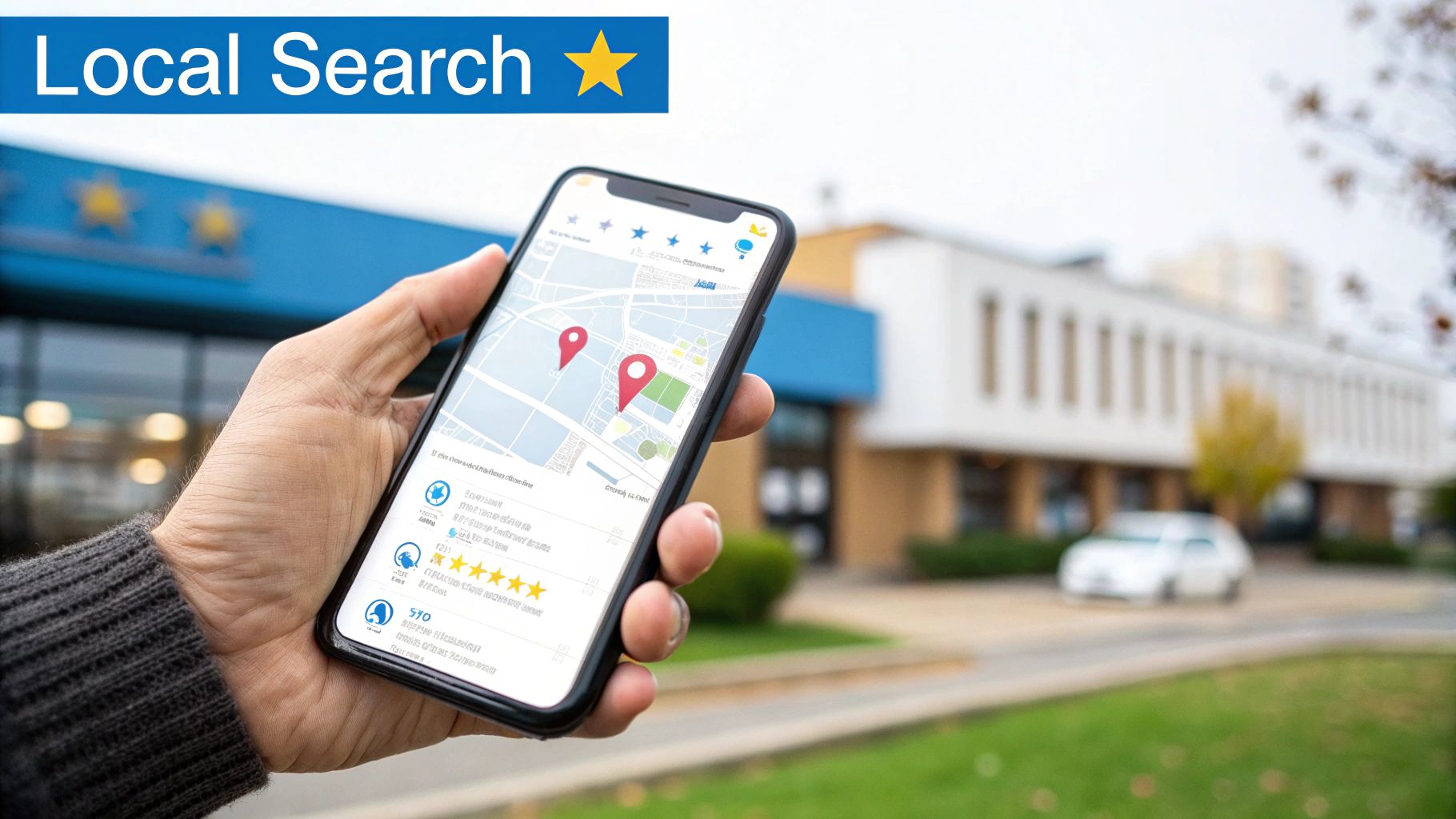
When a patient searches for an "urgent care clinic near me," your practice needs to appear prominently on the map. This is the goal of Local SEO and optimizing your Google My Business (GMB) profile. This strategy focuses on making your practice highly visible to patients in your immediate area.
Think of your GMB profile as your digital front door on Google. A fully optimized profile provides instant answers, showcases credibility through reviews, and makes it simple for patients to call you, driving more qualified appointment bookings directly from search results.
How to Implement Local SEO and GMB Optimization
Optimizing for local search means treating your Google My Business profile as a dynamic, information-rich hub. The objective is to prove to Google that your practice is the most relevant answer for local healthcare searches.
- Complete Every GMB Field: Meticulously fill out every section of your profile, including services, accessibility information, insurance options, and a detailed, keyword-rich business description.
- Encourage and Respond to Reviews: Actively solicit patient reviews and respond to every single one, both positive and negative. A professional response shows you value patient feedback.
- Use Google Posts: Share practice updates, health tips, or special announcements using the Google Posts feature to keep your profile active and engaging.
- A well-managed GMB profile is a cornerstone of patient acquisition. You can get a deeper understanding of the process and its benefits by exploring a comprehensive Google My Business optimization service.
7. Patient Referral Programs and Incentive Marketing
Your happiest patients are your most powerful advocates. A patient referral program formalizes word-of-mouth marketing, turning satisfied patients into a proactive growth engine for your practice.
A recommendation from a friend or family member carries more weight than any advertisement. This not only brings in new, high-trust patients but also strengthens your relationship with existing ones by rewarding their loyalty.
How to Implement a Patient Referral Program
A successful referral program is simple, valuable, and consistently promoted. The goal is to make it effortless for patients to participate and feel appreciated.
- Offer a Meaningful Incentive: A dental practice might offer a $50 credit toward future services for each successful referral, while a cosmetic clinic could provide a discount on a popular treatment.
- Simplify the Referral Process: Make it incredibly easy for patients to refer someone. Provide them with physical referral cards or a simple online form on your website.
- Promote the Program Consistently: Don't let your program be a secret. Mention it in patient newsletters, display signs in your waiting room, and have staff mention it at checkout. You can discover more about managing your practice's reputation here.
8. Video Marketing and Testimonial Content
Video content is one of the most powerful tools for building trust and connecting with prospective patients. It allows you to showcase your practice’s personality, expertise, and patient success stories in a dynamic and engaging format.
This form of content is highly effective because it makes complex medical information more digestible and puts a face to your practice. Video fosters an emotional connection that written content alone often cannot, making it a crucial element for converting viewers into loyal patients.
How to Implement Medical Video Marketing
Creating effective video content doesn't require a Hollywood budget; it requires authenticity and a focus on the patient's perspective. The goal is to ease their anxieties and demonstrate the quality of your care.
- Create Patient Testimonial Videos: Film brief interviews with satisfied patients (with their signed HIPAA-compliant consent) sharing their positive experiences. A LASIK patient describing their joy at seeing clearly is incredibly persuasive.
- Produce "Meet the Doctor" Videos: Introduce your providers in short, personable videos. This helps break down barriers and makes physicians more approachable.
- Develop Procedure Explanation Videos: Use simple animated videos or provider-led explanations to demystify complex procedures, positioning your practice as a transparent and authoritative resource. These videos work hand-in-hand with your other reputation-building efforts; find more details by learning about modern review management here.
9. Influencer and Partnership Marketing
Patients often turn to familiar, credible voices for health advice. Influencer and partnership marketing allows your practice to tap into these established relationships, leveraging the authority of trusted individuals to connect with a wider audience.
By partnering with a respected voice, you can build credibility through authentic endorsement. A well-chosen partnership introduces your practice to a pre-built community that already trusts the source, generating warm leads.
How to Implement Influencer and Partnership Marketing
The key to success is finding partners whose audience and brand ethos align with your practice's specialty and values. This ensures the collaboration feels natural and provides real value.
- Identify Aligned Partners: Look for local wellness bloggers, health-focused micro-influencers, or even non-competing local businesses like gyms or health food stores.
- Create Clear Partnership Agreements: Define the relationship from the start. Outline specific deliverables, such as a set number of social media posts, a blog feature, or an appearance at a community event.
- Track and Nurture the Relationship: Establish metrics to measure the success of each partnership, such as referral traffic from a unique link or a special offer code.
10. Website Optimization and Conversion Rate Optimization (CRO)
Your website is the digital front door to your practice, but getting visitors is only half the battle. A truly effective site must guide those visitors to book an appointment. This is the core of Conversion Rate Optimization (CRO).
By removing friction from the patient journey, you can dramatically increase the number of inquiries you receive from the same amount of website traffic. An optimized website not only fills your schedule but also builds trust by providing a seamless, professional experience from the very first click.

How to Implement Website and Conversion Optimization
The goal of CRO is to identify and eliminate any roadblocks that prevent a visitor from contacting you. Small, data-driven changes can lead to significant increases in patient acquisition.
- Make Booking Effortless: Place a prominent "Book an Appointment" button in your website header and on every service page. Simplifying a complex contact form can significantly boost completion rates.
- Prioritize Mobile Experience: Ensure your website is fast and easy to navigate on a smartphone. Your phone number should be a "click-to-call" link.
- Build Instant Trust: Integrate authentic patient testimonials and reviews directly on your homepage and service pages. Use high-quality photos of your staff and facility instead of stock images.
10-Point Medical Practice Marketing Comparison
| Strategy | Implementation complexity | Resource requirements | Expected outcomes (timeframe) | Ideal use cases | Key advantages |
|---|---|---|---|---|---|
| Search Engine Optimization (SEO) for Medical Practices | Medium — requires technical and content work | SEO tools, content writers, SEO specialist, ongoing maintenance | Sustainable organic traffic and local rankings (3–12 months) | Practices seeking long-term patient acquisition and local visibility | Cost-effective long-term traffic, targets high-intent patients |
| Content Marketing & Patient Education | Medium — ongoing content production and review | Writers/producers, medical reviewers, video/graphic tools | Increased authority, engagement, SEO lift (3–9 months) | Educating patients, improving trust, supporting SEO | Builds credibility, shareable assets, reduces cancellations |
| Google Ads & PPC Advertising | Medium–High — campaign setup and constant optimization | Ad budget, PPC specialist, tracking tools | Immediate visibility and leads while ads run (days to weeks) | Practices needing quick patient acquisition or service promotion | Fast traffic, highly targeted, measurable ROI |
| Social Media Marketing & Community Engagement | Medium — consistent content and moderation | Content creators, community manager, creative tools | Brand awareness and engagement (weeks to months) | Practices wanting community building and brand humanization | Builds loyalty, low-cost engagement, user-generated content |
| Email Marketing & Patient Retention Programs | Low–Medium — setup and segmentation work | Email platform, list building, copywriter, compliance checks | Improved retention, appointment reminders, high ROI (1–6 months) | Retaining existing patients, reducing no-shows | Direct, measurable communication; high ROI |
| Local SEO & Google My Business Optimization | Low — tactical profile and listings work | GMB management, review generation process, citation tools | Immediate local visibility improvements (days to weeks) | Practices dependent on nearby patient searches | Quick local impact, appears in Maps, cost-effective |
| Patient Referral Programs & Incentive Marketing | Low–Medium — program design and tracking | Incentive budget, tracking system, staff training | High-quality referrals over time (months) | Practices with satisfied patients wanting growth via word-of-mouth | Low acquisition cost, high lifetime value leads |
| Video Marketing & Testimonial Content | High — production, editing, and compliance | Video equipment or vendor, editors, consent/legal review | High engagement and conversions (weeks to months per asset) | Practices showcasing outcomes or complex treatments | Strong trust-building, improved conversion and SEO |
| Influencer & Partnership Marketing | Medium — partner identification and agreements | Partnership budget, legal/contracting, co-marketing resources | Access to new audiences; variable results (weeks to months) | Practices targeting niche or local audiences via trusted sources | Expands reach, builds credibility through association |
| Website Optimization & Conversion Rate Optimization (CRO) | Medium — testing and design/development work | UX designer, developer, analytics tools, CRO tools | Higher conversion from existing traffic (1–6 months) | Practices wanting better ROI from current website traffic | Improves appointment bookings, maximizes existing traffic |
Your Plan for a Thriving Practice
You've just navigated a comprehensive blueprint of modern medical practice marketing strategies. It can feel like a lot, but the journey to a thriving practice doesn't require doing everything at once. The real victory is creating a sustainable system that transforms your marketing into a powerful growth engine.
Your future patients are online right now, not just looking for a doctor, but for a trusted guide. Every helpful blog post and every glowing review serves as a beacon, guiding them to your door. The alternative is letting that patient scroll right past and into a competitor’s waiting room.
Recapping Your Path to Growth
Let's distill this down to the core pillars that will have the most significant impact. Think of this as your strategic starting lineup:
- Be Discoverable: Mastering Local SEO and your Google Business Profile is the fundamental first step to ensure patients in your community can find you.
- Build Unshakable Trust: Proactively generating and managing patient reviews is your most potent form of social proof. A steady stream of positive feedback validates your expertise.
- Convert Interest into Action: A well-optimized website is your digital front door. It must be easy to navigate and make booking an appointment an effortless, two-click process.
Your Actionable Next Steps
Feeling overwhelmed? Don't be. You, the dedicated healthcare provider, are the hero of this story, and this is your plan to win.
- Start with Your Foundation: Dedicate the next 30 days to your Google Business Profile. Audit your profile, ensure every section is complete, and upload high-quality photos.
- Implement a Review System: Choose one method for requesting reviews—either automated software or a simple email/text template—and commit to using it with every patient for the next quarter.
- Schedule Your Content: Brainstorm the top 10 questions your patients ask most frequently. Turn those into simple blog posts or short videos and publish one each week.
By focusing on these core medical practice marketing strategies, you move from being a passive observer to an active architect of your practice's success. Imagine the peace of mind that comes from a predictably full schedule, a stellar online reputation, and the freedom to focus on what you do best: providing exceptional patient care.
Struggling to manage your online reputation and turn patient feedback into a powerful marketing asset? Review Overhaul provides the tools to automate review generation, manage feedback across all major platforms, and transform your online presence into a patient-acquisition machine. See how your reputation is impacting your bottom line with a free audit from Review Overhaul.
