For a small business, online reputation management is all about actively shaping how people see your brand on the internet. It’s about taking the reins of the conversation happening about your company everywhere—from customer reviews and social media mentions to what pops up when someone searches your name. It’s a hands-on approach to make sure potential customers see the most accurate and positive version of who you are.
Your Digital First Impression Matters
Think of your online reputation as the modern-day storefront. Long before a customer walks into your shop or even visits your website, they’ve already done their homework. They’ve peeked in your “digital window” on Google, Yelp, or Facebook. What they find—the reviews, the photos, the comments—forms an instant, and often lasting, first impression.
This digital handshake isn’t just a minor detail anymore; it’s a fundamental part of running a business today. For a small business, where every single customer and every bit of trust matters, that online perception can make or break you. A polished and positive presence is a welcome mat, while a negative or neglected one is like a “Closed” sign hanging on the door.
The Power of Public Perception
The opinions of past customers have become the new word-of-mouth, and they’re incredibly persuasive. This shift means online reviews and social media chatter aren’t just feedback; they’re steering real-world buying decisions. The data on this is striking.
Research shows that a staggering 93% of consumers say online reviews influence their trust in a brand. That means almost everyone is looking at reviews before they decide to engage with you. Even more telling, a reported 74% of consumers will walk away from a purchase if they find anything negative on the first page of their search results. You can discover more insights about these online reputation statistics and see just how much this digital chatter impacts business.
From Luxury to Necessity
It wasn’t that long ago that only big corporations with hefty marketing budgets worried about public relations. But now, with review sites and social media in everyone’s pocket, the game has changed. Online reputation management is no longer a luxury for big players; it’s a must-do for any small business that wants to stay competitive.
Your online reputation is the sum of every interaction, comment, and review tied to your brand online. It’s an asset you have to build, protect, and manage with the same care you give your actual products or services.
Leaving your online reputation to chance is like letting strangers paint graffiti all over your storefront. When you actively manage it, you can’t just clean up the negative marks—you can paint a beautiful mural that draws people in and builds real, lasting trust. This control over your story is what separates the businesses that thrive from those that quietly disappear.
What Is Online Reputation Management Made Of?
To really get a handle on your online reputation, it helps to break it down. Trying to manage “everything” online is overwhelming. Instead, think of it as a continuous cycle built on three core activities.
I often compare it to tending a garden. A beautiful garden doesn’t just happen; it needs consistent care—scouting for problems, nurturing the good plants, and proactively planting new ones. A successful online reputation works the same way. The core components are Monitoring, Engaging, and Building.
Each part plays a unique role, but they all work together. Monitoring is your eyes and ears. Engaging is your voice. And Building is your hands, actively creating the brand presence you want. When you master all three, you create a powerful system that not only protects your business but helps it thrive.
This is a great visual for how different customer feedback channels flow into your overall brand perception.
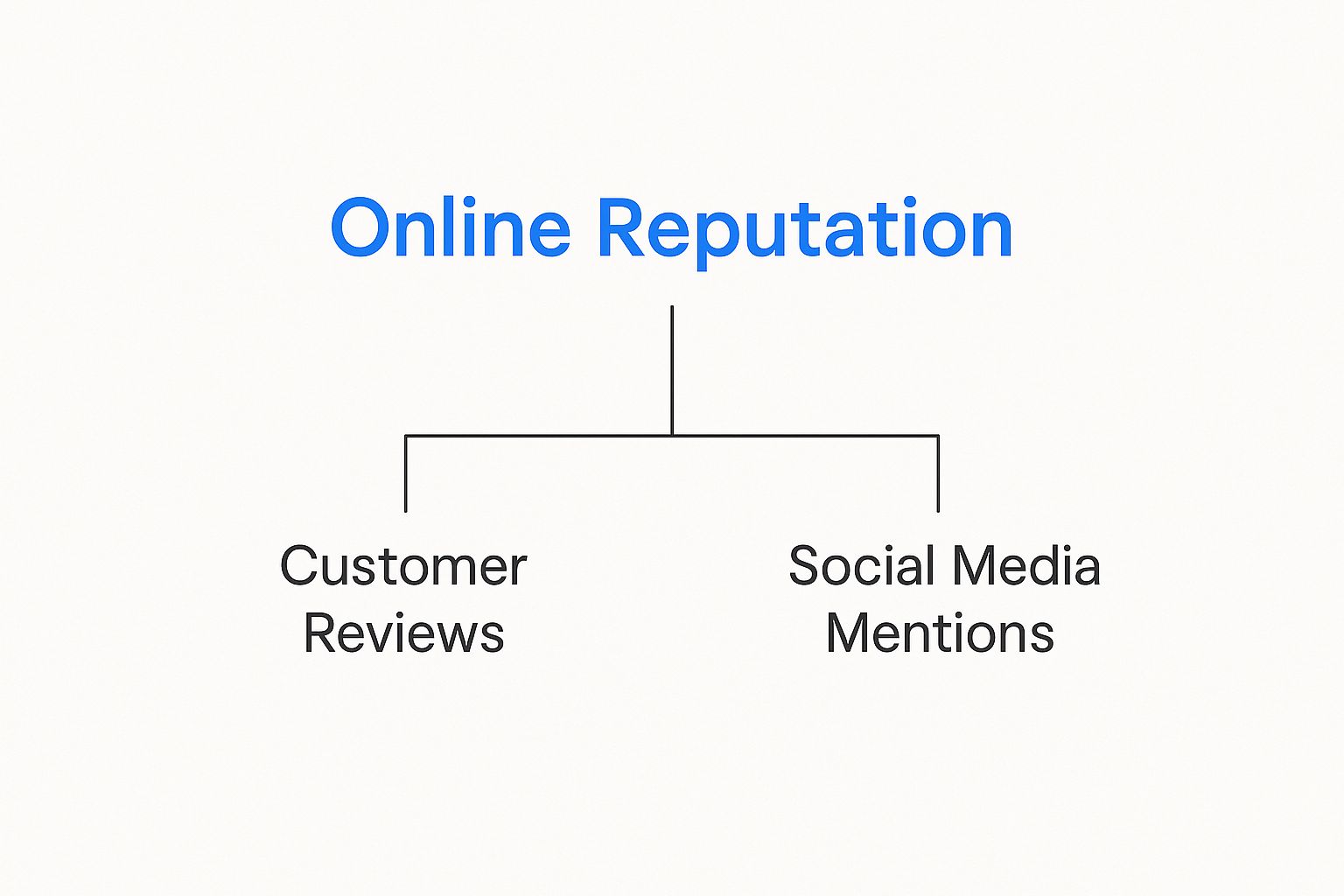
As you can see, what people say about you—whether in a formal review or a casual social media post—directly shapes how the public sees your business.
To put these ideas into a clear framework, here’s a breakdown of the three pillars and what they involve in practice.
The Three Pillars of Online Reputation Management
| Pillar | Objective | Key Activities |
|---|---|---|
| Monitoring | To listen to and be aware of all conversations happening about your brand online. | Setting up Google Alerts, checking review sites daily (Google, Yelp), social listening for tags and mentions. |
| Engaging | To interact with your audience and manage feedback in a way that builds trust. | Responding to all reviews (positive and negative), answering questions on social media, participating in relevant online discussions. |
| Building | To proactively create and promote positive content that defines your brand’s narrative. | Publishing helpful blog posts, encouraging happy customers to leave reviews, optimizing your website, creating case studies. |
By consistently working on these three fronts, you shift from a purely defensive stance to one where you are actively in control, shaping a reputation that attracts new customers. Let’s dig into each pillar a bit more.
Pillar 1: Monitoring Your Digital Footprint
The first step is always to listen. Monitoring is simply the act of keeping track of what’s being said about your business online. Think of it as your early-warning system.
Without it, you’re flying blind. A single angry review could fester for weeks, or a customer’s question on Facebook could go unanswered. Both scenarios send a clear message: you aren’t paying attention. The stakes are surprisingly high. Research from Moz found that just one negative article in search results can cost a business 22% of its potential customers. That’s a huge risk for not knowing what’s out there.
So, how do you monitor effectively?
- Set Up Alerts: The easiest first step is using free tools like Google Alerts. You’ll get an email whenever your business name pops up in a new article or post.
- Check Review Sites: Make it a daily habit to check your profiles on Google, Yelp, and any review sites specific to your industry.
- Social Listening: Pay close attention to your social media notifications—tags, mentions, comments, and direct messages are all vital sources of feedback.
Pillar 2: Engaging With Your Audience
Once you know what people are saying, the next step is to respond. Engaging is the art of joining the conversation. How you handle feedback, good or bad, is a public performance of your company’s values.
Responding to positive reviews is a great way to reinforce loyalty. But the real magic happens when you deal with negative feedback. A thoughtful, professional response to a complaint can completely turn the situation around.
When a potential customer sees you handle criticism with grace and a genuine desire to solve the problem, it can be more powerful than a dozen five-star reviews. It proves you stand behind your service and value your customers, even the unhappy ones.
Ignoring criticism makes you look dismissive and arrogant. Engaging shows you’re accountable and committed.
Pillar 3: Building a Positive Narrative
Finally, we get to the proactive part. Building is where you stop just reacting and start creating the story you want people to find. It’s about planting a garden so full of healthy, vibrant plants that the occasional weed has nowhere to grow.
The goal here is simple: flood the internet with positive, high-quality content that you control. When someone Googles your business, you want them to find a wealth of assets that paint a picture of expertise, trust, and quality.
Effective building strategies include:
- Creating Valuable Content: Write blog posts, create videos, or publish case studies that prove your expertise and help your customers.
- Owning Your Website: Your website should be the definitive, polished, and professional source of information about your brand.
- Asking for Reviews: Don’t be shy. Create a simple, systematic way to ask your happiest customers to share their positive experiences on key review sites.
Mastering the Currency of Online Reviews
In the world of small business, customer reviews have become the new currency of trust. A strong collection of positive reviews isn’t just a nice-to-have; it’s a powerful engine for attracting new customers. But a smart reputation management strategy is about much more than just crossing your fingers and hoping for good feedback. It demands a proactive, systematic approach to generating, managing, and defending this vital asset.
Think of your star rating as your customer experience, made public for all to see. It’s a direct reflection of your work that you have to manage actively. This means encouraging a steady stream of new reviews, of course, but it also means responding thoughtfully to every piece of feedback and knowing how to protect your business from unfair or fake comments. When you take control of this process, reviews stop being a source of stress and start driving real growth.
Encouraging a Steady Stream of Positive Feedback
The bedrock of a five-star reputation is your base of happy customers. The tricky part? Satisfied customers are often quiet, while a single unhappy one is far more likely to voice their opinion. Your job is to make it incredibly simple and routine for your best clients to share their positive experiences.
You don’t need a complex system here. Often, the most effective tool is a simple, direct request. As a small business owner, you can build powerful habits by working this “ask” right into your daily operations.
- At the Point of Sale: The moment a customer pays you a compliment is golden. A simple, “Thank you so much! We’d be incredibly grateful if you could share that on Google for us” works wonders.
- In Follow-up Communications: Add a direct link to your preferred review site (like your Google Business Profile) in your thank-you emails or appointment-reminder texts. You can frame it as a request for feedback to help you improve.
- Using Physical Reminders: For businesses with a physical location, a small sign or a QR code at the checkout counter serves as a gentle nudge for customers to share their thoughts online.
The Art of Responding to Every Review
Responding to reviews—the good and the bad—is simply non-negotiable today. It shows you’re paying attention, that you care about feedback, and that you value your customers. Every single reply you post is a public testament to your company’s character.
When you reply to a positive review, you get to amplify that goodwill. Thank the customer by name and reference something specific they mentioned. This personal touch proves you’re not just sending canned responses and validates their decision to choose you.
Negative reviews, on the other hand, are a different beast. While they can be stressful, they present a massive opportunity. A calm, professional, and empathetic response can win over prospective customers who are watching to see how you handle criticism. The aim isn’t to win an argument; it’s to show you take responsibility.
A graceful response to a negative review can be more persuasive than a dozen five-star ratings. It proves you stand behind your work and are dedicated to making things right, turning a potential liability into a showcase of your integrity.
As you can see below, major platforms like Google are investing heavily in machine learning to identify and remove fake reviews, which just goes to show how much authentic feedback really matters.

This kind of proactive policing from the platforms themselves is a huge benefit for honest businesses that work hard to earn genuine reviews.
Identifying and Flagging Malicious Reviews
Unfortunately, not every negative review comes from a real customer. Some are posted by shady competitors, disgruntled former employees, or outright scammers. Protecting your hard-earned rating means learning to spot these policy-violating reviews and reporting them.
Here are a few red flags that suggest a review might be fake:
- The complaint is vague and lacks any specific details about their experience.
- The reviewer has no other reviews, or their profile is filled with only one-star takedowns.
- The language is over-the-top, contains personal attacks, or is completely irrelevant to your services.
When you spot a review that clearly violates a platform’s rules (like those against hate speech, spam, or conflicts of interest), use the built-in flagging tool to report it. Write a clear, brief explanation for why you believe the review is fraudulent. While removal isn’t guaranteed, it’s a critical step in defending your reputation.
The stakes are incredibly high. Research shows that 92% of users will only consider businesses with at least a four-star rating, and one bad review can cost you up to 30 potential customers. This is precisely why the FTC has started cracking down on fake AI-generated reviews, which saw a staggering 758% increase between 2020 and 2024. You can dig into the full details on these online reputation management statistics to see just how much this all matters to small businesses.
Shaping What Customers See on Google

While review sites are certainly a huge piece of the puzzle, your online reputation is ultimately defined by the entire first page of Google. Go ahead, search for your business name. What shows up? That collection of links is your digital storefront, and just like a retail shop, you need to manage what people see on the shelves.
This is where a specific discipline within online reputation management for small business becomes critical: Search Engine Reputation Management, or SERM. It’s the hands-on practice of influencing and controlling what shows up on the search engine results page (SERP) when someone looks up your brand.
The goal is pretty straightforward: make sure the top results are positive, accurate, and—most importantly—controlled by you. You want to actively push favorable content up while pushing any negative, misleading, or irrelevant information down and out of sight.
Taking Control of Your Digital Shelf Space
Think of Google’s first page as a collection of digital properties. Some you own, some you rent, and some are owned by completely different people. A smart SERM strategy is all about developing and promoting the assets you own to dominate this incredibly valuable real estate.
The more positive properties you can get onto that first page, the less room there is for something negative to sneak in. This proactive approach builds a powerful buffer that insulates and protects your brand’s image long-term.
SERM isn’t just about reacting to negativity. It’s about proactively building a digital fortress of positive, authoritative content that defines your brand’s story before anyone else can.
When you do this right, you’re no longer just a participant in the conversation about your business; you’re the one leading it.
The Difference Between SERM and SEO
It’s easy to get SERM and traditional Search Engine Optimization (SEO) mixed up. They use similar tactics, but their end goals are fundamentally different.
| Strategy | Primary Goal | Target Keywords |
|---|---|---|
| Traditional SEO | To attract new customers who are searching for your services but don’t know your name yet. | Focuses on broad, non-branded keywords (e.g., “best pizza in Brooklyn”). |
| SERM | To control the perception and story around your brand name itself. | Focuses on branded keywords (e.g., “Tony’s Pizzeria Brooklyn”). |
In simple terms, SEO helps new customers find you. SERM makes sure that once they know your name, what they find convinces them to trust you and walk through your door.
Building Your Fortress of Positive Content
The heart of any strong SERM strategy is creating and optimizing a portfolio of high-quality digital assets that you control. When a customer searches for your business, you want that first page to be a wall of these positive, brand-owned properties.
Here are the most important assets to focus on developing:
- Your Official Website: This is your digital headquarters. It needs to be professional, fully optimized for your brand name, and serve as the undisputed source of truth about your business.
- Your Company Blog: A blog gives you a platform to consistently publish helpful content that proves your expertise. Every single post is another chance to rank for your brand name and related terms, pushing negative results further down the page.
- Key Social Media Profiles: You need to claim and actively manage profiles on major platforms like LinkedIn, Facebook, and Instagram. These profiles almost always rank high for brand searches and give you more direct control over the public conversation.
- Your Google Business Profile: This is a non-negotiable. It’s a powerful, free tool from Google that often appears right at the top of local search results. A complete and active Google Business Profile is absolutely essential for controlling how your business is presented on Google.
By building and promoting these core assets, you create a dominant online presence that constantly reinforces a positive and professional image. It’s the single most effective way to ensure you’re the one in control of the narrative.
Building a Reputation That Lasts

As the old saying goes, the best defense is a good offense. This couldn’t be more true when it comes to your digital brand image. While dealing with negative reviews and cleaning up search results is part of the game, the real goal of online reputation management for small business is to build a brand so strong that it can weather the occasional storm. This proactive work is about creating a reputational shield through consistent, positive actions.
Think of your online reputation like a savings account. Every glowing review, every helpful social media interaction, and every piece of positive press is a deposit. On the other hand, every negative comment or public misstep is a withdrawal. A business running on a low balance can be devastated by a single large withdrawal. But a business that makes regular deposits builds a substantial buffer, one that can easily absorb unexpected hits.
Your mission is to make such regular and meaningful deposits into your “reputational bank account” that your brand’s positive equity is never in doubt. This isn’t about flashy, one-off marketing stunts. It’s about weaving reputation-building into the very fabric of how you operate every single day.
Content as Your Reputational Cornerstone
One of the most effective ways to build this buffer is through high-quality content marketing. When you consistently publish content that showcases your expertise and genuinely helps your audience, you establish your business as a trusted voice in your field. This is more than just good SEO; it’s a fundamental reputation-building exercise.
Every useful blog post, informative video, or detailed case study you create becomes a positive asset you own and control. These assets populate Google’s search results for your brand name, reinforcing your credibility and pushing any potential negativity further down the page. After all, a disgruntled customer can’t leave a bad review on your company’s blog.
Proactive content creation is the art of telling your own story so effectively that it becomes the only one people remember. It ensures that when customers search for you, they find the expertise and value you provide, not someone else’s opinion.
By consistently sharing what you know, you’re making continuous deposits of trust and authority into your reputation account, solidifying your brand’s standing over the long term.
Weaving Your Brand into the Community
As a small business, your ties to the local community are a unique and powerful asset. Bringing this connection into the digital world is a brilliant strategy for building a reputation that lasts. When you engage authentically with your local community online, you build a layer of goodwill that is incredibly difficult to tarnish.
You can achieve this through a few simple, yet powerful, actions:
- Sponsor Local Events: Get involved with area charities, youth sports teams, or community festivals. Then, be sure to share your participation on your social media channels.
- Collaborate with Neighbors: Team up with other non-competing local businesses for joint promotions or events, and cross-promote each other to your respective online followers.
- Engage in Local Groups: Become a helpful presence in local Facebook groups or neighborhood forums. Offer your expert advice and support without delivering a hard sales pitch.
Each of these gestures shows you’re more than just a storefront; you’re a committed member of the community. This deepens relationships and creates a loyal following that is far more likely to support you, recommend you, and even defend you if a reputational issue ever pops up.
Cultivating Genuine Customer Relationships
At the end of the day, the strongest reputational shield is built one happy customer at a time. The relationships you foster are the bedrock of all your online efforts. A business that truly prioritizes genuine connections will discover that its customers become its most powerful advocates.
This means moving beyond purely transactional interactions. It’s about remembering a repeat customer’s name, responding to direct messages with a personal touch, and showing sincere appreciation for their business. When customers feel seen and valued, they don’t just return—they tell their friends.
More importantly, these are the people most likely to leave the five-star reviews that form the core of your positive reputation. These authentic advocates are your most valuable asset, providing the social proof that attracts new business and protects your brand for years to come.
Your Online Reputation Questions Answered
If you’re a small business owner, the world of online reputation management can feel like a minefield of questions. How much does it cost? Can I get rid of that one bad review? How long will it take to fix things? Let’s clear up the confusion with some straight, practical answers to the most common concerns.
How Much Does Online Reputation Management Cost for a Small Business?
The truth is, there’s no single price tag. The cost of managing your online reputation really depends on your specific situation and how hands-on you want to be.
If you’re just getting started or have a tight budget, the do-it-yourself (DIY) route is your most cost-effective option. You can set up free tools like Google Alerts to keep an eye on brand mentions and actively manage your Google Business Profile. The only investment here is your time, and it’s a fantastic starting point for any business.
When you’re ready to level up, basic monitoring software can be a huge time-saver. These platforms typically run between $50 and $300 per month and automatically track reviews and mentions for you across dozens of sites.
For more serious situations, like a full-blown reputation crisis or a persistent negative search result, you’ll likely need professional help. Bringing in a specialized agency can cost anywhere from $500 to several thousand dollars per month. Ultimately, though, the best strategy is proactive reputation building, which centers on consistently earning positive feedback and engaging with your customers.
Can I Legally Have a Bad Review Removed?
This is a question every business owner asks at some point. The short answer is usually no—you can’t force a platform to remove a legitimate negative review. Customer opinions, even harsh ones, are protected as free speech.
However, that protection has its limits. You absolutely have the right to report reviews that cross the line and violate a platform’s terms of service. Most review sites have clear rules against things like:
- Hate speech or discriminatory language
- Personal attacks, harassment, or threats
- Spam, fake reviews, or obvious conflicts of interest
- Rants that are completely off-topic and irrelevant to the customer experience
If you see a review like this, take a screenshot for your records and use the platform’s reporting tool. For legitimate complaints, however, your best move isn’t removal—it’s a thoughtful, public response.
A professional and empathetic reply to a negative review shows potential customers that you listen to feedback and genuinely care about making things right. That response can be more influential than the original complaint ever was.
How Long Does It Take to Repair a Damaged Online Reputation?
The timeline for fixing a damaged reputation depends entirely on two things: the severity of the damage and the consistency of your repair efforts. Think of it like rebuilding trust—it doesn’t happen overnight.
If you’re dealing with a few isolated bad reviews, you can often see a noticeable improvement in a few weeks or months. The key is to launch a concerted effort to generate a stream of new, positive reviews that will raise your overall star rating and push the negative feedback down.
For bigger problems, like a negative news article or a complaint forum that’s ranking on the first page of Google, the road is much longer. This requires a dedicated Search Engine Reputation Management (SERM) strategy to create and promote positive content that can outrank the negative. This kind of work is a marathon, not a sprint, and can easily take six months to over a year of focused effort.
What Are the Best Free Tools for a Small Business to Start With?
You don’t need a big budget to get started. In fact, some of the most powerful reputation tools are completely free and give you a solid foundation to build upon.
Here are the essentials for any small business:
- Google Alerts: This is your early-warning system. It emails you anytime your business name (or any other keyword you track) is mentioned in news, blogs, or forums online. It’s a must-have.
- Google Business Profile: For any local business, this is your most important piece of online real estate. It’s where you control your information in Google Search and Maps, and it’s a primary source of customer reviews.
- Manual Monitoring: It sounds simple, but it works. Set aside a few minutes each week to check your profiles on key review sites (like Yelp, Trustpilot, or industry-specific ones) and your main social media channels.
While paid tools offer more advanced features, these free resources give you everything you need to start listening, engaging with customers, and taking control of your online story.
Are you ready to stop worrying about negative reviews and start building a five-star reputation that attracts customers? The experts at Review Overhaul specialize in online reputation management for small business, turning feedback into your most powerful marketing tool. Get your free reputation audit and see how we can help. Learn more at https://reviewoverhaul.com.
Article created using Outrank
