
Are you a dedicated healthcare provider, frustrated by empty appointment slots while knowing you offer top-tier care? It feels like you’re shouting into the void. Bad reviews and a weak online presence are costing you patients and revenue, creating a barrier between you and the community that needs you most.
What if you had a simple, 3-step plan to fix this? Imagine a consistently full waiting room, a stellar reputation that attracts patients automatically, and the peace of mind that comes from a thriving practice. This isn’t a dream; it’s an achievable reality. The choice is yours: continue losing customers to competitors or finally achieve the growth and stability you deserve.
We are the guide who can show you the way. This article breaks down 10 proven patient acquisition strategies that put you back in control, transforming your marketing into a reliable system for growth. It’s time to implement a plan that connects you with patients who need your expertise, so you can focus on being the hero of your practice: providing exceptional care.
1. Strategy 1: Dominate Local Search with Digital Marketing & SEO
When a potential patient searches for “dentist near me” or “best physical therapist in [Your City],” your practice must appear at the top. This makes a strong local search strategy one of the most effective patient acquisition strategies available today.
This is your digital storefront. It’s not just about having a website; it’s about making sure Google sees you as the most relevant, trustworthy answer to a patient’s local query.
How to Implement This Strategy
To effectively harness local search, your focus should be laser-sharp. Ensure every piece of your online presence is optimized for your service area.
- Optimize Your Google Business Profile: This is your most powerful local SEO tool. Fill out every section completely, encourage patient reviews, and keep information updated.
- Create Service-Specific Content: Develop dedicated pages on your website for each core service (e.g., “Invisalign in Brooklyn”) to rank for specific, high-intent searches.
- Build Local Citations: Ensure your practice’s name, address, and phone number (NAP) are consistent across all online directories like Yelp, Healthgrades, and Vitals.
Key Insight: Winning in local search means proving to Google that you are the most authoritative local provider for a specific medical need. Your online presence must consistently reinforce this expertise. For an in-depth understanding, refer to this ultimate guide to SEO for lead generation.
If you’re serious about making your practice the obvious choice for local patients, mastering your online search presence is non-negotiable. Dive deeper and learn more about local SEO to start building your digital dominance.
2. Referral Programs & Physician Networks
While digital marketing casts a wide net, some of the most qualified new patients come from a source you already have: trusted relationships. Building a robust referral system is a cornerstone of sustainable patient acquisition strategies.
This approach turns your existing patients and professional colleagues into a powerful growth engine. It leverages word-of-mouth marketing, which remains one of the most effective forms of advertising in healthcare.
How to Implement This Strategy
A successful referral program is built on simplicity, communication, and mutual benefit. Make it effortless for both patients and other physicians to send new people your way.
- Formalize Your Patient Referral Program: Don’t just hope for referrals, ask for them. Create a simple program where current patients can easily refer friends and family.
- Build Your Physician Network: Identify primary care providers and other specialists in your area who serve your ideal patient demographic. Reach out and establish a clear, frictionless process for them to send patients to you.
- Streamline the Referral Process: Use secure online forms, dedicated phone lines, or even a referral coordinator to make the process seamless for your partners.
Key Insight: The most effective referral programs remove all friction. Your partners and patients are busy; if the process is complicated, they simply won’t do it. Your system must be fast, simple, and reliable to generate a consistent flow of high-quality new patients.
By nurturing these relationships, you create a self-sustaining ecosystem of patient growth that builds on trust and proven results. For a deeper look at creating these valuable connections, explore this guide to physician liaison marketing.
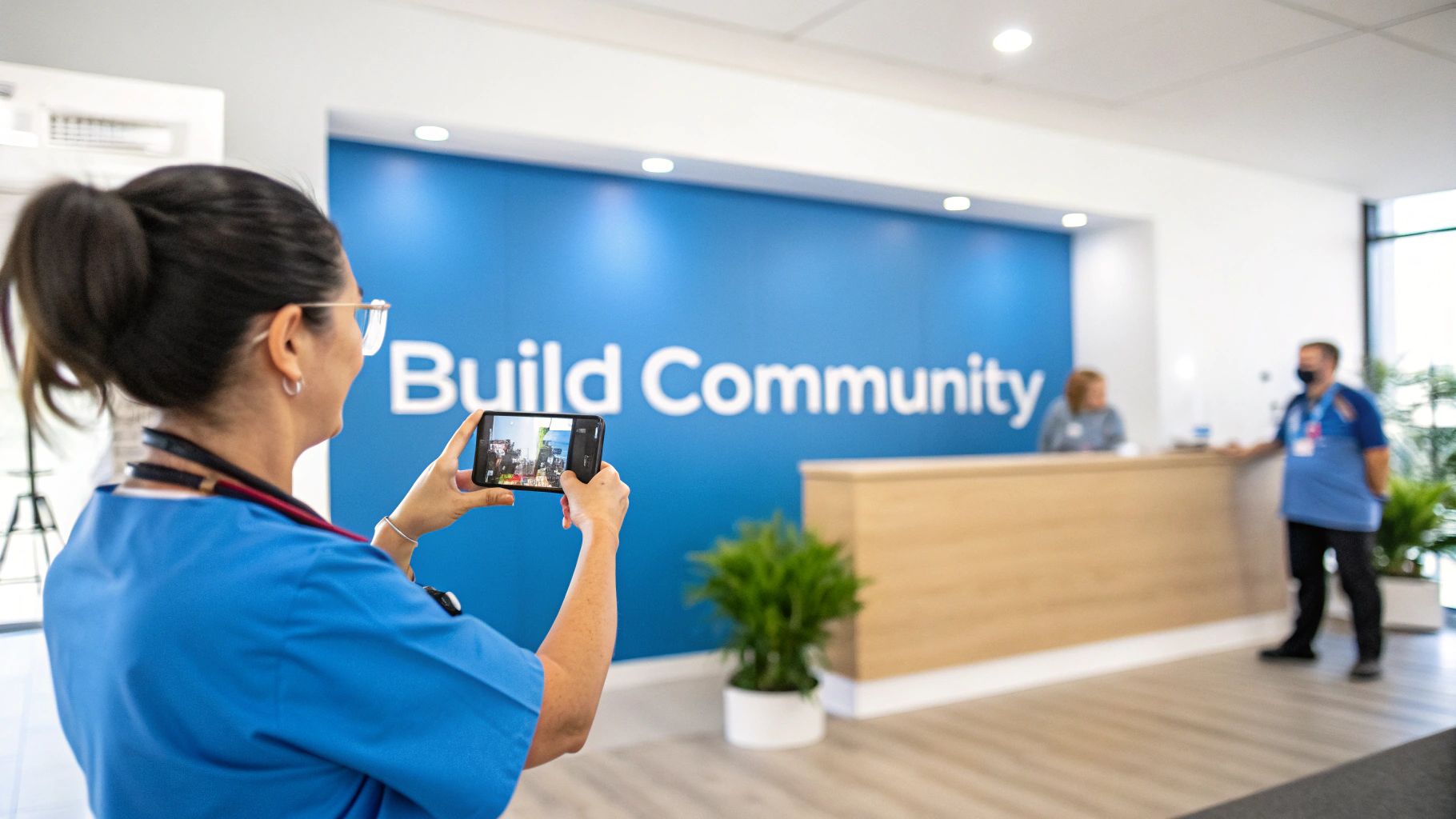
3. Social Media Marketing & Community Engagement
Platforms like Facebook and Instagram have become powerful arenas for healthcare education and community building. This is where you can connect with potential patients on a human level, one of the most proactive patient acquisition strategies.
This strategy builds trust and top-of-mind awareness long before a patient needs your specific service. It focuses on creating a genuine dialogue with your community, making your practice more approachable.
How to Implement This Strategy
A successful social media presence requires consistency and engagement. It’s about providing value, not just broadcasting advertisements.
- Choose Platforms Wisely: Don’t try to be everywhere. If your patient demographic is primarily on Facebook and Instagram, focus your efforts there.
- Create Educational, Patient-Centric Content: Post short, digestible videos explaining common conditions, share infographics with health tips, and host Q&A sessions.
- Engage Authentically and Consistently: Respond to comments and direct messages promptly. Post consistently (at least 3-5 times per week) to stay visible.
- Ensure HIPAA Compliance: Never share patient information without explicit, written consent. Always prioritize patient privacy above all else.
Key Insight: Social media for healthcare isn’t about selling; it’s about educating, engaging, and building a community. When you consistently provide value, patients will naturally think of your practice when they need care.
By building a strong social media community, you create a powerful and sustainable engine for patient acquisition, driven by trust and authentic connection.
4. Content Marketing & Educational Resources
What if you could attract patients by simply answering their most pressing health questions? This is the core of content marketing, a powerful patient acquisition strategy that positions your practice as a trusted authority.
This educational approach builds trust and credibility long before a person ever needs to book an appointment. When you become the go-to source for reliable health information in your community, your practice naturally becomes the first choice for care.
How to Implement This Strategy
A successful content strategy is built on understanding and addressing patient intent. Your goal is to provide the best, most helpful answer to their health-related queries.
- Target Specific Health Conditions: Develop in-depth content around the specific conditions and treatments you specialize in, answering common patient questions.
- Use Multiple Formats: Appeal to different learning styles by creating content in various formats like informational videos, infographics for social media, or a downloadable PDF guide.
- Include Clear Calls-to-Action: Every piece of content should guide the reader on what to do next, such as “Schedule a consultation” or “Download our free guide to managing back pain.”
Key Insight: Content marketing shifts the dynamic from interruption to attraction. By generously providing expertise and education, you build a foundation of trust that makes your practice the logical and preferred choice when a potential patient is ready for care.
5. Direct Mail & Targeted Print Advertising
In an increasingly digital world, a physical piece of mail can cut through the noise. A well-executed direct mail campaign is a powerful patient acquisition strategy, allowing practices to reach highly specific demographics.
This traditional approach leverages data to send targeted brochures and postcards to households that fit your ideal patient profile. It positions your practice as a professional and established local authority.
How to Implement This Strategy
Success in direct mail hinges on targeting, messaging, and a clear call to action. Make your mailer feel less like an ad and more like a personal invitation to better health.
- Segment Your Mailing List: Purchase or build lists segmented by specific zip codes, age brackets, or other demographics to ensure your offer is relevant.
- Create a Compelling Offer: Include an introductory discount, a free consultation, or a value-added service to motivate a response.
- Integrate Digital with a QR Code: Bridge the physical-digital gap by including a QR code on your mailer that links directly to a dedicated landing page.
Key Insight: Direct mail is most effective when it’s not a standalone effort. It should complement your digital strategies by driving targeted local traffic to your website and converting offline interest into online appointments.
For practices looking to make a memorable first impression in specific local communities, targeted print advertising remains an invaluable tool in your marketing arsenal.
6. Forge Powerful Partnerships & Engage Through Community Events
Some of the most enduring patient relationships are built offline. Engaging directly with your community through partnerships and local events is one of the classic patient acquisition strategies that builds trust face-to-face.
This approach establishes your practice as a caring, integrated part of the local fabric. It’s about being present where your potential patients live, work, and play.

How to Implement This Strategy
Success in community engagement requires a genuine desire to add value, not just to advertise. Your goal is to be a resource first and a service provider second.
- Identify Strategic Partners: Collaborate with non-competing providers or local businesses that serve your ideal patient demographic, like gyms or corporate wellness programs.
- Provide Tangible Value at Events: Offer free blood pressure checks, posture screenings, or brief consultations. This demonstrates your expertise and gives people a reason to interact.
- Capture Information and Follow Up: Use a simple sign-up sheet to collect contact information from interested attendees and send a personalized follow-up email.
Key Insight: Community engagement isn’t about a one-time splash; it’s about consistently showing up. Building trust in person creates a strong foundation that digital marketing can then amplify, making this a vital component of your overall patient acquisition plan.
7. Build Trust with Patient Testimonials & Case Studies
Facts can describe your services, but a compelling patient story can truly sell them. Leveraging patient testimonials is one of the most authentic patient acquisition strategies because it provides the social proof prospective patients need.
Seeing a real person’s successful outcome builds an immediate layer of trust. For a potential patient wrestling with a difficult health decision, these stories provide hope and validation.

How to Implement This Strategy
A successful testimonial strategy requires a thoughtful process. You must capture and share patient journeys in a way that is both compelling and compliant.
- Systemize Your Request Process: Train staff to identify happy patients who might be willing to share their stories and have a clear process for obtaining signed, HIPAA-compliant release forms.
- Diversify Your Formats: Capture stories in various formats, from high-impact video testimonials to detailed written case studies with before-and-after photos.
- Focus on the Transformation: The most powerful stories highlight the specific problem the patient faced, their treatment journey, and the tangible, positive outcomes they experienced.
Key Insight: A testimonial isn’t just a compliment; it’s a narrative that allows prospective patients to see themselves in the success of others. The goal is to make a potential patient think, “If they can achieve that, maybe I can too.”
Effectively managing and showcasing these stories is a cornerstone of a strong digital presence. To see how testimonials fit into a broader strategy, learn more about online reputation management for doctors and start building undeniable social proof.
8. Strategy 8: Build Relationships with Email Marketing & Patient Nurturing
Your relationship with a patient shouldn’t end when they walk out the door. An effective email marketing program is one of the most powerful patient acquisition strategies for re-engaging past patients.
This approach allows you to stay top-of-mind, build trust, and deliver value directly to their inbox. It turns a one-time visit into a long-term healthcare partnership.
How to Implement This Strategy
A successful email strategy is built on relevance and personalization. Sending the right message to the right person at the right time is crucial for driving action.
- Segment Your Patient Lists: Group your contacts by patient type or specific conditions to send targeted, relevant content.
- Balance Education and Promotion: Follow the 80/20 rule. 80% of your emails should offer valuable, educational content, while 20% can be promotional.
- Automate Nurture Sequences: Set up automated email series for new inquiries or post-appointment follow-ups to ensure consistent communication without manual effort.
Key Insight: Winning with email isn’t about selling; it’s about nurturing. By consistently providing value and demonstrating your expertise, you build the trust that turns subscribers into loyal patients. Ensure every email is HIPAA-compliant and offers a clear benefit to the recipient.
9. Strategy 9: Build Community Trust with Local Advertising & Traditional Media
While digital marketing often takes the spotlight, traditional media remains a powerful force for building brand awareness. This is one of the classic patient acquisition strategies that helps you become a household name.
Leveraging local radio, television, and print can reach patients where they live and work. It embeds your name into the fabric of the community.
How to Implement This Strategy
A successful traditional media campaign requires a clear message and consistent delivery. Your goal is to create memorable touchpoints that drive action.
- Focus on a Single, Clear Message: Don’t try to list all your services. A billboard for an orthopedic center should focus on “Get Back to Your Game,” not a long list of procedures.
- Maintain High Frequency: One or two ads won’t move the needle. The power of traditional media lies in repetition.
- Bridge the Gap to Digital: Use unique, trackable phone numbers or specific website landing page URLs (e.g., “YourPractice.com/Radio”) in your ads to measure ROI.
Key Insight: Traditional advertising excels at building top-of-mind awareness at scale. When a patient in your service area suddenly needs care, your practice should be the first one they think of and subsequently search for online.
Even with a strong traditional campaign, patients will ultimately search for you online to validate their decision. Ensure your digital storefront is ready for them with a fully optimized profile. You can start by implementing a proven Google Business Profile optimization service to capture that high-intent traffic.
10. Online Reputation Management & Review Platforms
In today’s digital world, your online reputation is your most valuable asset. A proactive approach to online reputation management is one of the most critical patient acquisition strategies for building trust.
This strategy involves more than just hoping for good reviews. It’s about actively monitoring, managing, and improving your digital footprint to convert prospective patients into loyal ones.
How to Implement This Strategy
A successful reputation management plan is built on consistency and responsiveness. It shows potential patients that you care deeply about their experience.
- Automate Your Review Requests: Implement a system that automatically asks patients for feedback a day or two after their appointment.
- Respond to Every Review: Make it a policy to respond to all reviews, positive and negative, within 24-48 hours. Thank patients for positive feedback and address negative comments professionally.
- Showcase Your Best Reviews: Feature your top testimonials and a high overall rating prominently on your website’s homepage and service pages.
Key Insight: Your online reputation is an active conversation, not a static score. Engaging with feedback demonstrates transparency and a commitment to patient care, which is a powerful differentiator in a competitive healthcare market.
To truly master your practice’s online image, you need a system that works for you. Explore how reputation management services can streamline this entire process, turning patient feedback into your most effective marketing tool.
Top 10 Patient Acquisition Strategies Comparison
| Strategy | Implementation complexity | Resource requirements | Expected outcomes | Ideal use cases | Key advantages |
|---|---|---|---|---|---|
| Digital Marketing & SEO | Medium–High (technical SEO + paid ads) | SEO specialists, content creators, PPC budget, analytics tools | Higher search rankings, steady organic traffic, measurable leads | Practices seeking online patient acquisition and local visibility | Measurable ROI, targets active searchers, builds long-term visibility |
| Referral Programs & Physician Networks | Medium (processes & relationship-building) | Staff time, CRM/referral tracking, partner management, incentives | High-quality referred patients, predictable referral flow | Specialties relying on clinician referrals and established practices | Trust-based leads, lower acquisition cost, higher retention |
| Social Media Marketing & Community Engagement | Medium (continuous content + moderation) | Content creators, community manager, ad spend, platform tools | Increased brand awareness, engagement, community growth | Consumer-facing practices and providers targeting younger demographics | Direct patient engagement, humanizes providers, cost-effective reach |
| Content Marketing & Educational Resources | High (consistent multi-format production) | Writers, video/graphic production, SEO, time investment | Authority building, organic traffic growth, lead capture over time | Providers seeking thought leadership and long-term patient education | Builds trust and SEO, repurposable assets, sustainable lead source |
| Direct Mail & Targeted Print Advertising | Low–Medium (design & mailing logistics) | Print production, mailing lists, design, postage | Local responses, tangible brand recall, effective in older demos | Local practices targeting seniors or community-specific outreach | Precise geographic targeting, tangible medium, strong response in 50+ |
| Partnerships & Community Events | Medium (coordination & presence) | Staff time, event materials, modest sponsorships, logistics | Local brand awareness, direct patient interactions, goodwill | Community-focused providers, preventive care, FQHCs | Builds community trust, low-cost visibility, direct relationship-building |
| Patient Testimonials & Case Studies | Medium (consent + production) | HIPAA-compliant releases, video/photo production, editing | Higher conversion rates, stronger social proof, trust in outcomes | Procedural specialties and clinics with demonstrable patient success | Highly persuasive, emotive credibility, repurposable across channels |
| Email Marketing & Patient Nurturing | Low–Medium (segmentation & automation) | Email platform, content, list management, compliance measures | Improved retention, appointment adherence, strong measurable ROI | Practices with an existing patient database, chronic care management | High ROI, personalized communication, trackable performance |
| Local Advertising & Traditional Media | Medium (creative + media buying) | Significant media budgets (TV/radio/billboards), production | Broad brand recognition, high frequency, name recall | Established brands in regional/smaller markets seeking awareness | Strong local reach, builds credibility, effective for mass recall |
| Online Reputation Management & Review Platforms | Medium (ongoing monitoring & response) | Reputation tools, staff for monitoring/response, review workflows | Improved conversion, higher trust, better local search rankings | Practices where patient choice is review-driven (e.g., consumer clinics) | Directly influences decisions, cost-effective trust-building, actionable feedback |
Stop Losing Patients – Start Building Your Legacy
You’ve just navigated a comprehensive blueprint of powerful patient acquisition strategies. The journey from an empty waiting room to a thriving practice isn’t about a single magic bullet. It is about creating a powerful, interconnected system to build the legacy practice you’ve always envisioned.
The real “hero” of this story is you, the dedicated provider. Success isn’t just about higher revenue; it’s about the peace of mind that comes from a stellar reputation driving consistent, predictable growth. This allows you to focus on what truly matters: your patients.
From Blueprint to Action: Your Next Steps
Information without implementation is just noise. To turn this knowledge into a tangible increase in appointments, you need a clear, actionable plan.
Here’s how to start building momentum today:
- Choose Your “One Thing”: Pick one strategy that addresses your biggest bottleneck. Is your Google Business Profile incomplete? Start there.
- Set a 30-Day Goal: Define what success looks like for your chosen strategy, such as “gather 10 new five-star reviews” or “secure one new community partnership.”
- Track Everything: You cannot improve what you do not measure. Use simple tools like Google Analytics to track where new patients are coming from.
Key Takeaway: The most effective patient acquisition strategies are not isolated tactics but part of a holistic ecosystem. Your digital presence, community involvement, and internal processes must work in harmony to attract, convert, and retain patients for life.
Mastering these concepts is about future-proofing your practice. To truly build a lasting legacy and ensure your practice thrives, it’s essential to continually explore proven strategies for increasing patient volume and adapt to the ever-changing healthcare landscape.
Ultimately, your reputation is your most valuable asset. Stop letting a handful of negative reviews or a weak online presence define your practice. It’s time to take control of your narrative and build a reputation as powerful as the care you provide.
Feeling overwhelmed by your online reputation? Review Overhaul provides a simple 3-step plan, handling the complexities so you can be the hero your patients need. Stop guessing what’s holding you back.
