
Are you a dedicated healthcare provider watching your hard-earned reputation get damaged by a few negative online reviews? It's incredibly frustrating. You pour everything into patient care, but a handful of unhappy comments on Google or Healthgrades can quietly steer new patients to your competitors, costing you revenue and peace of mind.
This isn't just about feelings; it's about the survival of your practice. When almost every patient uses online reviews to choose their doctor, a weak online presence becomes a constant drain on your growth. You're losing high-value patients before they even have a chance to experience the quality care you provide.
At Review Overhaul, we provide the simple plan and tools you need to take back control. We'll guide you through turning your online reputation from a source of stress into your most powerful patient acquisition tool. Success means a thriving practice, a stellar reputation, and the peace of mind that comes from knowing your online presence truly reflects the excellence of your work.
The Real Cost of Patient Reviews to Your Practice
You can pour years of dedicated care into your practice, only to have it all overshadowed by a handful of negative online reviews. We get how frustrating it is to see your hard-earned reputation defined by a few unhappy voices.
But this isn't just about hurt feelings; it's about the health of your practice. When potential patients use online reviews to choose their next doctor, a weak online presence directly translates to lost revenue. This guide is your game plan to take back control.
The New Digital Front Door for Patients
Gone are the days when a referral was the only path to a new patient. Today, that journey almost always starts with a search engine. And patients aren't just looking for a phone number; they're sizing you up based on what others have said.
Here's what a potential patient sees when they're looking for a new doctor:
Those star ratings create an instant first impression that determines whether someone clicks to learn more or keeps scrolling.
This digital word-of-mouth has become the single most powerful factor in patient choice. Think about it: approximately 94% of patients use online reviews to evaluate healthcare providers. Over 84% trust these reviews just as much as a personal recommendation.
Quantifying the Impact on Your Practice
For many practice owners, the stakes are higher than they realize. A single negative review can deter dozens of potential patients, while a steady stream of positive feedback acts like a powerful magnet.
A poor online reputation is a constant drain on your practice's growth. It silently steers high-value patients to your competitors, costing you revenue and undermining the hard work your team puts in every day. The cost of inaction is far greater than the effort required to manage your reputation proactively.
The financial hit isn't just theoretical; it shows up on your bottom line. We've seen firsthand how a negative shift in online sentiment can correlate with a dip in new patient bookings.
The High Cost of a Poor Online Reputation
| Impact Area | Consequences of Poor Reputation | Benefits of Strong Reputation |
|---|---|---|
| Patient Acquisition | A 22% loss of potential patients for just one negative result. This climbs to 70% with four or more. | Higher conversion rates from online searches and profile views into actual appointments. |
| Revenue | Significant loss of patient lifetime value. A single deterred patient can cost tens of thousands over time. | Increased patient volume and higher revenue per patient, as trust leads to greater case acceptance. |
| Trust & Credibility | Erosion of trust before a patient even contacts you. It creates a barrier that's hard to overcome. | Establishes immediate credibility, making your practice the default choice in a competitive market. |
| Staff Morale | Negative feedback can demoralize staff and create a defensive, stressful work environment. | Boosts team morale and pride in the workplace, reinforcing the value of their hard work. |
| Marketing ROI | Diminishes the effectiveness of all other marketing efforts. Paid ads and SEO drive traffic to a broken reputation. | Amplifies the ROI of all marketing channels by converting prospects into loyal patients more effectively. |
Effective reputation management for healthcare isn't just a marketing activity—it's an essential business function for survival and growth.
Building Your Foundation for Online Trust
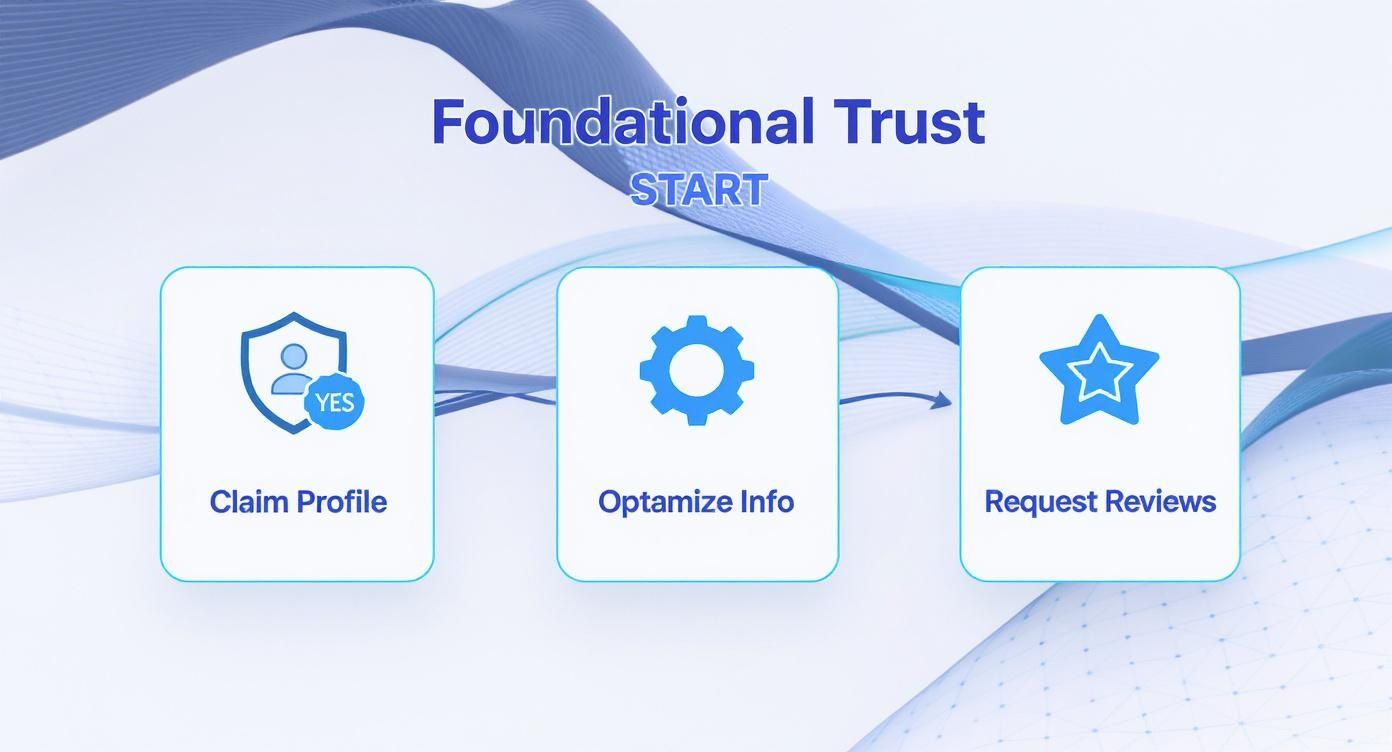
When you're dealing with tough online reviews, it can feel like you've lost control of your practice's narrative. It's time to get back in the driver's seat. Our 3-step plan helps you build a strong reputation on a solid foundation.
This isn't about fancy marketing tricks; it's about making sure your online presence is accurate, complete, and trustworthy.
Step 1: Master Your Digital Front Door
Your Google Business Profile (GBP) is often the first interaction a potential patient has with your practice. It’s your digital storefront, and it needs to be pristine. An unmanaged profile suggests a lack of attention to detail, while an optimized profile establishes immediate credibility.
Here’s a look at the clean, straightforward interface Google gives you to manage this vital asset.
This dashboard is your command center. Making sure every detail here is correct is the most powerful thing you can do for your online presence today.
Your Google Business Profile Optimization Checklist
Getting your GBP in top shape isn't complicated, but the results are significant. Regular check-ins are key to ranking higher in local search.
Here are the non-negotiables:
- Accurate NAP Data: Your Name, Address, and Phone number need to be 100% identical everywhere online.
- Service & Category Selection: Get specific. List all individual services, like "Annual Physicals," "Vaccinations," and "Sports Physicals."
- High-Quality Photos: Add professional photos of your office, staff, and yourself to humanize your practice and build trust.
- Hours of Operation: Keep your hours meticulously up-to-date, especially for holidays, to avoid frustrating patients.
A quick note: building a strong online foundation also means ensuring accessibility. It's well worth understanding ADA Compliance for Healthcare Websites to make sure your digital presence is inclusive.
Step 2: Create a Simple System for Generating Reviews
Once your foundation is solid, it's time to build social proof. This is where you set up a simple, ethical, and HIPAA-compliant system to get a steady stream of positive reviews from your happy patients.
The most powerful reputation management for healthcare strategy is turning your happiest patients into your best advocates. A proactive system ensures their positive experiences don’t go undocumented, creating a protective buffer against the occasional negative comment.
Make it incredibly easy for people to share feedback. A simple text or email with a direct link to your Google review page can make a world of difference.
Step 3: Respond to Reviews with HIPAA Confidence
Engaging with patient feedback is where you truly forge trust. But for many, the fear of violating HIPAA rules is paralyzing. Responding thoughtfully is a huge part of modern reputation management for healthcare, but you have to do it right.
We'll walk through practical, safe examples you can start using today. You can turn potential criticism into a public display of your patient-first values.
The Golden Rule of HIPAA Compliant Responses
This is the most important part: never, ever confirm that the reviewer is a patient. Your public response cannot acknowledge their status as a patient in any way. Doing so is a direct violation of their Protected Health Information (PHI).
You need to think of your response as a public conversation, not a patient interaction. This mental shift is everything.
A HIPAA-Safe Review Response Cheatsheet
This cheatsheet breaks down common scenarios with simple, compliant actions.
| Scenario | What to Do (HIPAA-Safe Action) | What to Avoid (HIPAA Violation Risk) |
|---|---|---|
| Positive Review | Offer a general thank you for the feedback. Praise your team's commitment to service. | "So glad we could help with your [specific condition]!" or "Thanks for coming in, [Patient Name]!" |
| Vague Negative Review | Acknowledge the feedback and invite the person to contact the office manager directly via phone. | "I'm sorry your appointment didn't go as planned. Let's look up your chart." |
| Detailed Negative Review | Use the standard offline script: "Thank you for the feedback. Please contact [Name] at [Number] to discuss this." | "I see from your file that…" or "We disagree with your version of the events of your visit." |
| Review Mentions Staff by Name | "We appreciate you sharing your thoughts. Our team is dedicated to providing a great experience." | "I'll be sure to pass your kind words on to Nurse Sarah about your visit." |
Remember, a generic, offline-focused response is your safest bet every single time.
Responding to Positive Reviews Safely
Replying to positive reviews builds goodwill. It shows potential patients that you're an engaged, caring practice.
Here are a few safe, plug-and-play examples:
- Simple & Sweet: "Thank you for sharing your positive experience. We strive to provide excellent service to everyone in our community."
- Team Focused: "We appreciate you taking the time to leave such kind words. Our team works hard to create a welcoming environment, and your feedback means a lot."
- Mission Focused: "Thank you for the feedback. Our goal is to ensure everyone who walks through our doors feels heard and cared for."
These are broad, appreciative statements about your practice's mission, and that’s exactly what you want.
A Framework for Negative Review Responses
Negative reviews are stressful, but they're also a massive opportunity. A calm, professional, and HIPAA-compliant response can build more trust than a dozen five-star reviews.
Your goal isn't to "win" an argument online. It's to de-escalate the situation and prove your professionalism.
The Three-Step De-escalation Process:
- Acknowledge Without Confirming: Thank them for bringing their concerns to your attention.
- Take It Offline: Immediately invite them to continue the conversation in a private channel.
- Reiterate Your Commitment: End on a high note about your dedication to quality care.
Your Go-To Negative Review Response:
"Thank you for taking the time to share your feedback. We take all comments seriously, as our goal is to provide every person with the best possible experience. Please contact our Practice Manager, Jane Doe, at (555) 123-4567 so we can better understand and address your concerns directly."
This script is your shield. It's polite, professional, and airtight from a HIPAA perspective. For comprehensive compliance, it’s worth looking into the best HIPAA risk assessment tools.
Turning a Crisis into a Trust-Building Moment
It’s the scenario every healthcare provider dreads: a negative review goes viral or a sudden wave of bad press hits. The stakes feel incredibly high, as one event can threaten the trust you've spent a career building.
But a crisis doesn't have to be the end of the story. Handled correctly, it can become a moment to show your integrity and reinforce the trust of your community.
Your Immediate Crisis Playbook
When a reputation crisis hits, those first few hours are everything. The trick is to move quickly, but not hastily.
Before saying a word publicly, your first move should be a rapid internal huddle. Get your leadership team together and get the facts straight.
Your crisis plan should kick off with these immediate actions:
- Pause and Assess: Fight the urge to fire off a defensive, emotional reply. Take a breath and look at the situation objectively.
- Conduct an Internal Review: Privately investigate the claims to get to the root cause. This is critical for fixing any real internal issues.
- Designate a Single Spokesperson: All communication needs to flow through one person to keep the message consistent and controlled.
Crafting Your Public Statement
Once you have the facts, create a single, unified public statement. The goal is to show accountability and transparency without necessarily admitting fault. Getting this balance right is a crucial part of reputation management for healthcare.
Your statement needs to be professional and empathetic. Acknowledge the feedback and state clearly that you take patient concerns seriously.
A well-crafted crisis response shows everyone watching that you are a practice that listens, cares, and takes responsibility. It turns a negative event into a public display of your core values, reinforcing trust even in the face of criticism.
Post this statement consistently wherever the conversation is happening.
Counterbalancing the Narrative with Positive Voices
While your public statement puts out the fire, your long-term strategy is about shifting the narrative. You can dilute the negative story's impact by turning up the volume on positive experiences.
Activate a proactive review generation campaign. Reach out to recent, happy patients and make it simple for them to share their positive stories online. This creates a wave of genuine feedback that pushes the negative noise down, demonstrating that the crisis was an exception, not the rule.
Using Technology for Proactive Reputation Management
Managing your practice's reputation can feel like a full-time job. It’s a time-consuming chore that pulls you away from what matters: patient care. The good news is that modern tools can automate and simplify the entire process.

As a practice owner, the daily grind leaves little time for scouring review sites. Technology can be your partner, handling repetitive tasks so you can focus on the human side of healthcare.
Automating Your Review Generation Engine
The simplest way to improve your online reputation is to get a steady stream of new, positive reviews. Technology makes this almost effortless.
By integrating simple tools with your practice management system, you can automatically send a polite review request via text or email after an appointment. This ensures a constant flow of positive feedback, creating a buffer that drowns out random negative comments.
The core of modern reputation management for healthcare is automation. When you systemize how you ask for feedback, you ensure the silent majority of your satisfied patients are heard. That’s how you build an authentic and powerful online presence.
This consistent stream of new reviews also feeds fresh content to search engines, signaling that your practice is active and trusted.
Real-Time Monitoring and Sentiment Analysis
You can't fix problems you don't know you have. AI-driven platforms act as your digital watchtower, monitoring every online mention of your practice in real-time. Instead of stumbling upon a negative review weeks late, you get an instant alert.
These tools also use sentiment analysis to categorize feedback and spot recurring themes.
- Positive Trends: Discover what patients consistently praise, like a specific employee or an easy check-in process.
- Negative Patterns: Flag issues like long wait times or billing confusion, pointing you to operational hiccups that need attention.
By pinpointing these patterns, you can make targeted changes that genuinely improve the patient experience.
Aligning Technology with Healthcare Priorities
Bringing technology into your reputation plan aligns with the top priorities of modern healthcare leadership. More than 70% of healthcare C-suite executives identified improving operational efficiencies and patient engagement as top priorities.
When you use technology to analyze feedback and streamline communication, you're hitting those critical goals. You can explore the complete executive outlook on Deloitte.com.
The choice is clear: continue to struggle with a manual approach or adopt a smarter, automated system. By making technology your partner, you can build deeper patient trust and secure the lasting success your practice deserves.
Answering Your Top Healthcare Reputation Questions
As a practice owner, you're busy running a practice. This can feel like one more complex task on an already full plate. Most providers worry about the time it will take, the legal lines they can't cross, and whether it actually translates into more patients.
Let's clear the air and tackle those common questions head-on. This will give you the confidence to put a solid plan in motion.
How Long Does It Take to Improve a Reputation?
While you can see immediate wins within weeks, making a real dent in your overall rating—say, moving from 3.5 to 4.5 stars—realistically takes 3 to 6 months of consistent work. The secret is the steady accumulation of new, positive reviews.
When it comes to reputation management for healthcare, think marathon, not sprint. It’s that consistency that builds lasting trust, pushes you to the top of local search, and creates a powerful asset that attracts new patients for years.
Can I Ask a Patient to Remove a Negative Review?
Let's make this simple: No. Never directly ask a patient to take down a negative review. It comes across as pressure and can backfire, making the situation worse.
Instead, shift your focus to two things:
- Following the HIPAA-compliant response strategy we covered earlier.
- Doubling down on generating positive reviews. The best way to neutralize a bad review is to bury it under a mountain of new, positive ones.
This approach keeps you on the right side of ethical lines and turns a negative into a trust-building opportunity.
What Is the Single Most Important Review Platform?
For almost every healthcare practice, the answer is Google. Your Google Business Profile is your digital front door and non-negotiable.
But a solid strategy doesn't end there. To build deep credibility, you need a presence on industry-specific sites, too.
- Healthgrades is a huge, trusted resource where patients compare doctors.
- Vitals adds another layer of credibility with specialty-specific reviews.
- Facebook recommendations still hold a lot of weight, especially in local community groups.
While Google is your number one priority, keeping an eye on these other key sites is crucial.
How Is Technology Changing Healthcare Reputation?
The world of reputation management is getting smarter and more automated. Looking ahead, this field is being shaped by artificial intelligence (AI). Modern AI tools can analyze patient reviews in real-time, helping you spot patterns and respond to issues before they blow up. You can get more details on these upcoming trends over at leaphealth.ai.
This shift means tasks that used to take hours can now be handled automatically. Technology helps you get out of a reactive crouch and into a proactive stance, turning your online presence into a powerful engine for practice growth.
Ready to stop stressing about negative reviews and build a reputation that drives growth? The team at Review Overhaul is here to guide you. We provide the expert strategy and simple tools to take back control of your online story, so you can focus on what you do best.
Schedule your free reputation audit today and discover how we can help your practice thrive. Visit us at https://reviewoverhaul.com.
