
Are you tired of being invisible on Google? You've built a great business, but potential customers can't find you online, and it's costing you sales every single day. This constant struggle to show up in search results is frustrating and leaves you wondering what you're doing wrong.
At Review Overhaul, we see this all the time. Good business owners like you are losing out to the competition, not because their service is better, but because their online presence is. We provide a clear, simple plan to fix your online visibility and turn your website into a customer-generating machine. Imagine waking up to a steady stream of leads and feeling confident that your business is growing, all because customers can finally find you.
Our clients see their online reputation transform, leading to more calls, more foot traffic, and ultimately, more revenue. One local contractor we worked with saw a 40% increase in qualified leads within three months after implementing our strategy.
Ready to stop being invisible? Let's fix this together.
The Simple 3-Step Plan to Rank Higher
Here’s our straightforward plan to get your business seen by the right customers.
Step 1: We Build Your Foundation
First, we dive into the technical health of your website. We fix the behind-the-scenes issues—like slow page speed and mobile-friendliness—that are hurting your rank. This ensures both customers and Google have a great experience on your site.
Step 2: We Create Content That Attracts Customers
Next, we help you create content that directly answers your customers' biggest questions. This positions you as the go-to expert in your field. This isn't about keyword stuffing; it's about building real trust and authority.
Step 3: We Boost Your Local Authority
Finally, we optimize your Google Business Profile and build your local reputation. By gathering positive reviews and building local connections, we send powerful signals to Google that you are the best choice in your area. This is how you start showing up in that critical "map pack."
Why Your Website Is Invisible on Google
It's a familiar and frustrating feeling for many business owners. You’ve got a great website, but it’s languishing on page five of Google’s search results, collecting digital dust. You know your customers are out there searching, but they just can't find you.
This invisibility is more than just an annoyance; it costs you real leads and sales. It can feel like you're shouting into the void, unsure of what you're doing wrong or what to try next. The rules of the game seem impossibly complex, almost like a secret code you haven't cracked.
Mastering the Signals That Matter
Here’s the good news: you don't need to get bogged down by all 200+ ranking signals Google supposedly uses. That's a recipe for overwhelm. Instead, focusing on the foundational pillars will get you much further, much faster.
Think of it like building a house. You can't just throw up some walls and call it a day. You need a solid foundation (that's your technical SEO), a great floor plan and interior design (your content and user experience), and a good reputation in the neighborhood (your website's authority).
We're going to walk through these core areas without the confusing jargon. This is about making your website genuinely valuable to both search engines and, more importantly, your customers. When you do that, your site stops being a ghost town and starts becoming a reliable magnet for the right kind of leads.
This infographic gives you a great visual breakdown of how these pillars work together.
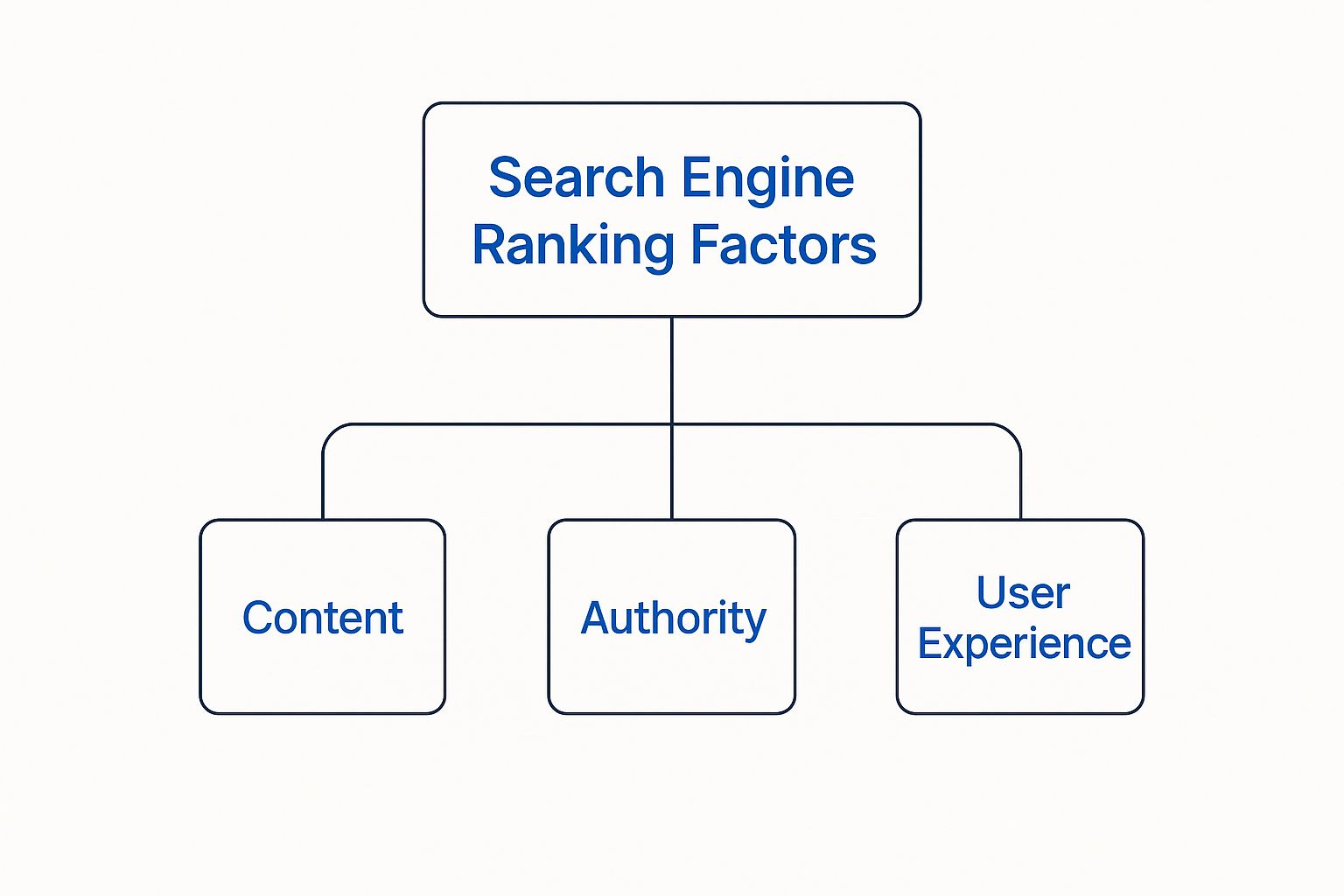
As you can see, everything from backlinks to page speed ultimately rolls up into these main categories.
The Core Pillars of SEO Success
Before we get into the nitty-gritty, it helps to understand a bit about what search engine optimization is at a high level. At its heart, SEO is simply the practice of making your website the best, most helpful, and most authoritative answer to a person's question.
To help you get a clear picture of how this works, here’s a quick overview of the main categories of ranking factors.
Core Ranking Factor Categories at a Glance
This table breaks down the primary pillars of modern SEO. Think of it as your cheat sheet for understanding where to focus your efforts.
| Factor Category | Primary Focus | Example Signal |
|---|---|---|
| Content Quality & Relevance | The substance of your website—what it's about, how deeply it covers topics, and how well it matches queries. | Keyword usage, Freshness |
| Authority & Trust | Your site's reputation across the web, proven by other reputable sources vouching for you. | Backlinks, Brand mentions |
| User Experience & Technical SEO | How easily people and search engines can access, understand, and interact with your site. | Page speed, Mobile-friendliness |
By understanding these categories, you can build a more strategic and effective plan instead of just chasing individual signals.
Let’s quickly unpack these main groups:
- Content Quality and Relevance: This is the heart of your website. Are you providing genuinely helpful, in-depth answers? Are you using the same language your customers use? Getting this right is non-negotiable. For a deeper dive, check out our guide on the role of keywords in content strategy.
- Authority and Trust: Think of this as your website’s street cred. In Google’s eyes, authority is primarily built through backlinks—links from other websites pointing to yours.
- User Experience and Technical SEO: This covers the "under-the-hood" elements that make your site a pleasure (or a pain) to use. Is your site fast? Does it work well on a smartphone?
Content That Satisfies Searchers and Search Engines

Let's get one thing straight: content is the heart and soul of your SEO strategy. Think of your website as your digital storefront. Your content is the expert inside, ready to greet visitors, answer their questions, and solve their problems.
Great content isn’t about stuffing keywords into a page. It’s about becoming the single most helpful answer to your customers' questions. When you do that consistently, you build real trust—not just with people, but with Google, too.
Demonstrating E-E-A-T: The Bedrock of Trust
Google has a framework for figuring out who to trust online. It's called E-E-A-T, which stands for Experience, Expertise, Authoritativeness, and Trustworthiness. This is how the search engine separates the real experts from the noise.
To build E-E-A-T, you have to show, not just tell. You need to prove you’re a legitimate business owner who truly gets your customers' struggles.
- Experience: Share real-world stories and case studies from your business.
- Expertise: Write detailed guides and how-to articles that go deeper than what your competitors offer.
- Authoritativeness: Get mentioned or linked to by other respected local businesses or industry websites.
- Trustworthiness: Make your contact info easy to find and show off your customer reviews.
Understanding What Your Customers Really Want
The best content nails the user's search intent—the "why" behind their search. Are they just looking for information? Comparing products? Or are they ready to pull out their credit card?
Someone searching for "best pizza near me" clearly wants to order a pizza. But a person searching for "how to make pizza dough" is in research mode. By aligning your content with search intent, you directly answer the user's unspoken question.
The Power of Fresh and Satisfying Content
Let's be clear: consistently publishing high-quality, helpful content isn't just a good idea. A massive study analyzing Google's algorithm confirms it. The consistent publication of satisfying content accounts for a whopping 23% of all ranking influence. You can dig into the full analysis in the Google Algorithm Ranking Factors report to see how things have changed.
Structuring Your Content for Readability
People don’t read online; they scan. Your job is to make your key points impossible to miss. Good formatting makes your content more enjoyable for humans, which tells search engines it's high-quality.
Stick to these simple rules to make your content easy to digest:
- Use Short Paragraphs: No more than 2-3 sentences.
- Incorporate Subheadings: Break up your content with clear H2 and H3 headings.
- Leverage Bullet Points: Lists are perfect for breaking down steps, features, or examples.
- Bold Key Phrases: Make your most important takeaways pop with bold text.
Building Authority and Trust with Backlinks

Think of it this way: your website content is what you say about your business. Backlinks are what other people say about you. These links are one of the most powerful search engine ranking factors because they're third-party endorsements.
Every backlink is like a referral. A link from a highly respected industry blog is like a referral from a trusted colleague—it carries a lot of weight. This is the foundation of "authority," a key ingredient in how Google sizes up your site's credibility.
Good Links vs. Bad Links: What's the Difference?
Here’s the thing: not all backlinks are good for you. A healthy backlink profile looks natural—it’s built over time from different types of sites because you’ve created genuinely valuable content.
Google is incredibly smart and can spot sketchy link patterns from a mile away. Quality over quantity isn't just a suggestion; it's the only real strategy for building authority that lasts.
A Realistic Plan for Earning Quality Backlinks
You don't need to resort to shady tactics to get great backlinks. It all comes down to creating real value and building relationships. For a local business, your community connections are your secret weapons.
Here’s a simple, ethical plan to start earning links that move the needle:
- Create Awesome Local Resources: Put together a guide to the best parks in your neighborhood or a calendar of local festivals.
- Team Up with Local Partners: Get in touch with other local businesses. Offer to write a guest post for their blog or co-host a workshop.
- Become the Go-To Expert: Find respected blogs in your industry and offer to share your expertise.
Why You Should Never Take Shortcuts
The temptation to buy cheap, fast links is real. But trust me, these schemes are a fast track to disaster. Buying links can earn you a Google penalty, which can make your website practically invisible online.
It's just not worth the risk. If you want to know more about the dangers, our guide on buying backlinks from Fiverr breaks it all down.
Getting Technical SEO and User Experience Right
You could have the most amazing content, but it won’t matter if your website is slow or confusing. This is where technical SEO and user experience (UX) come into play. They're the nuts and bolts that hold your site together.
Think of your website like a physical store. If the front door is stuck and the aisles are a mess, people are going to leave. A technically sound website is the digital equivalent of a clean, well-organized shop where everything just works.
This stuff isn't optional anymore. With over 99,000 Google searches happening every single second, you have a split second to make a good first impression. You can dig into more numbers in the most current SEO statistics from AIOSEO.
The Pillars of a Strong Technical Foundation
Don't worry, you don't need to be a coding wizard to handle the essentials. Nailing these basics will have a huge impact on your rankings and your customers' happiness.
- Site Speed: How fast does your website load? Every extra second of waiting is another reason for a potential customer to hit the back button.
- Mobile-Friendliness: Your site has to look and function perfectly on a smartphone. Period.
- Security (HTTPS): That little padlock in the browser bar matters. It builds trust and is a confirmed ranking signal from Google.
What Are Google’s Core Web Vitals?
To give us a clearer picture of what a "good experience" looks like, Google introduced Core Web Vitals. These are specific metrics that score a user's real-world experience on a webpage. They focus on loading speed, interactivity, and visual stability.
Think of Core Web Vitals as Google’s official report card on your site’s user-friendliness. A good score tells Google your site provides a quality experience, giving you an edge over slower, clunkier competitors.
Making Your Site Accessible to Everyone
A great user experience means everyone can use your site. Simple things like using clear headings and adding "alt text" to your images make a world of difference. This also future-proofs your business for new tech like voice search. You can learn more about what voice search optimization is here.
Winning Local Search With the Right Signals
For a local business, what really matters is being the top result for customers right in your own backyard. Winning in local search comes down to a different set of search engine ranking factors. It’s about being the most relevant and trusted choice for people searching nearby.
Think of it like this: Google is trying to be the ultimate local matchmaker. When someone types in "best pizza near me," Google’s job is to recommend the perfect spot.
The Three Pillars of Local SEO Success
Getting a handle on these three concepts is the key to showing up for customers in your service area.
- Proximity: How close is your business to the person searching? You can't move your shop, but you can make sure Google knows exactly where you are.
- Relevance: How well does your business match what the person is looking for? This is about the services you list and the keywords you use.
- Prominence: This is all about your reputation. A business with 150 great reviews will almost always look more prominent than one with only 2.
Your Google Business Profile is Your Local SEO Hub
Your Google Business Profile (GBP) is the single most important tool you have for local SEO. It's not just a directory listing; it's a living profile that tells Google and customers everything they need to know.
Think of your Google Business Profile as your digital storefront. Keeping it complete, accurate, and active is like hanging a bright, welcoming “Open” sign.
A Simple Plan for GMB Optimization
Getting your GBP into tip-top shape isn't rocket science. Follow these steps, and you'll be sending all the right signals to Google.
- Claim and Verify Your Profile: First, you have to claim ownership of your listing to prove you're the real deal.
- Fill Out Every Single Section: Add your hours, list your services, and upload high-quality photos. For a deep dive, our guide to local search ranking factors covers it all.
- Choose the Right Categories: Be precise when selecting your business categories. This is crucial for getting matched with the right searches.
- Encourage and Respond to Reviews: Make it a habit to ask happy customers for a review and respond to all of them.
If you’re trying to attract customers in your area, figuring out how to rank for 'near me' searches is essential. Your GBP is the foundation for turning those local searches into actual foot traffic.
How Google Ranking Factors Evolved Over Time
To get a grip on what works for SEO today, you have to look at where it came from. The story of search engine ranking factors is the story of Google getting smarter.
In the early days, SEO was almost a video game with cheat codes. This kicked off the era of "keyword stuffing," where businesses would jam pages full of keywords, making the text unreadable for humans.
The Shift Toward Quality
Thankfully, Google caught on. This led to a couple of massive, game-changing updates that started rewarding real quality.
- The Panda Update (2011): This went after websites with "thin" or low-quality content.
- The Penguin Update (2012): This took aim at spammy and manipulative backlinks. The message was clear: links had to be earned.
These updates were a major turning point. Google stopped just counting keywords and links and started judging the quality and intent behind them.
From Keywords to Context
This evolution hasn't stopped. Ever since search engines appeared back in 1995, the rules have constantly changed. You can get the full story on how Google ranks results on their official site.
So, what does this history lesson mean for you as a business owner? It’s simple: trying to find the latest trick is a losing battle. The only strategy that stands the test of time is to focus on giving people the best, most helpful answers. As we'll dig into, understanding why content is king in digital marketing is the foundation for lasting success.
Got Questions About Ranking Factors? Let's Clear Things Up.
Diving into the world of search engine ranking factors can feel a bit like drinking from a firehose. Let's tackle some of the most common ones.
What’s the #1 Most Important Ranking Factor?
There isn't one magic bullet. But the closest thing we have is creating fantastic, high-quality content that genuinely answers a searcher's question.
But even the most amazing content can't do the job alone. It all works together: your content, your technical SEO, your backlinks, and your user experience.
Seriously, How Long Will This SEO Thing Take?
SEO is a marathon, not a sprint. For a small business putting in consistent work, seeing real traction within 3 to 6 months is a realistic timeframe.
Of course, that timeline can shift based on:
- Your Competition: It’s quicker to rank for "cupcakes in Omaha" than for "New York real estate."
- Your Website's Age: An older website often has a head start.
- Your Game Plan: A smart, focused strategy will always beat random tactics.
Can I Actually Do SEO Myself?
Yes, one hundred percent! You don't need to be a coding wizard to get fantastic results.
If you just focus on a few key areas—like creating helpful content, beefing up your Google Business Profile, and making sure your site is fast—you’ll be miles ahead of many of your competitors.
Stop losing customers to your competitors just because they show up higher on Google. You can have a thriving business with a steady stream of new clients, or you can continue to be invisible online. Review Overhaul provides the expert guidance and simple plan you need to succeed. Don't let another day go by where customers can't find you.
Schedule your free consultation today and let's start growing your business.
