
Are you a small business owner watching a few bad reviews sabotage your reputation? You pour your heart into providing excellent service, but a handful of negative comments online are costing you customers and real revenue. It's a frustrating, helpless feeling to see potential clients choose a competitor based on an unfair online snapshot of your business.
This cycle is costing you more than just sales; it's costing you peace of mind. But you don't have to fight this battle alone. We're here to guide you with a simple plan and the right customer satisfaction measurement tools to turn your reputation into your most powerful marketing asset.
Imagine waking up to a stream of 5-star reviews, with new customers calling because they saw your stellar online reputation. That's not a fantasy; it's what happens when you have a clear plan. Business owners we've guided have seen a 30% increase in inbound leads and a significant boost in their star ratings in just a few months.
Here's how we help you achieve that success:
- Step 1: Audit Your Reputation: We start with a free, no-obligation audit to pinpoint exactly what's hurting your online score.
- Step 2: Implement the Right Tools: We help you choose and use the best tools to consistently gather positive feedback.
- Step 3: Manage & Grow: We build a system to manage your reviews, turning happy customers into your best marketers.
You can continue letting a few unhappy voices define your business, or you can take control and build a reputation that drives growth. Schedule a free reputation audit today and let us show you the simple path to a better reputation and more sales.
1. Review Overhaul – Reputation Management That Actually Works
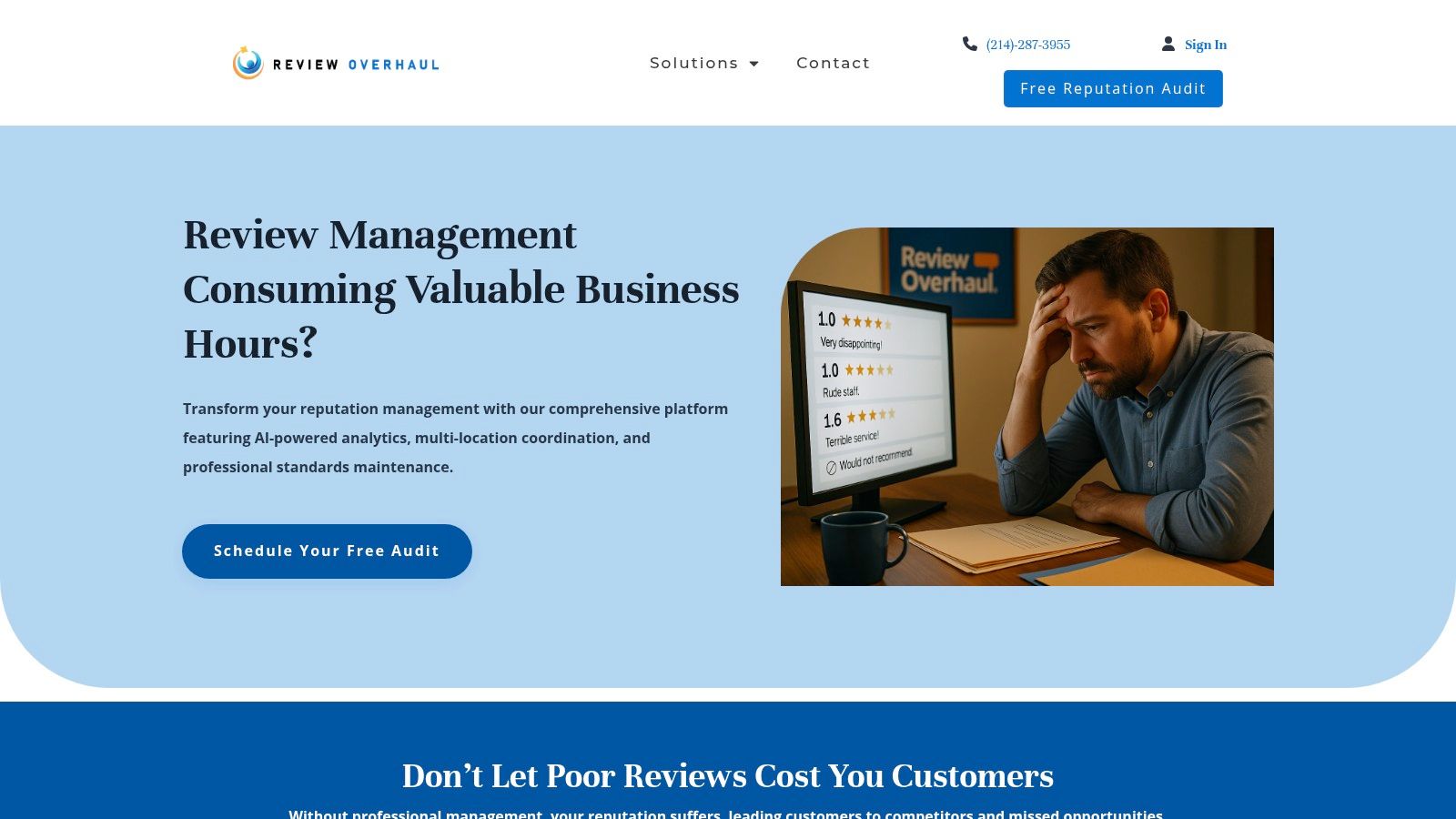
When your goal is to measure customer satisfaction, you need a tool that goes beyond simple surveys. Review Overhaul offers a comprehensive platform designed for small and local service businesses, transforming raw customer feedback from public review sites into a powerful engine for growth. It acts as your expert guide, helping you understand what customers are truly saying and turning those insights into a stronger online reputation.
Instead of just collecting data, Review Overhaul focuses on actionable intelligence. For business owners in hospitality, healthcare, or auto repair, this means you're no longer guessing what a three-star review really means. The platform equips you with the tools to audit your current standing, monitor real-time feedback, and manage your response strategy effectively. This structured approach helps you stop losing customers to negative reviews and start building a reputation that drives real-world sales.
Why It's Our Top Choice
Review Overhaul stands out because it combines technology with a service-oriented approach, making it one of the most practical customer satisfaction measurement tools available. Its proprietary AI-powered sentiment analysis dissects review text to pinpoint specific issues, like "long wait times" or "friendly staff," giving you clear direction on what to improve.
The platform's automated response system ensures no customer feedback goes unacknowledged, building trust and showing you care. This is a game-changer for busy owners who can't personally reply to every comment. Furthermore, their jargon-free monthly reports are designed for action, not just observation, making it easy to see your progress and make informed decisions.
Key Features and Use Cases
- AI Sentiment Analysis: Automatically categorizes feedback to identify recurring themes. A restaurant owner, for instance, could discover that "food quality" is consistently praised while "service speed" is a common complaint, providing a clear focus for staff training.
- Automated Review Responses: Drafts and posts context-aware replies to reviews, ensuring timely engagement that can turn a negative experience into a positive one.
- Comprehensive Reporting: Delivers clear, easy-to-understand monthly reports that track your reputation score, highlight trends, and provide actionable next steps.
- Google Business Profile Optimization: Manages and enhances your GMB listing to improve local search visibility, ensuring satisfied customers can easily find you.
What You Need to Know
Best for: Small and local service businesses in industries like hospitality, healthcare, legal, and automotive services who need a hands-on partner to manage their online reputation.
Pricing: Custom pricing based on business needs. Review Overhaul starts with a free, no-obligation reputation audit to assess your current online presence.
Pros:
- Combines powerful tools (AI, automation) with a clear, actionable process.
- Focuses on authentic engagement and provides transparent, easy-to-understand reporting.
- Offers a guarantee of improved ratings, providing peace of mind.
Cons:
- The service is highly tailored to small and local businesses, so it may not be the right fit for large enterprises with complex needs.
- Maximizing certain features, like voice search optimization, may require some initial client input.
Get started by visiting Review Overhaul's website. To dive deeper into the landscape of reputation tools, check out their guide on the top tools for effective reputation management.
2. Qualtrics XM (CustomerXM)
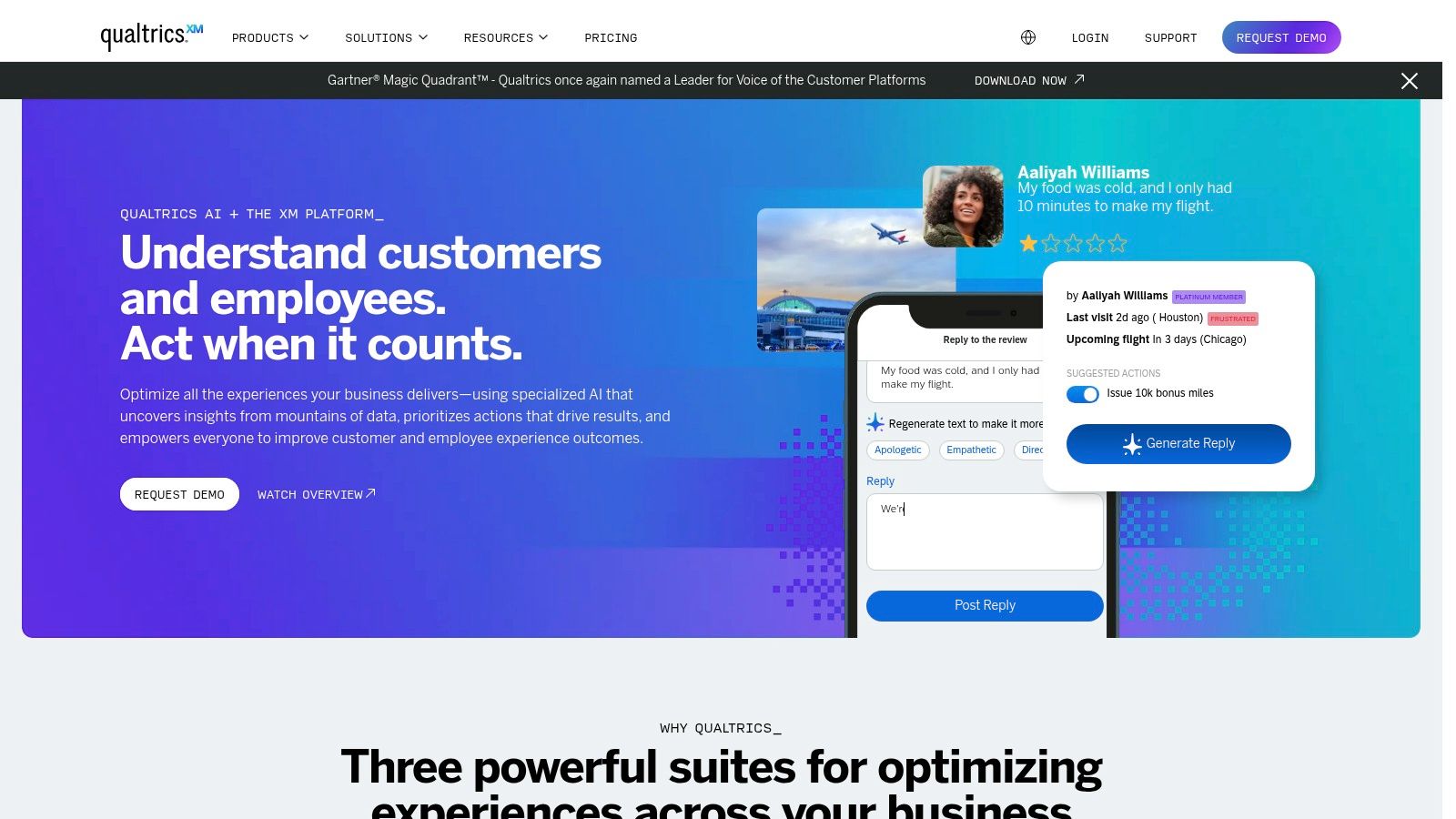
Qualtrics is the powerhouse of customer satisfaction measurement tools, designed for businesses ready to dive deep into their customer experience (CX) data. This isn't just a survey tool; it's an enterprise-grade experience management platform that connects feedback from every touchpoint, from your website and app to your contact center and physical locations. For a multi-location auto repair group or a growing dental practice, this means you can track satisfaction from the initial online booking all the way to the follow-up service call.
Unmatched AI-Driven Analytics
What sets Qualtrics apart is its AI-driven analytics. It can analyze text and even speech from customer calls to pinpoint recurring issues and sentiment trends, giving you insights you’d otherwise miss. When you're managing feedback across multiple channels, making sense of it all is a huge task. The process of Choosing Customer Feedback Management Software often comes down to which platform can best simplify this complexity, and Qualtrics excels here.
Key Features and Considerations
- Best For: Larger service businesses, multi-location practices, or global teams needing a comprehensive, scalable solution.
- Unique Strength: Its ability to integrate feedback across a vast number of channels and provide deep, predictive analytics is unmatched. The platform’s closed-loop workflows automatically create tickets and alerts for follow-up, ensuring no customer issue falls through the cracks.
- Pricing: Quote-based and tailored to your needs, which often places it in a premium price bracket.
- Pros: Highly scalable, powerful analytics, and extensive integration capabilities with systems like Salesforce and Slack.
- Cons: The platform’s complexity means a steeper learning curve, and the cost can be prohibitive for smaller, single-location businesses.
Qualtrics is an investment, but for organizations that need a single source of truth for all customer experience data, it’s a strategic choice that supports robust review management services.
Website: https://www.qualtrics.com/
3. Medallia Experience Cloud
Medallia Experience Cloud is another enterprise-level giant among customer satisfaction measurement tools, built for organizations managing complex, multi-touchpoint customer journeys. It excels at capturing signals from a vast array of channels, including surveys, social media, speech analytics from calls, and digital interactions. For a healthcare system with multiple clinics or a hospitality group with various locations, this means you can get a unified view of patient or guest satisfaction, no matter how they interact with your brand.
Company-Wide Access to Insights
What makes Medallia unique is its pricing model, which is based on Experience Data Records (EDRs) rather than per-user seats. This allows every employee, from the front desk to the C-suite, to access customer insights without driving up costs. The platform’s AI engine then crunches this omnichannel data to deliver predictive insights and automate closed-loop workflows, ensuring customer issues are flagged and resolved promptly.
Key Features and Considerations
- Best For: Large, complex organizations like multi-state legal firms or national service chains that require unlimited user access to customer data.
- Unique Strength: The EDR pricing model offers a predictable total cost of ownership for high-volume feedback programs, encouraging company-wide engagement with customer experience data.
- Pricing: Quote-based and designed for enterprise budgets. The purchasing process is sales-led, and pricing details are not publicly available.
- Pros: Broad channel coverage for a truly holistic customer view and powerful, enterprise-grade analytics powered by AI.
- Cons: Implementation can be a resource-intensive process, and the platform may be overly complex for smaller, single-location businesses.
Medallia is a strategic investment for businesses that want to democratize customer data across their entire organization, fostering a truly customer-centric culture from the ground up.
Website: https://www.medallia.com/
4. SurveyMonkey
SurveyMonkey is arguably one of the most recognized names in the world of online surveys, making it an incredibly accessible entry point into customer satisfaction measurement tools. Its strength lies in its simplicity and speed. For a local law firm or an auto repair shop needing to quickly gauge client sentiment after a service, SurveyMonkey provides ready-to-go templates for CSAT, NPS, and CES that can be deployed in minutes.

User-Friendly and Accessible
What makes SurveyMonkey a staple for so many businesses is its user-friendly interface and extensive library of expert-certified questions. You don't need to be a market research expert to build a survey that yields valuable insights. This ease of use is crucial for busy owners who are focused on harnessing customer feedback for business growth without getting bogged down in complex software.
Key Features and Considerations
- Best For: Small to medium-sized businesses, marketing teams, and individuals needing a fast, reliable, and easy-to-use survey tool.
- Unique Strength: Its combination of a generous free plan, a massive template library, and benchmark data allows businesses to not only collect feedback but also see how their scores compare to others in their industry.
- Pricing: Offers a free basic plan with limitations, with paid tiers (Team Advantage, Team Premier) starting around $25-$75 per user/month, and enterprise plans available.
- Pros: Extremely easy to get started, strong template library, and a large user base with extensive documentation and support resources.
- Cons: Advanced features like logic branching and in-depth analytics are locked behind higher-priced plans, and the pricing structure can be a bit confusing to navigate.
SurveyMonkey is the perfect tool for businesses that want to start measuring customer satisfaction immediately without a steep learning curve or significant upfront investment.
Website: https://www.surveymonkey.com/
5. GetFeedback (by SurveyMonkey)
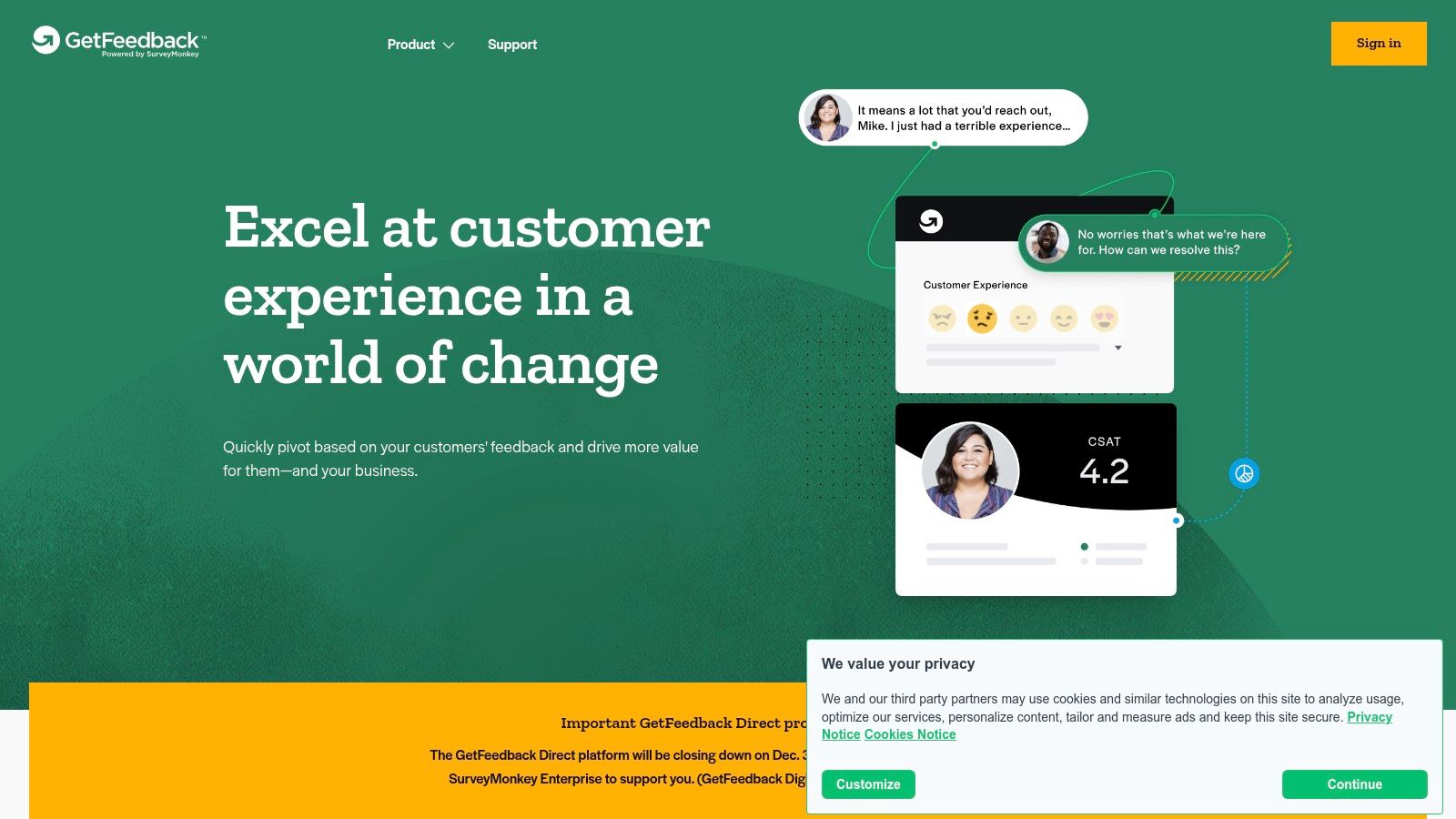
GetFeedback, a part of the SurveyMonkey family, is one of the most agile and user-friendly customer satisfaction measurement tools available, especially for businesses deeply embedded in the Salesforce ecosystem. It’s designed to capture real-time feedback at critical moments in the customer journey, from post-purchase follow-ups for an auto repair shop to patient experience surveys after a dental visit.
Seamless Salesforce Integration
What makes GetFeedback stand out is its seamless, powerful integration with Salesforce. Feedback data from CSAT, NPS, or CES surveys can be mapped directly to customer records, triggering instant alerts for your service team when a poor score is received. This allows a law firm, for example, to immediately follow up on a negative client experience, turning a potential detractor into a loyal advocate before a negative review is even considered.
Key Features and Considerations
- Best For: Small to mid-sized service businesses that use Salesforce as their primary CRM and need a quick-to-implement feedback solution.
- Unique Strength: Its native Salesforce integration is best-in-class, allowing for sophisticated, automated workflows and real-time data synchronization without complex IT involvement. The mobile-first survey design is a significant advantage.
- Pricing: Quote-based with packaging often tied to the larger SurveyMonkey enterprise ecosystem. You'll need to contact their sales team for specific pricing details.
- Pros: Very easy to set up and use, especially for Salesforce users. Its mobile-optimized surveys look professional and lead to higher completion rates.
- Cons: The lack of public pricing and its packaging within the broader SurveyMonkey suite can be a hurdle. It may be less suitable for businesses not using Salesforce.
For organizations prioritizing speed-to-value and deep CRM integration, GetFeedback is a powerful tool for closing the feedback loop and proactively managing customer satisfaction.
Website: https://www.getfeedback.com/
6. Delighted by Qualtrics
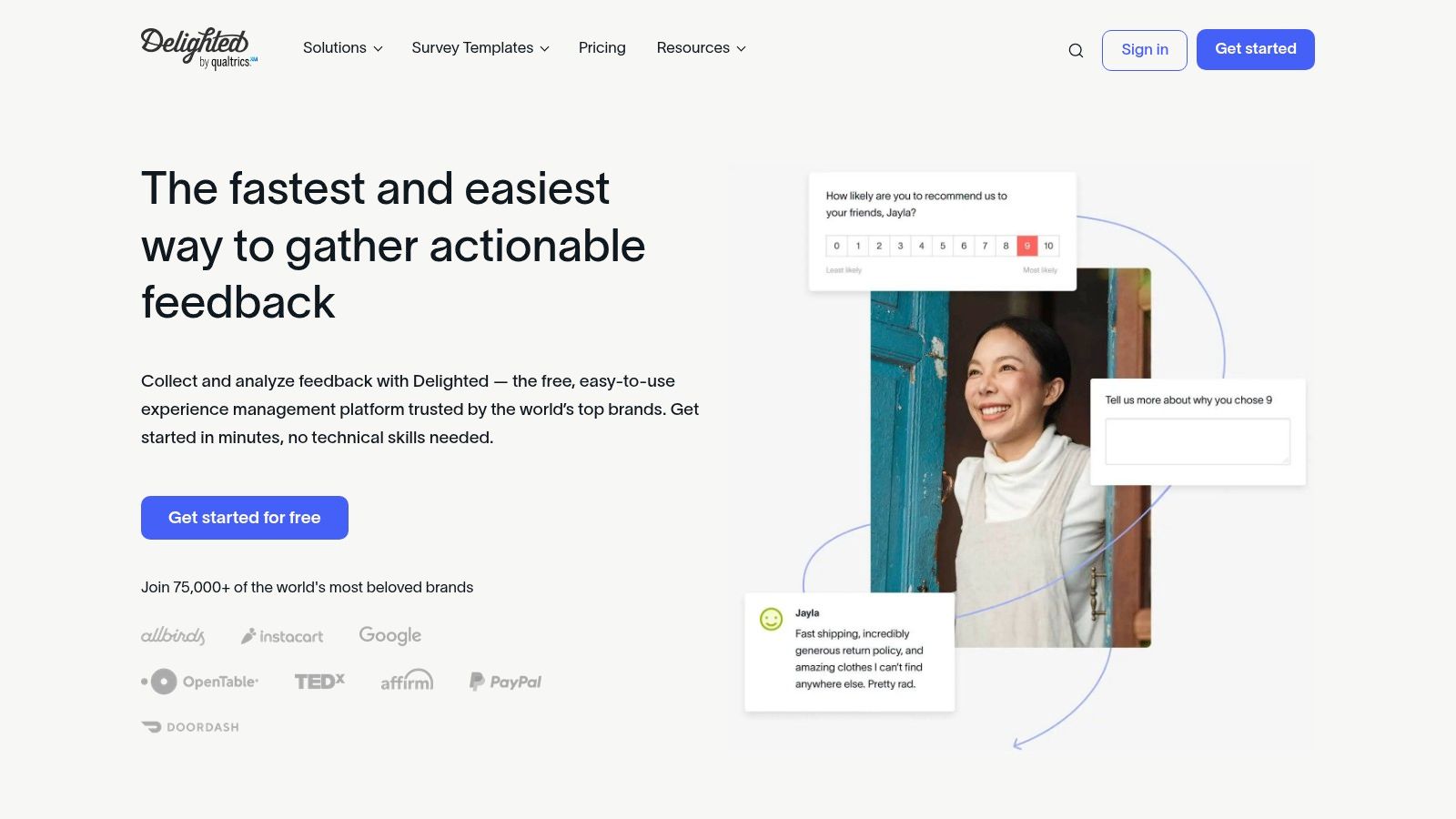
For businesses that need a powerful, yet straightforward way to gather feedback, Delighted by Qualtrics is a fantastic choice. Acquired by Qualtrics, it serves as a lightweight and incredibly user-friendly entry point into the world of customer satisfaction measurement tools. Its strength lies in simplicity; you can launch a survey for NPS, CSAT, or CES in minutes.
Speed and Simplicity
What makes Delighted stand out is its focus on speed and ease of deployment. The platform allows you to send surveys via email, web links, or even on a kiosk in your physical location, providing flexibility for different types of service businesses. This accessibility ensures you can capture feedback at the most critical moments in the customer journey.
Key Features and Considerations
- Best For: Small to mid-sized businesses, product teams, and companies new to formal feedback collection who prioritize ease of use and quick setup.
- Unique Strength: Its combination of a clean, intuitive interface with a surprisingly robust set of features and integrations (like HubSpot and Salesforce) at a low entry point. It provides a clear and painless upgrade path to the full Qualtrics platform as your needs grow.
- Pricing: Offers transparent, tiered pricing, including a generous free plan, with paid plans starting at a very accessible price point.
- Pros: Extremely easy to deploy and manage, transparent pricing with a low barrier to entry, and a wide variety of survey types.
- Cons: Response and user limits on lower-tier plans can be restrictive for growing businesses, and it lacks the deep, complex analytics of its parent platform.
Delighted strikes a perfect balance between simplicity and power, making it one of the most approachable yet effective customer satisfaction measurement tools available for businesses focused on growth.
Website: https://delighted.com/
7. Zendesk (Support/Suite with built-in CSAT)
Zendesk is a titan in the customer service world, offering a robust help desk platform where customer satisfaction measurement is baked directly into the workflow. Instead of adding a separate tool, Zendesk allows businesses to automatically send a CSAT survey the moment a support ticket is resolved. This seamless integration ensures feedback is captured when the experience is freshest in the customer’s mind.
An Integrated Ecosystem
What makes Zendesk a go-to choice is its ecosystem. It's more than just a ticketing system; it’s a full-fledged service suite that centralizes customer conversations from email, phone, chat, and social media. Effective customer experience optimization starts with understanding these individual touchpoints, and Zendesk makes it easy.
Key Features and Considerations
- Best For: Service businesses of any size that already use or need a dedicated customer support platform and want an integrated CSAT solution.
- Unique Strength: The native integration of CSAT surveys is its biggest advantage. There's no complex setup or third-party tool needed; feedback collection is an automated, built-in part of your support process. Exploring other essential customer support KPIs can provide a more holistic view.
- Pricing: Varies widely based on plan (Support vs. Suite) and team size, with foundational plans starting around $19 per agent/month.
- Pros: Seamlessly integrates CSAT into the support ticket lifecycle, highly scalable, and offers an extensive marketplace for integrations.
- Cons: Advanced analytics and reporting are often tied to higher-tier plans, and the cost can add up quickly with add-ons and more agents.
Zendesk is the practical choice for teams that want to tie customer satisfaction directly to support performance without managing separate systems.
Website: https://www.zendesk.com/
8. HubSpot Service Hub
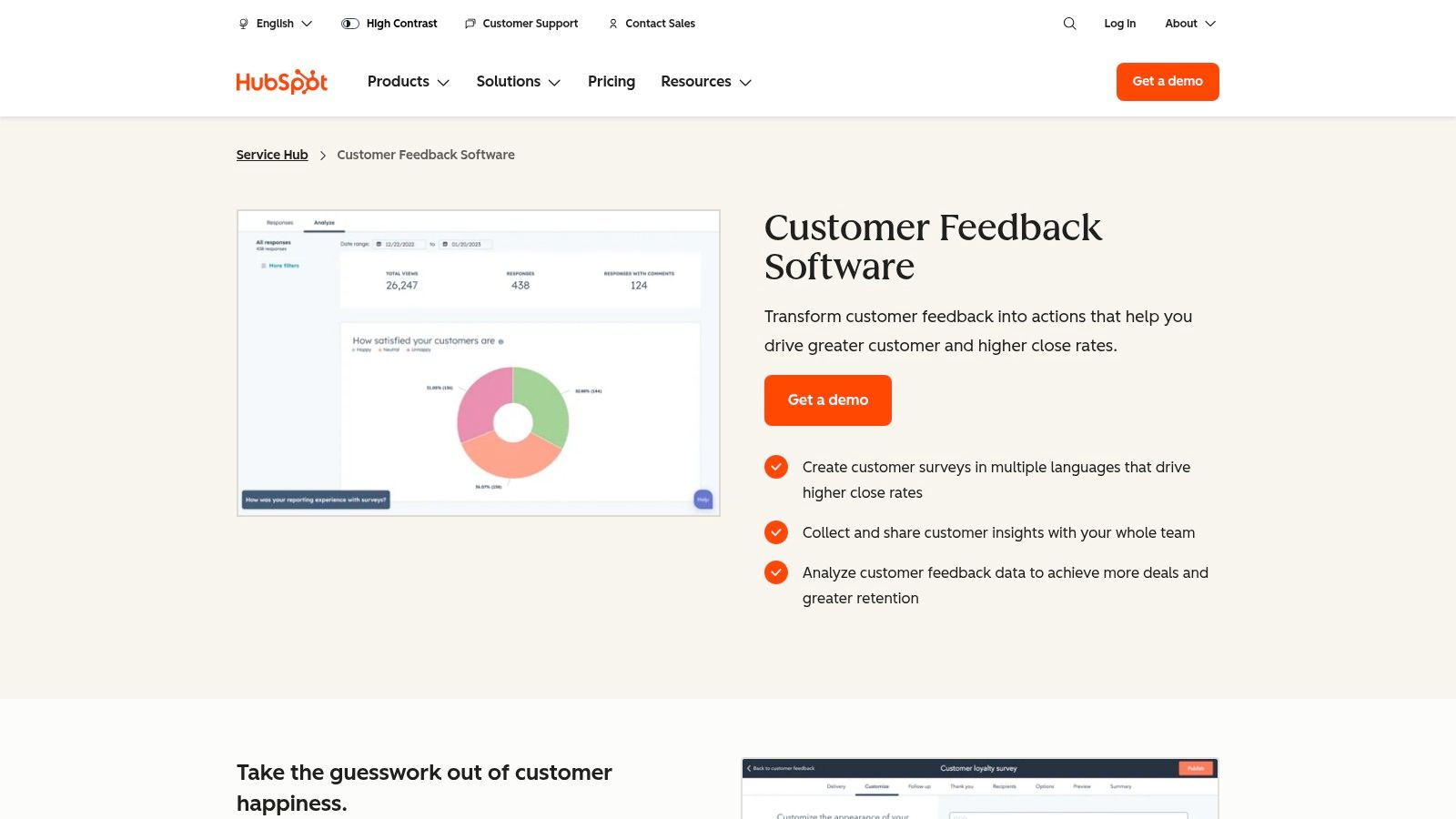
For businesses already operating within the HubSpot ecosystem, the Service Hub is one of the most seamless customer satisfaction measurement tools available. It isn’t a standalone survey app; it's a fully integrated customer service platform where feedback collection is natively built into your CRM. This means when a client leaves feedback, it’s instantly tied to their contact record.
Unifying Customer Data
What makes HubSpot so effective is its unification of data. You can trigger a Customer Satisfaction (CSAT) survey automatically after a support ticket is closed or send a Net Promoter Score (NPS) survey to a specific list of loyal customers. This unified view is crucial for providing personalized, context-aware service.
Key Features and Considerations
- Best For: Small to mid-sized service businesses that use or plan to use the HubSpot CRM for marketing, sales, and service.
- Unique Strength: The native integration with the HubSpot CRM is its superpower. Tying feedback directly to a customer’s record gives teams unmatched context, making follow-up and problem-solving incredibly efficient.
- Pricing: Offers a range of tiers, from free tools to enterprise plans. Paid plans are seat-based, and costs can increase with team size and feature needs.
- Pros: All-in-one platform connects feedback to the full customer journey, and its clear progression from free to paid tiers supports business growth.
- Cons: Can become expensive as you add more service seats, and the most powerful automation features are locked behind the pricier Professional and Enterprise plans.
HubSpot Service Hub is the logical next step for any service-based business aiming to consolidate its tech stack and make customer feedback an actionable part of its daily operations.
Website: https://www.hubspot.com/products/service/customer-feedback
9. Nicereply
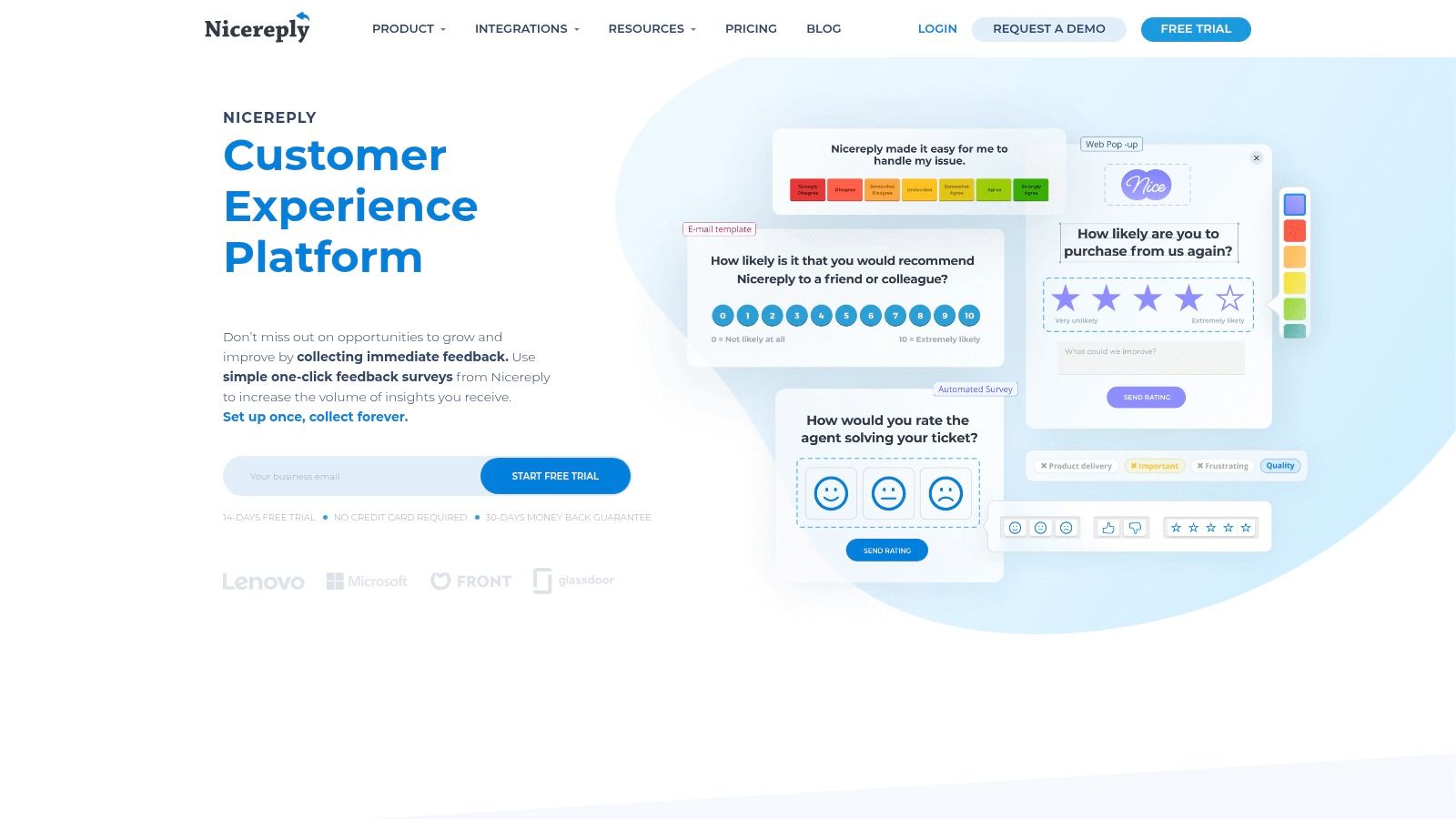
Nicereply is one of the most focused customer satisfaction measurement tools available, designed specifically to capture feedback right after a support interaction. It’s built for service teams who live inside their help desk software and need to measure performance on a ticket-by-ticket basis. This means you can automatically send a CSAT, CES, or NPS survey the moment a customer's issue is resolved.
Simple and Integrated
What makes Nicereply stand out is its seamless integration and simplicity. Unlike larger platforms that can feel overwhelming, Nicereply’s strength is its direct focus on the post-support experience, making it incredibly easy to set up and manage. It excels at measuring agent performance and overall service quality.
Key Features and Considerations
- Best For: Service-based businesses of any size that want a straightforward, effective tool to measure satisfaction after support interactions.
- Unique Strength: Its deep integration with help desk platforms is a key differentiator. It allows you to trigger surveys based on specific ticket actions, and all feedback is tied directly back to the agent and conversation, making performance tracking simple.
- Pricing: Offers predictable, response-based subscription plans. Note that the pricing pages were last updated in 2023, so it's wise to verify current rates at checkout.
- Pros: Very easy to set up and use, focuses entirely on support team workflows, and includes all integrations in every plan.
- Cons: Less comprehensive than enterprise platforms for tracking the entire customer journey, and there are no publicly listed custom enterprise options.
Nicereply is the ideal choice for teams that need a dedicated, no-fuss solution to monitor and improve the quality of their customer service interactions.
Website: https://www.nicereply.com/
10. Hotjar (Ask: Surveys & Feedback)
Hotjar is one of the most powerful customer satisfaction measurement tools for understanding the why behind your website's performance. It goes beyond simple feedback collection by combining on-page survey widgets with visual behavior analytics like heatmaps and session recordings. This means you can ask for feedback and simultaneously watch recordings of users who struggled to see exactly what went wrong.

Connecting Feedback to Behavior
What makes Hotjar stand out is its ability to connect direct feedback (the "what") with observable user behavior (the "why"). If you see a drop in satisfaction scores related to your "Get a Quote" page, you can filter session recordings to see where users are rage-clicking in frustration. This contextual insight is invaluable for improving the digital customer journey.
Key Features and Considerations
- Best For: Any service business focused on optimizing its website or app experience, from law firms to restaurants with online ordering.
- Unique Strength: The seamless integration of qualitative feedback (surveys) with quantitative behavioral data (heatmaps, recordings). This provides a complete picture of the user experience that feedback alone cannot capture.
- Pricing: Offers a free-forever plan with limited responses. Paid plans scale based on the number of sessions/responses needed, starting at around $32/month.
- Pros: Extremely easy to install and deploy surveys. Provides powerful visual context to understand customer satisfaction scores.
- Cons: Primarily focused on the digital experience, so it's not a comprehensive tool for measuring satisfaction across offline touchpoints like phone calls or in-person visits.
Hotjar is a must-have for any business that relies on its website to attract and serve customers, providing the visual evidence needed to make meaningful improvements.
Website: https://www.hotjar.com/
11. Typeform
Typeform redefines the survey experience, making it feel more like a conversation than a questionnaire. For businesses like a modern dental practice or a boutique auto shop, this conversational approach is perfect for gathering customer feedback without making it feel like a chore. It excels at creating visually appealing, mobile-friendly surveys that are genuinely enjoyable for customers to complete.

Engagement-Focused Design
What makes Typeform one of the standout customer satisfaction measurement tools is its focus on a slick, one-question-at-a-time interface. This design keeps users engaged and less overwhelmed, leading to more thoughtful answers. Its "Logic Jumps" feature creates dynamic survey paths that adapt based on a customer’s previous answers.
Key Features and Considerations
- Best For: Small to medium-sized businesses, marketing teams, and anyone prioritizing a beautiful user experience to maximize engagement.
- Unique Strength: The highly polished, conversational user interface is its signature feature, proven to increase completion rates. Its "Logic Jumps" allow for sophisticated, personalized survey paths that feel interactive and responsive to the user.
- Pricing: Offers a free plan with limitations. Paid plans start at around $25/month, with tiers based on response limits and advanced features.
- Pros: Exceptional design quality and user experience, transparent tiered pricing, and extensive integration options with tools like Slack, Mailchimp, and HubSpot.
- Cons: Response caps on lower-tier plans can be restrictive for businesses with high volume, and advanced analytics are reserved for more expensive plans.
Typeform is an excellent choice for businesses that want their feedback forms to reflect the quality and care of their brand.
Website: https://www.typeform.com/
12. HappyOrNot
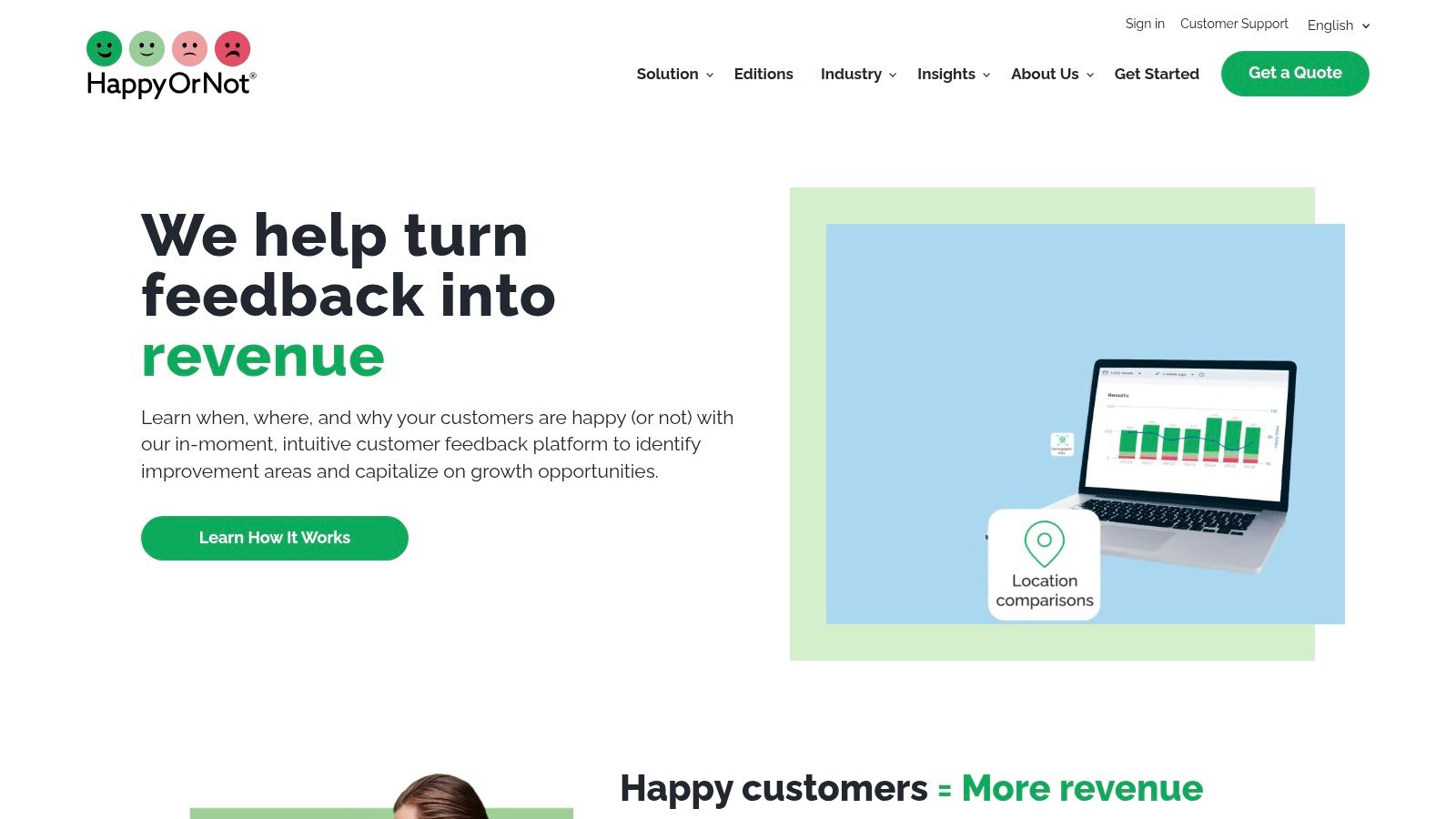
HappyOrNot takes customer satisfaction measurement into the physical world with its iconic smiley-faced feedback terminals. This tool is purpose-built for service businesses with high foot traffic, like a busy dental clinic waiting room or an auto repair shop’s service counter. It captures in-the-moment sentiment with a single tap, making it one of the most frictionless feedback methods available.
Capturing In-the-Moment Feedback
The genius of HappyOrNot lies in its simplicity, which drives incredibly high response rates compared to email or QR code surveys. Instead of asking for a customer’s time later, you get an instant gut reaction at the point of service. Its terminals provide a continuous stream of real-time data that helps you track performance hourly and make immediate operational adjustments.
Key Features and Considerations
- Best For: Physical service locations like healthcare clinics, auto shops, restaurants, and retail stores that want high-volume, real-time feedback.
- Unique Strength: Its hardware-based approach makes feedback collection effortless for customers, resulting in high engagement and a constant pulse on satisfaction. The terminals are instantly recognizable and easy for anyone to use.
- Pricing: Quote-based, as it involves hardware procurement and a subscription for the analytics platform.
- Pros: Extremely high response rates, simple for customers, and provides real-time data on location-specific satisfaction.
- Cons: Focuses primarily on a single CSAT metric, requires hardware deployment, and pricing can be a significant investment compared to software-only tools.
HappyOrNot is one of the most effective customer satisfaction measurement tools for understanding the on-site experience, turning a fleeting moment into actionable data.
Website: https://www.happy-or-not.com/
Customer Satisfaction Tools Feature Comparison
| Product | Core Features | User Experience | Value Proposition | Target Audience | Price Points / Notes |
|---|---|---|---|---|---|
| Review Overhaul — Reputation Management That Actually Works | Review monitoring, AI sentiment analysis, automated responses, GMB & voice search optimization | Clear, jargon-free monthly reports, tailored service | Trust-focused, transparency, guaranteed rating improvement | Small & local businesses (hotels, healthcare, legal, auto) | Free audit, customized pricing |
| Qualtrics XM (CustomerXM) | CSAT, NPS, CES measurement, advanced analytics, integrations | Role-based dashboards, alerts, automation | Enterprise-grade, scalable, deep insights | Large/global enterprises | Quote-based, premium pricing |
| Medallia Experience Cloud | Omnichannel feedback, AI-powered analytics, case management | AI insights with broad channel coverage | Predictable cost, unlimited users | Complex multi-touchpoint enterprises | Sales-led pricing, resource-intensive setup |
| SurveyMonkey | CSAT, NPS, CES templates, logic, reporting, integrations | Fast launch, extensive support & documentation | Flexible plans for individuals to enterprises | Individuals, teams, enterprises | Free tier + multiple paid tiers |
| GetFeedback (by SurveyMonkey) | Multi-channel surveys, real-time alerts, Salesforce app | Mobile-optimized, Salesforce integration | Quick implementation, loop-closing workflows | Salesforce users, mid-market teams | Sales-led pricing, tied to SurveyMonkey ecosystem |
| Delighted by Qualtrics | CSAT, NPS, CES & other survey types, multi-channel delivery | Easy setup, transparent pricing | Lightweight tool, upgrade path to enterprise | SMB and mid-market product teams | Transparent pricing, usage limits |
| Zendesk (Support/Suite with built-in CSAT) | Built-in CSAT surveys post-ticket resolution, APIs, automation | Native CSAT integration within support workflows | Mature ecosystem, no extra CSAT tools needed | Support teams, customer service | Varies by plan; add-ons increase cost |
| HubSpot Service Hub | Built-in CSAT, NPS, CES surveys, CRM integration, automation | Unified data & feedback tied to CRM | Scalable from free to enterprise plans | Teams using HubSpot CRM | Seat-based pricing, onboarding fees |
| Nicereply | Email, triggered & popup surveys, advanced reporting | Simple setup for support teams | Predictable pricing, smooth integrations | Support & service teams | Subscription plans, pricing check recommended |
| Hotjar (Ask: Surveys & Feedback) | On-site CSAT widgets, heatmaps, session recordings | Behavioral insights with fast digital deployment | Context-rich user feedback for UX/product teams | Product & UX teams | Tiered response limits, unlimited storage |
| Typeform | CSAT, NPS surveys, logic, branding, 300+ integrations | Modern, mobile-friendly, user-friendly design | Polished surveys driving higher completions | Marketing, product, SMB teams | Tiered pricing, response caps on lower plans |
| HappyOrNot | Physical smiley terminals, touch kiosks, real-time analytics | Extremely easy, low-friction CSAT collection | High-volume physical location feedback | Retail, airports, healthcare venues | Quote-based pricing, requires hardware |
Turn Your Reputation Into Your Best Asset
We've covered a wide array of customer satisfaction measurement tools, from enterprise giants to nimble survey specialists. Each has its strengths, but the most important takeaway is that technology is only one piece of the puzzle. The right tool for your business depends on your specific goals, team, and budget.
From Measurement to Mastery
Feeling overwhelmed by the options? That's normal. Let’s simplify it:
- Just Starting Out? Tools like Delighted or Nicereply are perfect for getting started without a steep learning curve.
- Need Deeper Insights? Platforms like SurveyMonkey or GetFeedback offer more advanced reporting to understand the why behind your scores.
- Want an All-in-One Solution? HubSpot Service Hub or Zendesk integrate feedback directly into your daily customer service workflow.
Your Path to Success
Remember, a tool can collect data, but it can't show empathy to an unhappy customer. You, the business owner, are the hero of this story. Success comes from pairing the right technology with a simple, repeatable plan: audit, monitor, and manage. This is how you stop reacting to bad reviews and start proactively building a reputation that becomes your most powerful marketing asset.
Imagine the peace of mind that comes from knowing you have a system to handle any feedback, turning potential problems into opportunities. Don't let another bad review define your business. Your hard-earned reputation is too valuable to leave to chance.
You've seen the tools, but a clear plan and an expert guide make all the difference. At Review Overhaul, we've helped hundreds of small business owners just like you stop losing customers to bad reviews. Schedule your free, no-obligation reputation audit today and see exactly how our simple 3-step process can bring you the growth and peace of mind you deserve.
