
Customer reviews are critical for local business success in 2026. They influence buying decisions, build trust, and improve search rankings. Ethical review practices are essential to avoid penalties and maintain credibility.
Key Points:
- 96% of US consumers read reviews before choosing a local business.
- Honest, non-selective review requests boost visibility and conversions.
- Unethical tactics like fake reviews, incentives, or review gating can lead to penalties, account suspensions, and loss of trust.
- Responding to reviews – both positive and negative – improves customer relationships and increases engagement.
Ethical Review Tips:
- Ask all customers for feedback without offering incentives.
- Provide direct links or QR codes to make leaving reviews simple.
- Train staff to request reviews during "peak satisfaction" moments.
- Respond promptly to reviews, addressing concerns professionally.
Avoid shortcuts. Ethical review generation builds trust, improves rankings, and drives long-term growth.
What Are Ethical Review Practices?
Ethical review practices involve gathering honest feedback from all customers without offering incentives or excluding negative feedback. Both Google and Yelp have clear guidelines outlining acceptable methods and what is considered unethical.
Google permits neutral, non-selective review requests as long as no incentives are involved. On the other hand, Yelp discourages direct solicitation and instead encourages businesses to naturally inspire reviews. Both platforms strictly ban fake reviews, whether from employees or others connected to the business. They also discourage using in-store devices that might lead to multiple reviews originating from the same IP address. Google’s policy is explicit: "Content that has been posted due to an incentive offered by a business – such as payment, discounts, free goods and/or services – is not allowed and will be removed".
One unethical practice to avoid is review gating. This involves pre-screening customers and only encouraging satisfied ones to post public reviews while redirecting unhappy customers to private feedback forms. Google mandates that businesses ask all customers for feedback, regardless of their perceived satisfaction. Adhering to these guidelines is critical to avoid risks.
Risks of Unethical Review Generation
Ignoring ethical review practices can lead to serious consequences. Businesses that violate these rules face penalties like having their reviews removed, lower rankings, or even suspension of their Google Business Profile from Search and Maps. Between 2025 and 2026, Google took enforcement actions that resulted in thousands of profile warnings or suspensions for incentivized or selective review solicitation.
Beyond platform penalties, unethical practices damage trust. 83% of consumers say they would avoid a business if they discovered it used fake or compensated reviews. Platforms may also display public warnings on profiles caught manipulating reviews, tarnishing a brand’s reputation permanently. Additionally, the Federal Trade Commission (FTC) can impose fines for deceptive marketing practices, adding legal risks to the mix.
Platforms now rely on AI tools to detect suspicious behavior, such as sudden spikes in review activity, repeated use of the same IP address, or similar wording across multiple reviews. Even if fake reviews initially go unnoticed, they are often flagged and removed later, leaving businesses worse off than before.
Benefits of Ethical Review Generation
Choosing ethical review practices leads to tangible benefits. Businesses that focus on genuine feedback often experience better local search rankings, increased click-to-call rates (20–60% higher), and stronger customer relationships. For example, collecting 5–15 authentic reviews each month can boost a business by 2–10 positions in competitive local search results.
Genuine reviews also foster trust. Customers are more likely to believe ratings in the 4.7–4.9 range than a perfect 5.0, as mixed feedback feels more realistic. Additionally, when businesses actively respond to both positive and negative reviews, 70% of customers are more inclined to leave their own feedback.
Josh Campbell, owner of Rescue Air Heating and Cooling, captures the essence of ethical review generation: "Don’t try to get 5-star reviews – go be five stars, and then the 5-star reviews happen". By delivering excellent service, businesses naturally inspire authentic reviews, creating a cycle of trust and growth.
sbb-itb-50c3429
How to Generate Reviews Ethically
The best way to encourage customer reviews comes down to three key elements: an optimized profile, a simple process, and a well-prepared team. These steps help you gather reviews ethically while maintaining trust and transparency.
1. Optimize Your Google Business Profile
Start by claiming, verifying, and optimizing your Google Business Profile. Use the "Get more reviews" short URL, which provides a direct link to your review form, making it easier for customers to leave feedback.
Take it a step further by creating QR codes from this link. Place these QR codes on receipts, business cards, menus, or table tents at checkout counters. These physical prompts make it convenient for customers to scan and leave a review right from their smartphone.
Also, ensure your profile information is accurate and complete. Missing or outdated details can erode customer confidence and reduce the chances of them leaving a review. Once your profile is polished with Google Business Profile management, focus on simplifying how customers can share their feedback.
2. Make It Easy for Customers to Leave Reviews
The easier the process, the more likely customers will follow through. Embed your review link into digital invoices, receipts, or thank-you emails after a service. Provide clear, one-click instructions so customers instantly know where to go – no searching required.
Timing plays a big role too. Send automated follow-ups 1–2 days after a service, and if necessary, a reminder 5–7 days later. For eCommerce, wait 7–10 days after delivery to allow customers time to use the product. Personalizing these requests – like addressing the customer by name or mentioning the specific service they received – can make them more effective.
3. Train Your Team to Ask for Reviews at the Right Time
Your staff can play a crucial role in gathering reviews by recognizing "peak satisfaction" moments – those times when customers express happiness or gratitude.
"The best time to ask for a review in person is when a customer offers up praise, such as commenting on the quality of the food after a meal at your restaurant" – Local Falcon
Equip your team with neutral, respectful scripts like, "If you have a moment, we’d love to hear about your experience on Google". Avoid asking for specific ratings, like 5 stars, as this crosses ethical boundaries.
Additionally, train staff to handle negative feedback on the spot. Addressing issues in person shows customers you care and can prevent those complaints from turning into public reviews. Timing is everything – don’t ask for reviews while customers are paying or during checkout, as it may come across as insincere or transactional.
How to Respond to Reviews
Once you’ve gathered reviews ethically, the next step is to engage with them thoughtfully. Responding to reviews isn’t just polite – it’s a key way to build trust with both current and potential customers. In fact, every response you write shapes how future customers see your brand. Did you know that 84% of consumers trust online reviews as much as personal recommendations? Plus, businesses that respond to reviews are seen as 1.7 times more trustworthy.
Engaging with reviews does more than build trust – it can also drive sales. Research shows that consumers spend 50% more with businesses that respond to reviews, and 89% of people are more likely to choose a business that actively engages with feedback. On top of that, search engines favor businesses that consistently respond to reviews, boosting your visibility in local search results.
Responding to Positive Reviews
Sometimes, a simple "thank you" can make all the difference. Forty percent of customers who leave positive reviews expect acknowledgment, and when they see businesses actively responding, 70% are more likely to write a review themselves. To make a strong impression, aim to respond within 24–48 hours to show you’re paying attention.
Here’s a quick approach to craft your reply: start with gratitude, reference something specific from their review, and invite them to return. For instance, if a customer mentions how friendly your staff was, thank them and give a shout-out to that team member by name. You might also suggest another product or service they’d enjoy.
"When the celebrity reaches back out to you to say, ‘Hey, that meant a lot,’ that encourages you to keep responding, to keep writing, and that what you do matters." – Reggie M., Yelp reviewer
Of course, not all reviews are glowing, and addressing negative feedback is just as important.
Responding to Negative Reviews
Negative reviews need a quick and thoughtful response – ideally within 12–24 hours – to show that you take concerns seriously. Sixty-four percent of customers who leave critical reviews expect a reply, and 62% are willing to give your business another chance if their issues are resolved promptly. Even better, 86% of people are more likely to overlook negative reviews when they see a business actively working to address concerns.
Here’s a simple framework to handle negative feedback: Read with empathy, Reflect on the issue, and Respond professionally. If your business made a mistake, own up to it. If there’s a misunderstanding, politely clarify without sounding defensive. Keep your reply short and to the point, and avoid long-winded explanations. If the issue requires more discussion, invite the customer to connect offline.
"If there is a negative review, it’s a good teaching moment. No matter what it is, even if we didn’t do anything wrong, it’s still a good teaching moment." – Dennis Akers, owner of The Candle Pour
Ethical vs. Unethical Review Practices
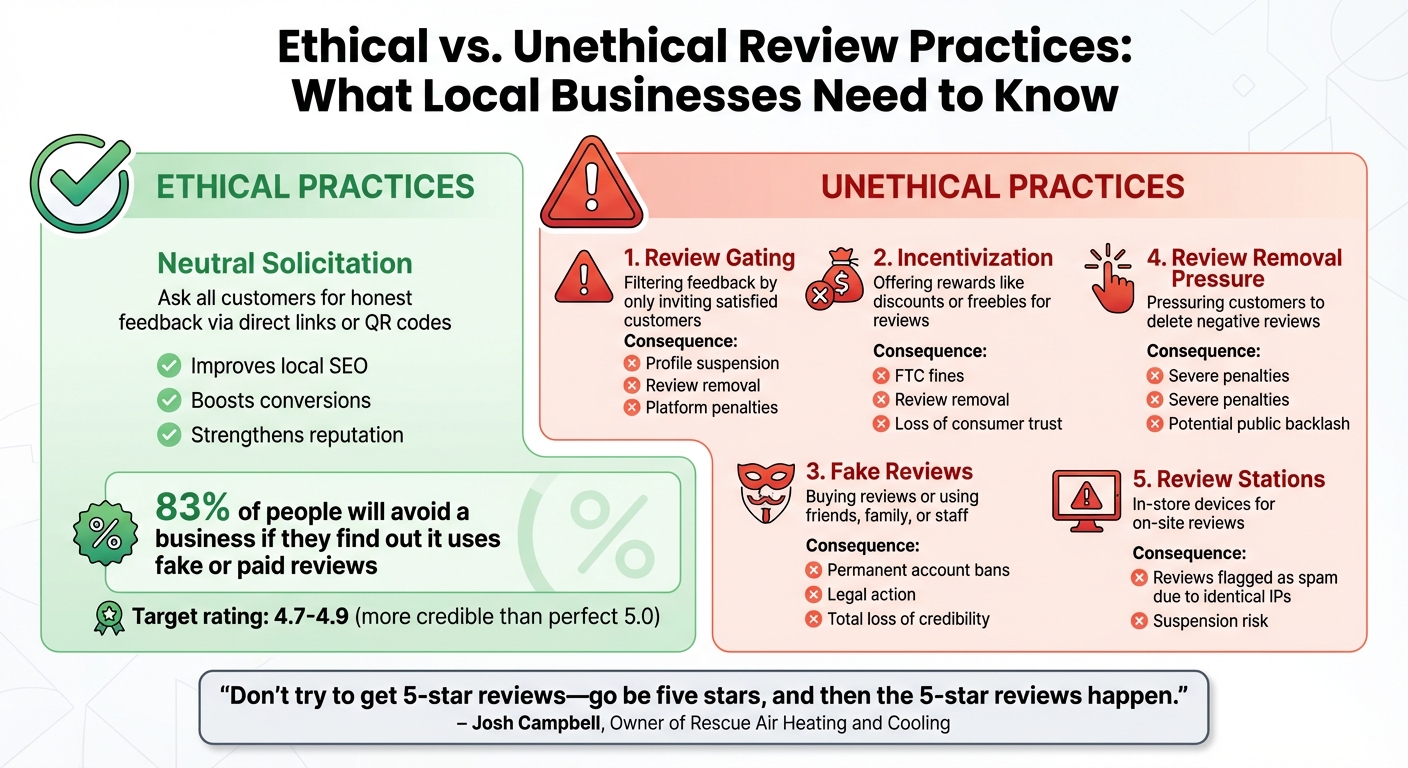
Ethical vs Unethical Review Practices for Local Businesses
Understanding the difference between ethical and unethical review practices is essential for optimizing your Google Business Profile, maintaining your reputation, and avoiding penalties. Ethical practices revolve around honest, transparent, and unbiased methods, while unethical tactics often involve manipulation, selective requests, or incentivized feedback.
Here’s a critical statistic: 83% of people will avoid a business if they find out it uses fake or paid reviews. Platforms have become stricter with enforcement, and violations can lead to severe consequences like review removal, account suspension, or even permanent bans.
Josh Campbell, the Owner of Rescue Air Heating and Cooling, offers a straightforward approach:
"Don’t try to get 5-star reviews – go be five stars, and then the 5-star reviews happen."
The goal isn’t to achieve a flawless 5.0 rating, which can seem suspicious to many. Instead, aim for authentic feedback that builds trust. Businesses with ratings between 4.7 and 4.9 are often viewed as more credible.
Here’s a quick breakdown of ethical versus unethical practices and their consequences:
Comparison Table
| Practice | Description | Consequences |
|---|---|---|
| Neutral Solicitation | Asking all customers for honest feedback via direct links or QR codes. | Improves local SEO, boosts conversions, and strengthens reputation. |
| Review Gating | Filtering feedback by only inviting satisfied customers to leave reviews. | Can result in profile suspension, review removal, or platform penalties. |
| Incentivization | Offering rewards like discounts or freebies in exchange for reviews. | May lead to FTC fines, review removal, and loss of consumer trust. |
| Fake Reviews | Buying reviews or using friends, family, or staff to post fake feedback. | Risks permanent account bans, legal action, and total loss of credibility. |
| Review Removal Pressure | Pressuring customers to delete negative reviews. | Triggers severe penalties and potential public backlash. |
| Review Stations | Setting up in-store devices for customers to leave reviews on-site. | Reviews may be flagged as spam due to identical IPs, risking suspension. |
Review Overhaul for Ethical Review Management
If you’re looking to strengthen your ethical review practices, a tool like Review Overhaul can be a game-changer for service-based businesses. This platform is designed to gather genuine customer feedback while adhering strictly to Google’s guidelines, which prohibit offering rewards or incentives for reviews. By focusing on authenticity, it helps businesses build trust without compromising ethical standards.
One of Review Overhaul’s standout features is its advanced Google Business Profile optimization, which ensures your online presence is both consolidated and accurate. This includes maintaining up-to-date business information across various online directories. The platform caters to industries such as healthcare, legal, hospitality, and auto repair, tailoring its services to meet specific needs.
Additionally, Review Overhaul doesn’t just stop at generating reviews. It offers professional response services to help you handle both positive and negative feedback effectively. The platform also incorporates voice search optimization, making your business more accessible in voice-activated search results. With continuous monitoring tools, you can stay on top of your online reputation, ensuring you’re always in control.
Features
At the heart of Review Overhaul’s offerings is its commitment to ethical review management. The platform ensures all feedback is based on genuine customer experiences by avoiding tactics like incentivized reviews or review gating. It also integrates Google Business Profile management and local listing updates to keep your business information consistent across platforms.
The tailored solutions are particularly beneficial for specific industries:
- Healthcare: Helps providers build patient trust and confidence.
- Hospitality: Enhances guest trust and promotes positive experiences.
- Legal Services: Establishes credibility and professionalism for legal professionals.
By combining these features, Review Overhaul not only supports ethical review practices but also safeguards your business’s reputation in the long run.
Pricing
Review Overhaul offers a transparent pricing structure with options suitable for businesses of all sizes. Here’s a breakdown of the three available plans:
- Basic Plan – $299/month: Covers essential reputation management services like review generation, basic monitoring, and response tools.
- Professional Plan – $399/month: Adds features such as Google Business Profile optimization and updates to local listings, making it ideal for single-location businesses.
- Premium Plan – $499/month: Offers full-service reputation management, including crisis response capabilities and voice search optimization.
These tiered plans ensure flexibility, allowing businesses to choose a package that aligns with their specific needs and goals.
Conclusion
Building a strong review profile isn’t about gaming the system – it’s about creating a reliable foundation that supports long-term growth. By sticking to ethical practices like asking for honest feedback, responding quickly to reviews, and avoiding incentives, you not only protect your business from penalties but also build genuine social proof. This approach earns the trust of both customers and AI-driven search engines that rely on reviews for recommendations.
Businesses that maintain consistent and recent reviews often experience noticeable boosts in local search rankings and higher conversion rates. With stricter enforcement of policies against unethical tactics like review gating in 2026, the risks of cutting corners have never been higher.
"Ethical, consistent review collection is the closest thing to a cheat code for local pack rankings and conversion rates in 2026." – Zava Build
The strategies outlined in this guide – like optimizing your Google Business Profile and training your team on the best timing for review requests – are designed to create lasting results. For example, a business with 50 new reviews from the past month often outperforms one with 500 outdated reviews from years ago. By committing to ethical practices, you can build momentum that keeps growing.
If you’re ready to take your efforts to the next level, Review Overhaul provides automation and monitoring tools to help you collect reviews ethically and efficiently. Starting at $299/month, their platform ensures a steady stream of genuine feedback while keeping you compliant with platform and federal regulations.
FAQs
What’s the safest way to ask every customer for a Google review?
The best time to ask for a review is right after a customer has interacted with your business – while their experience is still fresh in their mind. Keep your request polite and straightforward. Share a direct link to your Google Business Profile to make it easy for them to leave feedback. Make sure to emphasize that you genuinely value honest opinions.
It’s crucial to avoid offering any kind of incentives or only reaching out to happy customers. Doing so could violate Google’s policies and might even hurt your credibility. Stick to ethical practices to build trust and maintain compliance.
Are any “thank-you” discounts or freebies for reviews allowed?
Offering discounts or freebies in exchange for reviews is generally frowned upon and often outright prohibited. This approach falls under "incentivized review solicitation", which goes against most platform rules and can be seen as an attempt to manipulate engagement. Stick to ethical ways of asking for reviews to stay within guidelines and preserve credibility.
How should I respond to a bad review without hurting my ranking?
When responding to a negative review, it’s essential to keep your tone professional and show genuine concern for the customer’s experience. A well-crafted reply can demonstrate your commitment to resolving issues without risking your reputation or ranking.
Key Suggestions:
- Respond quickly: Aim to reply within 24-48 hours to show attentiveness.
- Apologize sincerely: Acknowledge the issue and express regret for the customer’s experience.
- Offer solutions: Suggest steps to address the problem or invite the customer to discuss the matter offline.
- Maintain a positive tone: Stay calm and polite, even if the review feels unfair.
- Protect privacy: Avoid sharing personal details or engaging in public arguments, as this can backfire and may breach platform rules.
By handling criticism with care and professionalism, you can turn a negative review into an opportunity to showcase your dedication to customer satisfaction.
