
Are you tired of seeing competitors pop up on Google Maps while your business remains hidden? It’s a frustrating feeling for any small business owner, watching potential customers call the competition simply because they showed up first. You know you offer a better service, but your phone isn't ringing.
This isn't just bad luck; it’s a visibility problem that’s costing you customers and revenue every single day. When 86% of consumers use Google Maps to find local businesses, being invisible means you’re handing your best customers directly to your rivals. You're working hard, but your online reputation isn't pulling its weight.
The Real Cost of Being Buried Online
The problem is that every customer who can't find you is a sale you've lost forever. You're already juggling operations, finances, and keeping your current customers happy. You don’t have time to become an SEO expert and decode Google's algorithm. Meanwhile, the gap between you and the top-ranked businesses just keeps getting wider.
The good news is, there's a straightforward plan to fix this. At Review Overhaul, we act as your trusted guide, providing a simple 3-step process to transform your online presence. We help you, the hero, reclaim your rightful place at the top of the local search results.
A Simple Plan to Win More Customers
Imagine a future where your business is the first one customers see on Google Maps. Picture your phone ringing with qualified leads and your calendar filling up with new appointments. This isn't a fantasy; it's what happens when you follow a proven plan.
Our 3-step process is designed for busy business owners like you:
- Step 1: Perfect Your Profile: We'll optimize every inch of your Google Business Profile to make you the most relevant choice for local searches.
- Step 2: Build Your Review Engine: We'll implement a system to generate a steady stream of five-star reviews, building powerful social proof.
- Step 3: Amplify Your Authority: We'll establish your business as a local leader across the web, locking in your top ranking.
This simple plan puts you back in control, turning your online reputation into a machine that drives real, measurable growth and gives you peace of mind.
"Our Google ranking and calls skyrocketed after working with Review Overhaul. They delivered exactly what they promised." – Satisfied Client Testimonial
Stop letting bad reviews or poor visibility cost you another customer. It's time to take control of your online reputation.
Your Blueprint For Dominating The Local Pack
Getting to the top of Google Maps isn't about gaming the system or hoping you stumble upon some secret trick. It's about following a proven path that systematically turns your Google Business Profile into a magnet for new customers.
Think of this as your roadmap. For a busy business owner, having a clear plan makes all the difference. Instead of getting bogged down by a million different "SEO tasks," you can pour your energy into a simple, focused process that actually gets results.
The Three Pillars Of Google Maps Success
The whole game really comes down to mastering three key areas. When you nail these, you're sending all the right signals to Google—that your business is relevant, trustworthy, and a genuine authority in your local area.
This is what separates the businesses that hope to be found from the ones that ensure they are.
Here’s the breakdown:
- Perfect Your Profile: We'll dive deep and optimize every single piece of your Google Business Profile. The goal is to make your business the most highly relevant answer for what people are searching for nearby.
- Build Your Review Engine: Next, we'll put a system in place to consistently bring in positive customer reviews. This builds the kind of unshakable trust and social proof that both Google and potential customers absolutely love.
- Amplify Your Authority: Finally, we'll strengthen your digital footprint across the web by building consistent local signals. This is how you establish your business as a legitimate local authority, locking in that top spot.
This simple flow—from optimization and reviews to building lasting authority—is the key to dominating Google Maps.
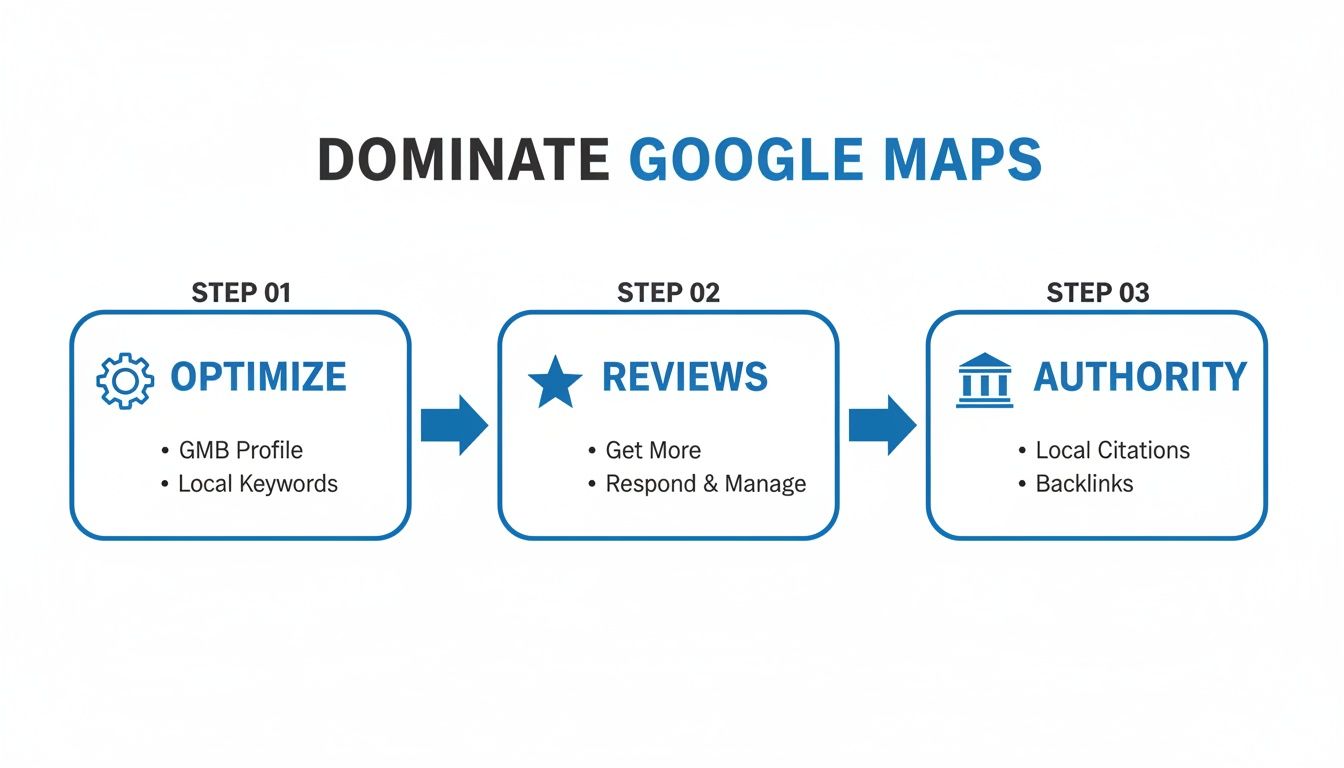
Each of these pillars supports the others, creating a powerful momentum that pushes you higher and higher in the Local Pack search results.
Google Maps Ranking Pillars At a Glance
Google uses three core pillars to determine your rank. This table breaks down what they are and the key actions you can take for each.
| Ranking Pillar | What It Means For Google | Your Action Plan |
|---|---|---|
| Relevance | Is this business a good match for the user's search query? | Complete every section of your GBP, use correct categories, and add keyword-rich descriptions and services. |
| Prominence | How well-known and respected is this business in the local area? | Generate consistent positive reviews, build high-quality local citations, and get backlinks from other local websites. |
| Proximity | How close is the business to the person searching? | While you can't change your address, you can ensure your service areas are correctly listed and create location-specific content. |
Focusing on these three areas ensures you're aligning your efforts directly with Google's ranking factors.
Taking Action And Seeing Results
This blueprint isn't just theory; it's an actionable strategy. You'll stop guessing what to do next and start climbing the rankings, bringing in more of your ideal customers. It’s the core of any successful local SEO plan.
The goal isn’t just to rank higher; it's to create a durable online reputation that drives sales and gives you peace of mind, knowing your business is growing stronger every day.
Sometimes, a business is invisible on Maps for a simple reason: Google doesn't even know its website exists. If you're starting from scratch, learning how to index your website on Google is the first, most crucial step. Our plan ensures your entire online presence is built on a solid foundation, starting with your profile and expanding out from there.
Mastering Your Google Business Profile

Your Google Business Profile (GBP) is the absolute cornerstone of any local SEO effort. Think of it as your digital storefront. If that storefront is messy, has the wrong hours listed, or is just plain incomplete, potential customers are going to walk right by and straight to your competitor.
For any small business owner serious about figuring out how to rank on Google Maps, getting this profile right isn't just a good idea—it's everything. A half-baked or inaccurate profile tells Google your business might not be active or trustworthy, which is a surefire way to get buried in the search results. This is where we lay the foundation for all the ranking success to come.
Choosing Your Business Categories
One of the very first things you'll do is pick your business categories, and it's a step that trips up a lot of people. Your primary category needs to be a laser-focused description of your main service. Be specific! If you're a plumber who handles late-night emergencies, "Emergency Plumber" is way more effective than just "Plumber."
Once you've nailed the primary category, flesh out your profile with relevant secondary categories. This is how you cast a wider net. For instance, a law firm might use "Personal Injury Attorney" as its main category, then add secondary ones like:
- Car Accident Attorney
- Slip and Fall Lawyer
- Wrongful Death Attorney
This level of detail tells Google exactly what problems you solve, which helps it match you with the right customers when they need you most.
Crafting A Compelling Business Description
Next up, your business description. This isn't just a spot to dump a list of services. It's your elevator pitch—your chance to connect with potential customers and explain what makes you different.
You'll want to naturally work in the keywords your customers are actually searching for. A roofer in Austin, for example, should include phrases like "roof repair in Austin," "local roofing contractor," and "hail damage specialists." This helps real people and Google's algorithm understand your value right away.
A well-crafted business description does double duty. It answers a potential customer’s immediate questions while simultaneously feeding Google’s algorithm the keywords it needs to rank you for relevant local searches.
The Power Of Visuals: Photos And Videos
Here's a stat that should get your attention: businesses with photos get 42% more requests for directions and 35% more website clicks than businesses without them. Visuals aren't just a "nice-to-have" anymore; they're critical. You want to give people a real feel for your business before they even think about calling or stopping by.
Make it a habit to upload high-quality, geotagged photos and videos. Show off your storefront, your team in action, finished projects, and happy customers. This constant activity signals to Google that you're a legitimate, active business that deserves a better ranking.
Leveraging Every GBP Feature
A complete profile is a trusted profile. Google gives you a ton of tools to engage with customers, and frankly, most business owners ignore them. That's your advantage.
- Google Posts: Think of these as mini-ads. Share updates, promotions, and news directly on your profile. They expire, so consistent posting shows Google you're open and active.
- Products & Services: Don't just list them—describe them. Explain what each service includes and add pricing if it makes sense. Every detail adds more relevant keywords to your profile.
- Q&A Section: Don't wait for people to ask questions. Add the most common ones yourself and provide clear, helpful answers. This lets you control the conversation from the start.
To really get this right, it's helpful to understand the essential business listing elements that build authority everywhere online, not just on Google.
Ensuring Flawless NAP Consistency
Finally, we land on what might be the single most crucial piece of the local SEO puzzle: NAP consistency. That stands for Name, Address, and Phone number. This info has to be exactly the same everywhere—on your GBP, your website, and every single online directory.
Even a tiny difference like "St." vs. "Street" or "Co." vs. "Company" can create confusion for search engines and hurt the trust you're trying to build. You need absolute, pixel-perfect consistency. Our team specializes in comprehensive GMB management services to hunt down and fix these errors, giving our clients a huge edge. Get this foundation right, and you're setting yourself up for long-term success on Google Maps.
Building An Unstoppable Review Engine

If your Google Business Profile is the foundation of your local presence, then customer reviews are the steel frame holding it all together. It can be deflating to see a competitor with hundreds of glowing reviews, especially when you know your service is just as good, if not better. Their online reputation is screaming "trust us," while yours is barely a whisper.
This isn't just about ego; it's about revenue. A steady flow of positive feedback is one of the most powerful signals you can send to Google's algorithm. It proves your business is active, valued by the local community, and a safe bet for new customers. Without that social proof, you’re just another pin on the map, easily overlooked.
The good news? You don't need a huge marketing team to build a powerful review engine. All it takes is a simple, repeatable plan. Let’s walk through how to turn your happy customers into your most effective advocates, creating a cycle of positive feedback that fuels your growth on Google Maps.
The Art Of Asking For Reviews
The biggest hurdle for most business owners is the sheer awkwardness of asking for a review. It can feel pushy or desperate. But if you reframe it as asking for feedback to help you improve, it becomes a natural part of your customer service process.
The real key is to make it ridiculously easy for them. A customer who has to search for your profile and figure out where to click is a customer who probably won't leave a review. You have to remove every ounce of friction.
Here are a few proven, non-awkward methods:
- Email Requests: Send a follow-up email a day or two after the service. Keep it short, thank them for their business, and include a direct link to your Google review page.
- SMS Blasts: Text messages have an incredibly high open rate. A quick text saying, "Thanks for choosing us! Would you mind sharing your feedback on Google?" with a direct link is highly effective.
- In-Person with QR Codes: For any brick-and-mortar business, a small sign at the checkout counter or on an invoice with a QR code is a total game-changer. It takes them right to your review page.
This isn't about begging for five stars. It’s about systematically creating opportunities for your satisfied customers to share their great experiences.
Why Responding To Every Review Matters
Getting reviews is only half the battle. Responding to them—all of them—is where you truly stand out. When a potential customer sees you actively engaging with feedback, it tells them you care about your clients and stand behind your work.
Responding to positive reviews is easy enough. A simple, personalized "Thank you" shows you're paying attention. But responding to negative reviews is what really separates the pros from the amateurs. A calm, professional reply that acknowledges the issue and offers a solution can often turn a negative experience into a positive one.
Never ignore a negative review. A thoughtful public response shows everyone that you take customer satisfaction seriously. It demonstrates accountability and can often win back the trust of the unhappy customer and impress onlookers.
This consistent engagement is a powerful ranking signal for Google. It shows your profile is actively managed, which boosts its prominence and helps you climb higher on Google Maps.
Freshness Over Volume: A Surprising Truth
Many business owners think the goal is to get the most reviews possible, period. While a high number is great, Google's algorithm places a massive emphasis on recency and frequency. A business with 500 reviews from three years ago might get outranked by a competitor with 100 reviews, if 20 of those came in the last month.
Fresh reviews prove your business is currently active and consistently delivering quality service. A groundbreaking study of over 8,000 businesses showed that top-10 rankers averaged significantly more reviews, with Local Pack leaders boasting 80+ compared to the pack's 47 average. More importantly, businesses getting steady new feedback—say, 5-10 fresh reviews per month—consistently edged out stagnant profiles with hundreds of older ones.
Here’s a practical look at what this means:
- For a restaurant: A stream of recent reviews shows that the food and service are great right now, not just two years ago.
- For a law firm: Consistent positive feedback reinforces ongoing success and expertise in current legal matters.
- For a home services contractor: Fresh reviews from recent projects prove you're still in business and actively satisfying local homeowners.
Building this unstoppable review engine is the key to turning your business from an unknown entity into a trusted local authority. Our expert approach to review management can provide the structure and guidance you need to succeed.
Amplifying Your Authority Across The Web
Ranking high on Google Maps isn’t just about tweaking your Google Business Profile. Google acts like a detective, scouring the whole internet for clues that prove your business is a legitimate, respected player in your local community. It wants to see other reputable websites vouching for you.
This is where a lot of business owners get stuck. They’ve perfected their profile and have a steady stream of reviews, but they still can't crack the top spots. The missing piece is often off-site authority—proving to Google you’re a local leader, not just another pin on the map.
Think of it as building a web of trust signals that all point back to your business, cementing your spot at the top of local search.
Building Consistent Local Citations
The first move here is building local citations. A citation is just a mention of your business's name, address, and phone number (NAP) on another website. Every consistent citation is another vote of confidence in Google's eyes.
But here’s the catch: consistency is everything. A tiny difference like "Suite 100" on one site and "#100" on another can muddy the waters and weaken these signals. You have to be meticulous about accuracy everywhere.
This all starts with identifying the most important online directories and getting your information listed perfectly. It’s a foundational step for anyone serious about figuring out how to rank on Google Maps.
Identifying Your Core Directories
Not all directories are created equal. Sure, the big platforms matter, but niche-specific and local directories can often pack a bigger punch. The goal is to show up where your customers—and Google—expect to find you.
We recommend focusing on a strategic mix:
- Major Data Aggregators: These are the heavy hitters that feed information to hundreds of smaller sites and apps. Getting your NAP right with them is priority one.
- General Directories: Think household names like Yelp, Apple Maps, and Bing Places. You absolutely have to have a strong presence here.
- Industry-Specific Sites: For a dentist, this might be Healthgrades; for a contractor, it could be Angi. These niche citations signal to Google that you’re a specialist.
- Local Community Sites: Getting listed on your local Chamber of Commerce website or a neighborhood blog sends powerful signals about your local roots.
A massive 46% of all Google searches now have local intent. Research shows the top three spots in the Local Pack—the prime real estate on Google Maps—get almost all the clicks and foot traffic. Businesses ranked 1-3 see up to 10 times more sales than those stuck at #4 or below.
The Power Of Local Link Building
Beyond directories, getting mentions from other local websites—what we call local link building—is a seriously effective way to boost your authority. When a popular local food blogger raves about your restaurant or a community news site features your business, that link acts as a powerful endorsement.
This isn't a numbers game. You don't need hundreds of links. What you need are a few high-quality, relevant ones. A law firm could sponsor a local charity run and get a link from the event page. A plumber could get featured in a "best of" list on a local publication's website. These are the kinds of signals that actually move the needle.
A single link from a well-respected local source is often worth more than dozens of listings in generic, low-quality directories. It tells Google your business is a trusted pillar of the community.
Staying Ahead With Voice Search
While you’re building up this online authority, don't forget how people are searching. More and more, they're just asking Siri or Alexa to find businesses "near me." A rock-solid citation profile with consistent NAP data is absolutely critical for this. Our guide on voice search optimization can help you make sure your business gets found, no matter how people are looking.
By systematically building citations and earning local links, you create a powerful web of authority that Google simply can't ignore. This isn’t a one-and-done task; it’s about establishing your business as a credible, lasting local leader.
What Does Winning on Google Maps Actually Look Like?
Imagine your phone starts ringing, and it's not just random calls. It's qualified customers, right in your neighborhood, ready to do business. Picture new faces walking through your door for the first time, guided straight to you by Google Maps. That’s what it feels like when you finally crack the code of how to rank on Google Maps.
This is about way more than just seeing your name pop up first in a search. It’s about building a reliable, predictable stream of new business that you can count on.
From Ghost to Go-To
When you put a solid plan into action, you stop being an online ghost and become a local landmark. You won't just see your business climb into that coveted Local Pack; you'll see a real, measurable jump in calls, bookings, and revenue. All that hard work you've put into your reputation will finally get the spotlight it deserves, pulling in the exact kind of customers you want.
So, what does that success look like in the real world?
- A packed calendar full of appointments from people who found you on the map.
- A busy storefront with foot traffic that just wasn't there before.
- The peace of mind that comes from knowing your marketing is working around the clock.
This isn't just about growth. It's about getting back the time and energy you’ve spent worrying about where the next customer is going to come from.
The real win is swapping that constant frustration of being invisible for the confidence of being the top choice in your area. You become the expert that Google trusts and actually recommends to people.
The Real Cost of Doing Nothing
On the flip side, ignoring your Google Maps presence has a steep price. Every single day you're buried on the second or third page of the search results, you're handing customers over to your more visible competitors. That nagging feeling of being left behind only gets worse as you watch them get stronger.
The stakes couldn't be clearer. You can keep losing business to the competition just down the street, or you can follow a proven playbook that leads to real growth and a stronger reputation. The choice is yours: risk being invisible, or take control and put your business on the map.
Common Questions About Google Maps Ranking
As a business owner, you’ve probably got a few nagging questions about what it really takes to climb the Google Maps rankings. It’s easy to get lost in all the advice out there, so let’s cut through the noise and clear up a few things.
You’re not alone if you feel like you’re doing everything right but still aren’t seeing the results you want. A lot of business owners hit this wall, wondering why their hard work isn’t turning into more calls and customers. The good news? The answers are often simpler than you think.
How Long Does It Take to See Results?
This is the big one, and the only honest answer is: it depends.
If your Google Business Profile is a total mess and you have zero reviews, you could see a real jump in just a few weeks. Simply cleaning things up and getting a handful of fresh, positive reviews can build momentum fast.
But if you're in a super competitive market—think a downtown restaurant or a law firm in a major city—climbing into that top-three "map pack" can take several months of consistent, focused effort. The key is to aim for steady progress, not a magic bullet.
The goal isn’t an overnight victory; it’s about building a durable online presence. Think of it as building a strong foundation brick by brick—it takes time, but the result is something that lasts.
Do I Need a Physical Storefront to Rank?
This is a huge worry for service-area businesses like plumbers, electricians, or consultants who visit clients or work from home. The short answer is no, you do not need a physical storefront that customers can walk into.
Google has a specific setup for this called a "service-area business" profile. Here's how it works:
- When you set up your profile, you'll enter your address for verification, but you can choose to hide it from the public.
- You then define your service areas by listing the specific cities, zip codes, or even neighborhoods you cover.
Doing this tells Google exactly where you operate, letting you show up for those "near me" searches in all the right places, even without a public address.
What Are the Most Critical Ranking Factors?
If you have limited time and have to focus on what moves the needle most, what should you do? While Google’s algorithm is complex, it really boils down to three core pillars that matter most for anyone wondering how to rank on Google maps.
- Relevance: How well does your profile match what someone is searching for? This is all about choosing the right business categories and using the right keywords in your services and description.
- Prominence: How well-known is your business? This is hugely influenced by your review count, your overall star rating, and how consistently your business name, address, and phone number appear across the web.
- Proximity: How close are you to the person searching? You can't change your address, but you can make sure you’ve properly defined your service area so you show up for every relevant local search.
Mastering these three areas is the most direct path to the top of Google Maps.
Feeling overwhelmed by bad reviews or a lack of visibility? The team at Review Overhaul can help you take control of your online reputation and turn it into your most powerful marketing asset. Stop losing customers to your competitors.
