
Are you tired of seeing competitors pop up everywhere online while your business remains hidden? You've poured everything into your service, but the phone isn't ringing and foot traffic is slow. It feels like you're shouting into the void, invisible to the very customers searching for you.
This isn't a problem with your business; it's a problem with your online visibility. Inconsistent and incorrect information scattered across the web is costing you customers and revenue. Every wrong phone number or old address creates confusion, telling search engines like Google that you can't be trusted.
The Simple Plan to Get Found
Fortunately, there's a straightforward plan to fix this. We'll guide you through a simple, 3-step process to overhaul your online presence, ensuring customers can find you easily and trust your information. This is local citation building done right.
Imagine your phone ringing with new, local customers who found you with a quick search. Picture your business showing up prominently on Google Maps, driving real foot traffic through your door. This isn't just a fantasy; it's what happens when you build a powerful, consistent online reputation that puts you ahead of the competition.
Our Clients Get Real Results
"Before, it felt like we were screaming into a void. Now, our online presence is professional and consistent, and we've seen a noticeable increase in local leads. It’s a game-changer." – Local Service Business Owner
This isn't just about cleaning up data; it's about building a foundation for growth and peace of mind. Will you continue to lose customers to competitors with a better online game, or will you take control and become the go-to choice in your area?
Don't let bad data sabotage your success. Let us show you exactly where the problems are and how to fix them.
Schedule Your Free Reputation Audit
Why Your Business Is Invisible to Local Customers
You've put your heart and soul into your business. The service is top-notch, your location is great, but the phone is quiet and foot traffic is slower than a crawl. Meanwhile, you see competitors all over the local search results and can't help but wonder, "What am I doing wrong?"
Here's the frustrating truth: the problem probably isn't your business. It's an invisible wall of mistrust between you and the search engines. Tiny, seemingly harmless mistakes in your online business info are creating a mess that makes you nearly invisible to the people actively looking for what you offer.
The High Cost of Digital Confusion
Every time someone nearby searches for a service you provide, Google and other engines do a lightning-fast background check. They scour hundreds of online sources—from Apple Maps and Yelp to niche industry directories—trying to confirm your details. When they find conflicting information, their confidence in your business plummets.
Maybe one directory lists you as "Main St." while another says "Main Street." A third might have an old phone number from two years ago. To you, they're minor typos. To an algorithm, they're massive red flags suggesting you might be unreliable or, even worse, out of business.
This digital doubt hits your bottom line, hard. When search engines can't confidently vouch for your information, they won't risk showing you in the top results. They'll show your competitor instead, effectively hiding you from your most valuable customers.
The Impact of Inconsistent vs. Consistent Citations
See how small listing errors can damage customer trust and search rankings, while consistency drives tangible business results.
| Business Impact Area | With Inconsistent Citations (The Problem) | With Consistent Citations (The Success) |
|---|---|---|
| Local Search Ranking | Your business gets pushed down in search results or doesn't appear at all. | You climb higher in local search results and map packs, increasing visibility. |
| Customer Experience | Customers get frustrated with wrong numbers, old addresses, or incorrect hours. | Customers easily find you, call you, and get accurate directions every time. |
| Brand Trust | Inconsistencies make your business look unprofessional and untrustworthy. | A clean, consistent online presence builds credibility and confidence. |
| Lead Generation | You miss out on calls and website clicks from ready-to-buy local customers. | Your phone rings more often and website traffic from local search increases. |
A small typo on one site might not seem like a big deal, but when dozens of small errors add up, they paint a picture of a business that isn't paying attention. Getting this right is how you turn things around.
How Consistency Builds a Bridge to Customers
This is where local citation building comes in. By making sure your Name, Address, and Phone number (NAP) are identical everywhere, you send a powerful, unified signal to search engines.
This consistency acts as a massive vote of confidence. It confirms that your business is legitimate, operational, and located exactly where you say it is. That trust pays off in very real ways:
- Better Local Search Rankings: Consistent citations are a fundamental ranking factor in local SEO.
- Happier Customers: Accurate info means no one gets lost trying to find you or calls a disconnected number.
- More Online Visibility: You'll start showing up in more places—maps, apps, directories, and even voice searches.
It's not just theory. A 2023 survey found that 32% of people use the internet multiple times a week to look up local businesses. On top of that, businesses with complete and consistent listings can see up to 25% more visibility in local search. That’s a huge slice of the pie you could be missing.
Your Plan to Reclaim Visibility
You are the hero of your business's story, and you absolutely have the power to fix this. This guide is your roadmap to taking back control of your online presence. You don't need to be a tech genius; you just need a smart, step-by-step approach to local citation building.
We’ll walk you through how to audit where you stand today, clean up the damaging inconsistencies, and build a strong foundation of accurate citations that work for you. This is a crucial first step in a much larger strategy for dominating your local market, which you can learn more about in our complete guide on local SEO. By the time you're done, you'll know exactly how to turn those online searchers into real, paying customers.
Establishing Your Authoritative NAP
Let's talk about the absolute bedrock of local SEO: your business's Name, Address, and Phone number. This is what we call your NAP, and you should think of it as your business's unique digital fingerprint.
If that fingerprint is even slightly smudged or inconsistent across the web, it creates confusion. That confusion makes search engines like Google hesitant to show your business to potential customers. It’s that simple. Getting your NAP right isn't just a technicality; it's the foundation of trust online.
Why Every Little Detail Matters
You might not think it’s a big deal, but tiny differences can quietly tank your local rankings. I’ve seen it happen time and time again. One directory lists a client on "Main Street," while their own website says "Main St." A third-party app pulls in an old tracking number from a campaign they ran years ago.
Each one of these variations creates a new, slightly different version of your business online. This digital mess forces search engines to guess which information is the real deal, and when they have to guess, they usually just move on to your competitor who has their act together.
The consistency and accuracy of NAP information across citations is the foundational principle of local SEO success, with even minor discrepancies creating measurable negative impacts. For example, listing a business as 'Smith & Associates, PLLC' in one directory while using 'Smith and Associates' in another can confuse search engines and directly reduce search rankings. You can explore more about how NAP affects rankings and read the full research on citation principles.
Creating Your Single Source of Truth
The only way to fix this is to define one, and only one, official version of your NAP. This becomes your master blueprint for every single online mention, from here on out. No exceptions.
A great starting point is to pull up your official business registration documents or a recent utility bill. What does the government or the power company think your official name and address are? Start there. Your Google Business Profile is also a cornerstone for this, so if you haven't nailed that down, now's the time to learn more about getting started with Google My Business. It often acts as the primary source for many other directories.
Here’s what you need to lock down:
- Business Name: Is it "Joe's Pizza LLC" or just "Joe's Pizza"? Pick one and never, ever deviate.
- Address: Decide on your abbreviations and stick to them. Is it "Street" or "St."? "Suite" or "Ste."? Consistency is key.
- Phone Number: Always use your main, local business line. Avoid using call-tracking numbers or toll-free numbers here, as they can muddy the waters.
Once you’ve made these decisions, write them down. Create a simple document that becomes your go-to guide. This is the first real step toward building a powerful, authoritative online presence that both customers and search engines can find and trust.
A Smart Plan for Building Citations That Actually Work
Alright, so you’ve nailed down your official NAP. Think of that as the master key to your business's online presence. But a key is pretty useless if you don't know which doors to open. This is where a smart citation-building strategy comes in, and it's what separates the businesses that customers find from those that get lost in the noise.
So many business owners fall into the trap of thinking "more is better." They spend countless hours and a good chunk of change trying to get listed on every obscure directory they stumble upon. But the goal isn't to be everywhere; it's to be in all the right places, and in the right order.
This is the basic game plan I recommend to everyone before they even think about building new listings. You have to get your house in order first.
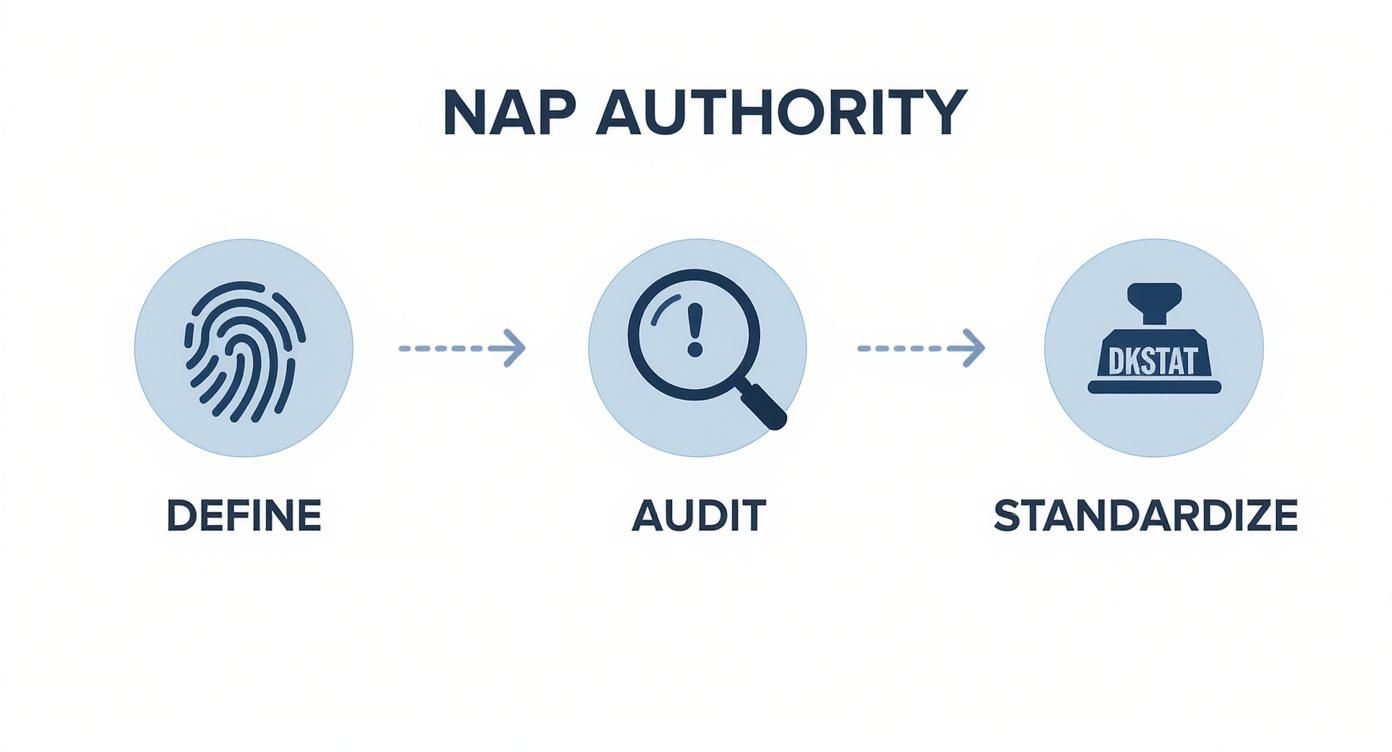
As you can see, it's all about defining your NAP, cleaning up the mess that's already out there, and then standardizing everything. Only then are you ready to build.
First, Nail the Heavy Hitters
Your first move is always to claim and perfect your listings on the big-name platforms. These are the ones customers and search engines already trust, so getting them right gives you the biggest bang for your buck, fast.
Start with this essential list:
- Google Business Profile: This is your most critical digital asset for local search, period. It's not just another listing.
- Apple Maps: An absolute must for the millions of iPhone users who use it for directions every single day.
- Bing Places: Don't forget Microsoft's search engine. It still has a huge user base, and you need to be there.
- Facebook: For many customers, this is the first place they check for business hours, photos, and what others are saying.
- Yelp: A true powerhouse, especially for restaurants, contractors, and other home service businesses.
Getting these platforms locked down is like setting up shop on the busiest streets in town. You do that before you even think about the smaller side streets.
Next, Go After Industry-Specific Directories
Once that foundation is solid, it's time to zero in on the niche directories where your ideal customers are actively looking for your specific services. These listings send incredibly strong relevance signals to Google, proving you're a serious player in your field.
For example, a restaurant absolutely has to be on TripAdvisor and OpenTable. A law firm that isn’t listed on sites like Avvo and Justia is leaving money on the table.
Think about it: these industry-specific sites aren't just lists of businesses. They're trusted hubs for that community. Being on them tells both potential customers and search engines that you're an authority in what you do.
Finding them is easier than you think. Just search for things like "[your industry] directories" or "[your city] [your industry] business listings." The sites that pop up on the first page are the ones Google already sees as important. Make sure you're on them.
Finally, Tap Into Hyper-Local Opportunities
The last piece of the puzzle is to plug into your local community's online ecosystem. These are the hyper-local citations that most businesses overlook, but they carry a ton of weight because they scream "local" to search engines.
This is where you show you're truly part of the neighborhood fabric. Look for opportunities like:
- Your Local Chamber of Commerce: Membership almost always includes a listing in their directory.
- Local News Sites and Blogs: Sponsoring a local kids' sports team or getting a mention in a local blog can earn you a powerful citation.
- Community Forums: Being recommended in a neighborhood Facebook group is pure gold.
- Supplier or Partner Websites: Do you sell a particular brand's products? Ask if they have a "where to buy" page you can be listed on.
These local mentions create a web of trust around your business that's incredibly hard for your competitors to copy. I know, managing all of this can sound like a full-time job. That's why using a dedicated list management service can be a game-changer. It automates the tedious work of keeping your info accurate everywhere.
This three-tiered approach to local citation building ensures your efforts are focused and efficient, turning casual online searches into real, paying customers.
How to Optimize Listings That Win Customers

Getting your business name, address, and phone number consistent across the web is step one. It gets you on the map. But the real magic—the part that actually gets customers to pick up the phone or walk through your door—happens when you truly optimize those listings.
Think of it this way: consistent NAP is the address on your storefront. It tells people where to find you. But optimization is your window display, your welcoming sign, and the helpful staff inside. It’s what convinces them to come in.
Go Beyond the Basics with Rich Content
A bare-bones listing is a huge missed opportunity. Customers are actively looking for reasons to choose you over the shop down the street, and a detail-rich profile gives them exactly what they need. You're painting a full picture of the experience you offer.
Kick things off by loading your profiles with high-quality, professional photos and videos. Show off your inviting space, your team in action, and your best-selling products or finished work. The data doesn't lie: listings with photos get a whopping 42% more requests for driving directions and 35% more clicks to their websites.
Your online business listing isn't just a directory entry; it's your primary sales pitch to a local audience. Every empty field is a chance you're not taking to persuade a potential customer that you are the best choice.
Write a Business Description That Sells
That business description box is prime real estate, so don't treat it like an afterthought. This is your chance to tell your story and connect with your ideal customer on a human level. What makes you different? What’s your unique value?
Instead of just listing what you do, focus on the problems you solve for your customers. For example, a generic auto shop might write, "We are a full-service auto repair shop." A smarter approach would be, "Tired of surprise repair bills? Our ASE-certified technicians provide transparent, upfront pricing to get you back on the road with confidence." See the difference? One is a statement, the other is a solution.
The Overlooked Power of Business Categories
Choosing the right business categories is one of the most powerful—and most frequently botched—parts of optimizing a listing. Your primary category tells search engines what your business is. The secondary categories tell them all the specific things your business does. Nailing this is crucial for showing up when it counts.
A dentist’s primary category is obviously "Dentist." But the secondary categories like "Cosmetic Dentist," "Pediatric Dentist," and "Emergency Dental Service" are what help them rank for those specific, high-intent searches. Don't be lazy here; be as specific and thorough as you can.
Engage Actively with Your Audience
Your business profile isn't a static page from a phone book. It's a living, breathing channel for communication. Features like Google Posts and the Q&A section are goldmines for talking directly to potential customers before they even click to your website.
Here's how to put them to work:
- Google Posts: Think of these as free mini-ads. Share a special offer, announce a new service, or shine a spotlight on a great review. They show up right in your profile and grab attention.
- Q&A Section: Get ahead of the game by populating this with answers to common questions. If you don't, someone else might, and their answer could be completely wrong. Answering questions shows you're attentive and helpful.
By actively managing and enriching your listings this way, you turn them from simple map pins into powerful customer-generating machines. You stop being just another option and start becoming the obvious choice.
Protecting Your Online Reputation Long Term
Getting your citations built and cleaned up is a huge first step, but it’s definitely not a "one-and-done" task. Think of it more like maintaining a garden. You’ve done the hard work of planting everything, but now you have to keep an eye out for weeds.
For a business owner, the thought of constantly policing your online presence sounds exhausting. Luckily, you don’t have to do it all by hand. With the right tools and a simple routine, you can protect your hard work and ensure it keeps paying off for years to come.
Let Automation Keep Watch for You
There's no way you have time to manually check dozens of websites every month for random changes or errors. That would be a nightmare. This is exactly where modern monitoring platforms become your best friend, acting as a 24/7 security guard for your business information.
They’ll automatically scan your most important listings and alert you if anything changes—like an old address suddenly reappearing or a data aggregator pushing incorrect store hours. This lets you jump on the problem right away, fix it, and maintain the consistency that search engines (and customers) trust.
The Pesky Duplicate Listing Problem
One of the most common headaches you'll run into are duplicate listings. They pop up without you even realizing it. Maybe a former employee created a page years ago, or a data aggregator hiccuped and spawned a second profile for your business.
Whatever the cause, these duplicates are poison for your local SEO. They split your authority, confuse Google, and can even scatter your hard-earned customer reviews across multiple pages.
Here’s a simple game plan for stamping them out:
- Find the Clones: Use a monitoring tool or just do some manual searching on Google and Yelp. Try slight variations of your name and address ("Main St" vs. "Main Street") to uncover hidden duplicates.
- Save the Good Stuff: Before you ask for a deletion, see if the duplicate has any unique photos or good reviews. If so, try to move that content over to your main, correct listing first.
- Request the Merge or Removal: Every platform has its own process for this. You'll typically have to prove you're the owner and point them to the primary listing you want to keep. It's a bit of a process, but absolutely worth it.
Are Your Efforts Actually Working? Track Your Rankings
So, how do you know if all this local citation building is making a difference? The proof is in your local search rankings. When you see your business climbing the results for your most important keywords, you know you're on the right track.
This is the kind of dashboard view that makes it easy to see where you stand. It gives you a bird's-eye view of your citation health.
A tool like this instantly shows you where the errors are, so you can fix the issues that might be dragging down your visibility.
You don't need to get obsessed with checking your rankings every day. But a monthly check-in on key search terms (like "roofer in phoenix" or "best coffee near me") will give you a clear picture of your progress. It helps you connect the dots between cleaning up your citations and seeing a real-world lift in your online presence.
Ultimately, your online presence is a mix of accurate data and what your customers are saying about you. To truly protect your image, it's smart to combine your citation work with these practical online reputation management tips.
It's also why integrating your citation strategy with a proactive plan for customer feedback is so important. You can learn more about our dedicated review management strategies to see how these two pieces fit together to build a powerful engine for growth.
Common Questions About Local Citation Building
Even with a solid plan in hand, it's completely normal to have a few lingering questions about building local citations. It’s a crucial piece of your online presence, so let's walk through some of the most common things people ask. Getting these cleared up will help you move forward with confidence.
Probably the biggest question on everyone's mind is, "How long does this actually take?" The honest answer? It depends. Think in terms of weeks and months, not days. You might see some small, initial bumps pretty quickly after a major cleanup as search engines start to re-crawl your corrected listings.
But the real, noticeable impact on your local search rankings—the kind that moves the needle—usually starts to show up after about three to six months of consistent work. This gives the big data aggregators enough time to process and distribute your accurate info, and for Google’s algorithm to start trusting the new signals you're sending out.
Do I Really Need to Be on Every Single Directory?
Absolutely not. In fact, please don't try. The name of the game with local citations is quality and relevance, not just raw numbers. Chasing down listings on hundreds of random, low-quality directories is a massive waste of time and, in some cases, can even do more harm than good.
A much smarter strategy is to take a tiered approach. Your first priority is always the major data aggregators and the big players like Google Business Profile, Apple Maps, and Bing. Once those are locked in, you can start focusing on the top-tier directories specific to your industry—the places where your customers are actually looking for you.
A single citation from a highly respected industry website is worth far more than a dozen listings on generic, spammy directories that no one has ever heard of. Quality trumps quantity every time.
How Can I Actually Measure the Impact of All This Work?
Measuring the success of your citation building involves looking beyond just your search rankings. Of course, you should be tracking where you rank for your most important local keywords, but that's just one part of the story. To see the full picture, you need to connect your efforts to real business results.
Here are the key metrics I always tell clients to watch:
- Google Business Profile Insights: Keep a close eye on the number of phone calls, website clicks, and requests for driving directions coming directly from your GBP listing. A steady upward trend here is a fantastic sign that things are working.
- Website Traffic: Jump into your Google Analytics and look for an increase in organic traffic, especially from local searches. This tells you that more people are finding your site because of your improved visibility.
- Leads and Conversions: At the end of the day, this is all about getting more business. Make sure you're tracking contact form submissions, phone calls, and online bookings to tie your citation work directly to your bottom line.
What Happens If My Business Information Changes?
This is a huge one. How you handle a change in your business info can either protect or destroy all the hard work you've put in. If you move, rebrand, or get a new phone number, you have to update your citations immediately and systematically. Waiting on this can cause your rankings to drop off a cliff.
Your first move should always be to update your own website and your Google Business Profile. These are your foundational digital assets. From there, tackle the main data aggregators and your most important directory listings. If you don't, you'll create a tidal wave of inconsistent information that erodes all the trust you've built with search engines.
Managing local citations isn't a one-and-done task; it's an ongoing effort that safeguards your online reputation and ensures a steady stream of new customers can find you. At Review Overhaul, we take this meticulous work off your hands, making sure your business is always represented accurately across the web.
Curious about how your business looks online right now? Get a free, no-obligation reputation audit to find out.
