
Are you a restaurant owner pouring your heart into incredible food, only to see empty tables on a busy night? It’s frustrating when you know your dishes are better, but the place down the street gets all the online attention and foot traffic. You feel invisible online, and it’s directly costing you customers and revenue.
This isn’t your fault. You’re a chef, not a digital marketer. The problem is that bad reviews or a weak online presence are costing you customers before they even find your door. We’re here to guide you through a simple plan to fix this.
With a stronger online reputation, you’ll see more reservations, better reviews, and a bustling dining room. Imagine turning those frustrating online searches into a reliable stream of happy customers. A recent study showed 90% of diners research online before visiting, and most choose from the top three results. If you’re not there, you’re losing business.
“Our online bookings have doubled since implementing these strategies. We’re finally getting the recognition we deserve.” – Local Pizzeria Owner
The choice is clear: continue losing customers to your competitors or gain the peace of mind that comes with a thriving, visible restaurant. Let’s get started.
Your Digital Foundation: A Perfect Google Business Profile
For a restaurant owner struggling to attract local diners, your Google Business Profile (GBP) is the digital front door. It’s often the first impression a potential customer has. A weak or incomplete profile is a huge missed opportunity, telling hungry searchers to look elsewhere.
But a fully optimized GBP becomes your single most powerful tool. It shows them exactly what makes you special, turning online searches into real-world visits. This is the cornerstone of effective local SEO for restaurants.
Mastering The Core Information
First, you must claim and verify your profile on Google. This confirms you are the owner and gives you control. It’s the most critical first step for any restaurant owner.
Next, get the fundamentals right. Your restaurant’s Name, Address, and Phone number (NAP) must be perfectly consistent everywhere online. Even a tiny discrepancy can confuse search engines and hurt your local ranking.
Your Google Business Profile is a dynamic, interactive billboard. Neglecting it is like locking your front door during business hours and expecting customers to find another way in.
Bringing Your Restaurant To Life
With the basics covered, add the details that persuade and convert. Your business description is your chance to tell your story. Don’t just list what you serve; explain what makes your restaurant different and special.
High-quality photos are essential. Profiles with great images get significantly more clicks and direction requests. Make your profile irresistible by including:
- Mouth-watering photos of your most popular dishes.
- A clear, text-based menu that’s easy to read on any device (avoid PDFs).
- Pictures of your interior and exterior so guests know what to expect.
- Behind-the-scenes shots of your team to build a human connection.
Engaging Actively With Customers
A static profile is an ineffective one. Use Google Posts to announce daily specials, promote an event, or highlight a new menu item. This signals to Google that your business is active and engaged.
Proactively manage the Q&A section. Answer common questions about parking or dietary options before customers even have to ask. This shows you’re committed to great service.
For a deeper dive, our comprehensive https://reviewoverhaul.com/google-my-business-optimization-service/ can ensure every element is perfectly tuned. As you build your presence, understanding what are SEO citations is another crucial step.
Making Your Website a Local Search Magnet
Once a diner clicks from Google, your website must close the deal. It’s more than a digital menu; it’s where your brand’s personality shines. A slow, confusing website will sink even the most polished Google profile.
This is where you, the hero of this story, turn a curious click into a confirmed reservation. Our plan will help you transform your site from a simple brochure into a customer-generating machine.
Weave Your Location Into Your Website’s DNA
The foundation of on-page local SEO for restaurants is simple: talk about where you are. People search for “sushi near Fenway Park,” not just “sushi.” Your website’s language needs to mirror that hyper-local behavior.
Put yourself in your customers’ shoes. Weave their search phrases naturally into your site’s content.
- Homepage Titles: Use titles like “Gourmet Burgers & Craft Beer in Downtown Austin” to tell Google and visitors who you are.
- “About Us” Story: Deepen your local roots by talking about your neighborhood or relationships with local farms.
- Menu Descriptions: Use phrases like, “Our signature Mission District Burrito, a local legend for over a decade.”
Pro Tip: You don’t have to be a coding wizard. Using SEO plugins like Yoast SEO on WordPress can guide you through optimizing titles and keywords, taking out the guesswork.
Your Website Must Work Beautifully on a Phone
Most customers will find you on their phones. If they have to pinch and zoom to read the menu, they’re gone. A quick exit tells Google your site isn’t user-friendly, which hurts your rankings.
A mobile-first design is essential. Your site needs to load fast and be easy to use on a small screen. Ensure your phone number is “tap-to-call” and your address opens in Google Maps.
Build Trust with a Consistent NAP
Your restaurant’s Name, Address, and Phone number (NAP) must be identical everywhere, especially on your own website. Place this information in the footer of every page. This consistent signal helps search engines verify your location and builds trust with diners.
Also, embed a Google Map on your “Contact” page. It’s a powerful trust signal for Google and removes friction for customers. If you have multiple locations, each needs its own dedicated, optimized page.
Turning Online Reviews Into Your Greatest Asset
Online reviews are the new word-of-mouth. A single negative review can feel like a personal attack, a public notice that your hard work wasn’t good enough. This isn’t just about pride; it’s about real customers choosing your competitor, a direct hit to your bottom line.
The frustration is valid. But what if you could turn this threat into your greatest marketing tool? We act as your trusted guide, showing you how to implement a simple 3-step plan to take back control of your online story.
Our plan focuses on encouraging your happy—but often silent—customers to speak up on crucial platforms like Google, Yelp, and TripAdvisor. The goal is to build an authentic chorus of support that reflects the quality you deliver. This success leads to a better reputation and more sales.
Build Trust Through Engagement
Let’s be clear: Google’s algorithms are watching. When you respond to reviews—both glowing and critical—you send a powerful signal that you are an active, attentive business owner. This simple act can directly improve your visibility.
A steady flow of recent, authentic reviews tells diners you’re a trustworthy establishment. Businesses that actively reply to feedback are viewed more favorably. This engagement builds a level of trust a silent profile can never achieve.
Have a Framework For Every Review
The key is having a proven framework for responding to every review. This turns a moment of potential conflict into a public demonstration of your professionalism. When you handle criticism with grace, you can often turn a detractor into a loyal advocate.
For a comprehensive breakdown, explore our guide on online reputation management for restaurants.
A negative review isn’t a verdict; it’s a conversation starter. How you handle it publicly says more about your restaurant’s character than a dozen five-star ratings.
Review Response Framework
| Review Type | Key Objective | Action Steps | Example Snippet |
|---|---|---|---|
| Positive | Amplify the good experience and encourage repeat business. | 1. Thank them by name. 2. Mention something specific from their review. 3. Invite them back. | “Hi Sarah, thank you so much for the kind words! We’re thrilled you enjoyed the truffle pasta. We can’t wait to see you again soon!” |
| Negative | De-escalate, show you’re listening, and take the conversation offline. | 1. Apologize for their poor experience. 2. Acknowledge their specific issue. 3. Offer a way to make it right offline. | “Hi Mark, we are so sorry to hear your steak was overcooked. That is not our standard. Please email our manager at [email] so we can learn more and make this right.” |
Proactive Strategies For Positive Feedback
You can’t be passive and wait for reviews. Many satisfied customers are happy to leave feedback but need a gentle nudge. Your job is to make it effortless for them.
Here are a few effective ways to encourage more positive reviews:
- Ask in Person: When a guest compliments their meal, say, “That’s wonderful to hear! We’d be so grateful if you shared that on Google.”
- Use Subtle Signage: A small sign or a note on the receipt with a QR code linking directly to your Google review page removes all friction.
- Email Follow-Ups: If you use a reservation system, a friendly follow-up message the next day with a direct link is a powerful tool.
By implementing these tactics, you take control of the narrative. You create a system that generates the positive social proof needed to climb the rankings and attract new diners, leading to sustainable growth and peace of mind.
Advanced Tactics to Dominate Your Local Market
Getting your Google Profile and website in order is the starting line. To be the top restaurant in your area, you need to build a competitive moat. These next steps are what separate the contenders from the champions.
This is how you, the restaurant owner, become the first choice for diners. Our plan provides the strategies to build unshakable authority and forge real community connections, locking in that top spot for good.
Build Authority with Local Citations
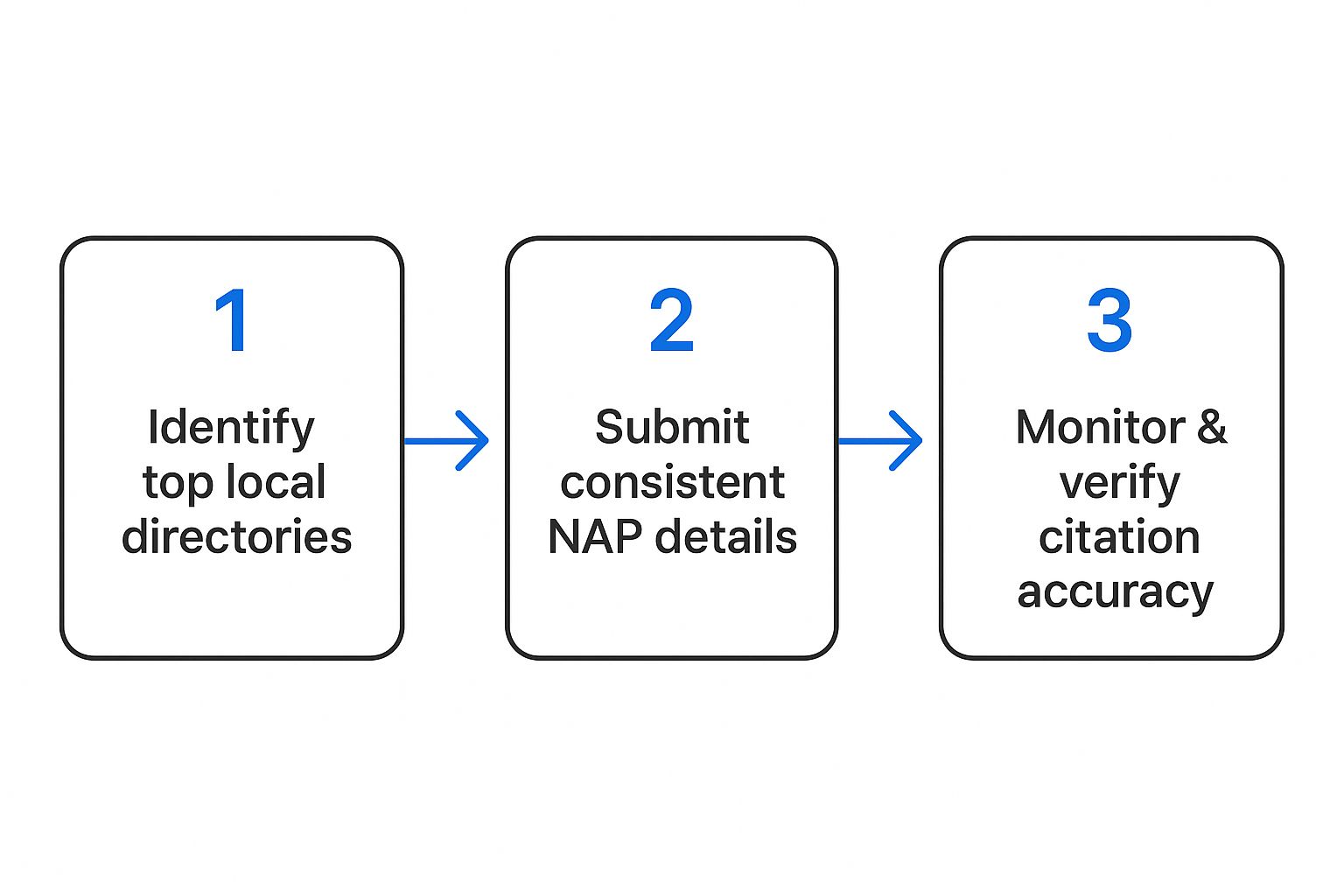
A local citation is any online mention of your restaurant’s Name, Address, and Phone number (NAP). Google uses these to verify your business information. The more consistent mentions you have, the more Google trusts your listing.
The absolute key is NAP consistency. Even a tiny error can create confusion and weaken your authority.
To start, get your restaurant listed on the platforms that matter most:
- Industry-Specific Directories: Yelp, TripAdvisor, and OpenTable.
- Major Data Aggregators: Apple Maps and Bing Places for Business.
- Hyper-Local Websites: Your local Chamber of Commerce, neighborhood blogs, or community portals.
Optimize for the Rise of Voice Search
More people are asking their phones for recommendations. “Hey Siri, find a great Italian place nearby” is replacing typed searches. Your SEO strategy must adapt to this conversational language.
Voice searches are longer and more specific. To capture this traffic, you must anticipate these questions and answer them on your website and GBP.
To win at voice search, you have to answer specific questions like, “What restaurants have gluten-free pasta in downtown?” The restaurant with the clearest answer wins that search.
Earn High-Value Local Links
Local links (or backlinks) are clickable links from other websites to yours. A link from a trusted local source is a massive vote of confidence in Google’s eyes. It’s a powerful endorsement of your restaurant’s credibility.
Earning these links is about building real-world relationships. For a deeper look, our guide on harnessing customer feedback for business growth is a great resource.
Here are proven ways to earn these valuable links:
- Partner with Food Bloggers: Invite an influential local food blogger for a meal.
- Sponsor a Local Event: Sponsoring a local team or festival almost always gets you a link from the event’s website.
- Get Featured in Local Media: Send a press release when you launch a new menu or host a special event.
Measuring What Matters: Turning Data Into Diners
All your work means little if you can’t tell whether it’s actually filling your tables. As a restaurant owner, digging into data can feel overwhelming, but flying blind is more dangerous. You must know which local SEO efforts are driving real business.
By focusing on a few essential metrics, you can stop guessing and start making informed decisions. This allows you to see a clear return on your investment as more reservations and takeout orders roll in.
Unlocking Your Google Business Profile Insights
Your most direct data source is inside your Google Business Profile. The “Performance” dashboard shows exactly how potential customers engage with your listing. It’s the best way to measure the immediate impact of your local SEO for restaurants.
Think of this dashboard as your real-time report card. It highlights the most critical actions a hungry searcher can take.
- How people found you: Did they search your name directly, or discover you with “best tacos near me”?
- Direction requests: This shows strong intent to walk through your door.
- Website clicks: The number of users who clicked to your site for your menu or story.
- Phone calls: This counts how many people tapped the “Call” button to book a table.
Tracking these numbers month-over-month provides concrete proof that your marketing is hitting the mark.
Going Deeper with Website Analytics
Tools like Google Analytics show what people do once they land on your website. A steady climb in organic traffic—visitors from search engines—is a clear sign your SEO strategy is gaining traction.
Effective local SEO for restaurants relies on tracking a full spectrum of performance indicators. It includes GBP insights, organic traffic, keyword rankings, and customer review trends. You can learn more by checking out this guide to local SEO.
Frequently Asked Questions About Restaurant SEO
If you’re new to local SEO, you probably have a few questions. That’s normal. Let’s tackle the most common ones restaurant owners ask.
How Long Does It Really Take to See Results?
This is the big one, and the honest answer is: it depends. You can often see an initial bump in visibility within a few weeks, especially after a thorough Google Business Profile optimization.
However, a comprehensive local SEO strategy is a marathon, not a sprint. To build lasting authority and see a substantial increase in traffic, plan for a 3 to 6-month timeframe.
Do I Actually Need a Website for My Restaurant?
In a word: yes. Think of your Google and social media profiles as rented properties. Your website is the one piece of digital real estate you completely own.
It’s the definitive source of truth for your brand, menu, and story. More importantly, it gives you a direct-to-consumer channel for online ordering, free from the hefty commissions of third-party apps.
For more detailed answers, you can explore our complete FAQ page.
Ready to turn searches into diners and see the success you deserve? The team at Review Overhaul is here to guide you. Schedule your free reputation audit today and let’s create a simple plan for your growth.
