
A single bad review is costing you clients. You could be the sharpest lawyer in your city, but a negative online comment or a low star rating is quietly turning potential clients away before they ever contact you. This digital first impression is undermining years of your hard work and professional integrity.
You’re a skilled professional, but potential clients aren’t judging your legal expertise. They’re making snap decisions based on what they find on Google, Avvo, and Yelp. It feels unfair because it is—your success is being dictated by anonymous online comments, not your actual ability in the courtroom.
The Guide to Taking Back Control
We provide a simple plan to help you, the hero of this story, overhaul your online reputation. Our process stops the bleeding from negative reviews and builds a powerful online presence that reflects the true quality of your firm. This isn’t about marketing fluff; it’s about showcasing your genuine excellence.
The result is peace of mind. Imagine knowing that when a high-value client searches for you, they find a pristine reputation that builds immediate trust. You’ll attract the cases you want, not just the ones that find you by chance.
Real Results for Firms Like Yours
Lawyers who implement a clear reputation plan see transformative results. One of our clients, a family law firm, saw a 35% increase in qualified leads within six months of systematically building their positive reviews. Data shows that 93% of consumers use online reviews to make decisions, and firms with higher ratings simply get more calls.
What’s at stake if you do nothing? You’ll continue to lose clients to competitors with better online ratings, even if they’re less experienced. The alternative is growth, a stronger brand, and the confidence that your digital handshake is as strong as your real one.
The Problem: Your Digital Reputation Is Your New Handshake

For a modern lawyer, the first meeting with a potential client doesn’t happen in a polished boardroom. It happens the moment they type your name into a search bar. They’re looking for social proof before they even think about picking up the phone.
You could be the sharpest litigator in your state, but your online presence might tell a different, damaging story. You risk losing control of your own narrative, as just a few negative reviews or a neglected Avvo profile can undermine years of professional achievement.
The High Stakes of Online Reviews
The reality is stark. Data shows a shocking 74% of people will walk away if they find negative information on the first page of search results. In a field where credibility is your most valuable asset, that’s a risk you cannot afford to take.
This turns proactive online reputation management for lawyers from a “nice-to-have” marketing task into a fundamental business imperative. Without it, you are letting strangers define your firm’s value.
A strong digital reputation acts as your firm’s most persistent advocate. It works 24/7 to build credibility and attract the high-value cases you want, ensuring your online persona finally matches your real-world excellence.
Understanding the Modern Client Journey
To grasp the importance of your online reputation, visualize the path a modern client takes. At each step, your digital footprint is either helping or hurting you.
| Client Action | Reputation Touchpoint | Potential Risk | ORM Opportunity |
|---|---|---|---|
| Problem Recognition | Google Search for “best [practice area] lawyer near me” | Being invisible on the first page | Optimize Google Business Profile, run targeted local SEO campaigns |
| Initial Vetting | Scans star ratings on Google, Avvo, and Yelp | A low average rating (e.g., 3.5 stars) deters clicks | Actively solicit reviews from satisfied clients to boost your average |
| Deeper Investigation | Reads recent positive and negative reviews | Unanswered negative reviews suggest a lack of care | Respond professionally to all reviews; highlight positive case studies |
| Final Consideration | Searches for the firm’s or attorney’s name directly | Negative news articles or disciplinary actions appear | Publish authoritative content (blogs, articles) to control search results |
| Contact Decision | Visits the firm’s website and social media profiles | An outdated website or inactive social media profile | Showcase client testimonials and awards prominently on your site |
Understanding these touchpoints is the first step. It allows you to move from a reactive to a proactive reputation strategy.
From Defense to Offense with a Simple Plan
Too many law firms only think about their online reputation when a crisis hits. This reactive approach is a constant, stressful firefight. A structured plan, however, shifts your firm from a defensive posture to an offensive one, allowing you to actively shape public perception.
This isn’t just about damage control; it’s about brand building. Our 3-step plan puts you back in command:
- Step 1: Systematically monitor what’s being said about you across the web using tools like Google Alerts.
- Step 2: Build a reliable process to encourage satisfied clients to share their positive experiences on key review sites.
- Step 3: Create and promote authoritative content—blog posts and case studies—that establishes your expertise.
By following this approach, you build a protective buffer of positive content that defines your firm’s brand on your terms. Our full guide on lawyer reputation management dives deeper into these strategies.
Our Plan: A 3-Step Digital Reputation Audit
Before you can improve your online reputation, you must see your firm through a potential client’s eyes. This starts with a meticulous audit of your entire digital footprint. Think of this as the discovery phase of a high-stakes case.
You’re systematically uncovering every piece of information that shapes public perception. This process finds any damaging mentions, fixes inaccurate information, and claims profiles that could be silently hurting your firm.
Step 1: Investigate Your Online Standing
Start by putting yourself in a potential client’s shoes and searching for your firm in an “incognito” browser window. This gives you a clean, unbiased look at what a new prospect actually finds.
Use a mix of broad and specific search terms:
- Your full name + “lawyer” or “attorney”
- Your law firm’s full name
- “[Your Practice Area] lawyer in [Your City]”
Document everything you find on the first two pages. This creates a clear inventory of your digital assets and liabilities, which is the foundation of your strategy.
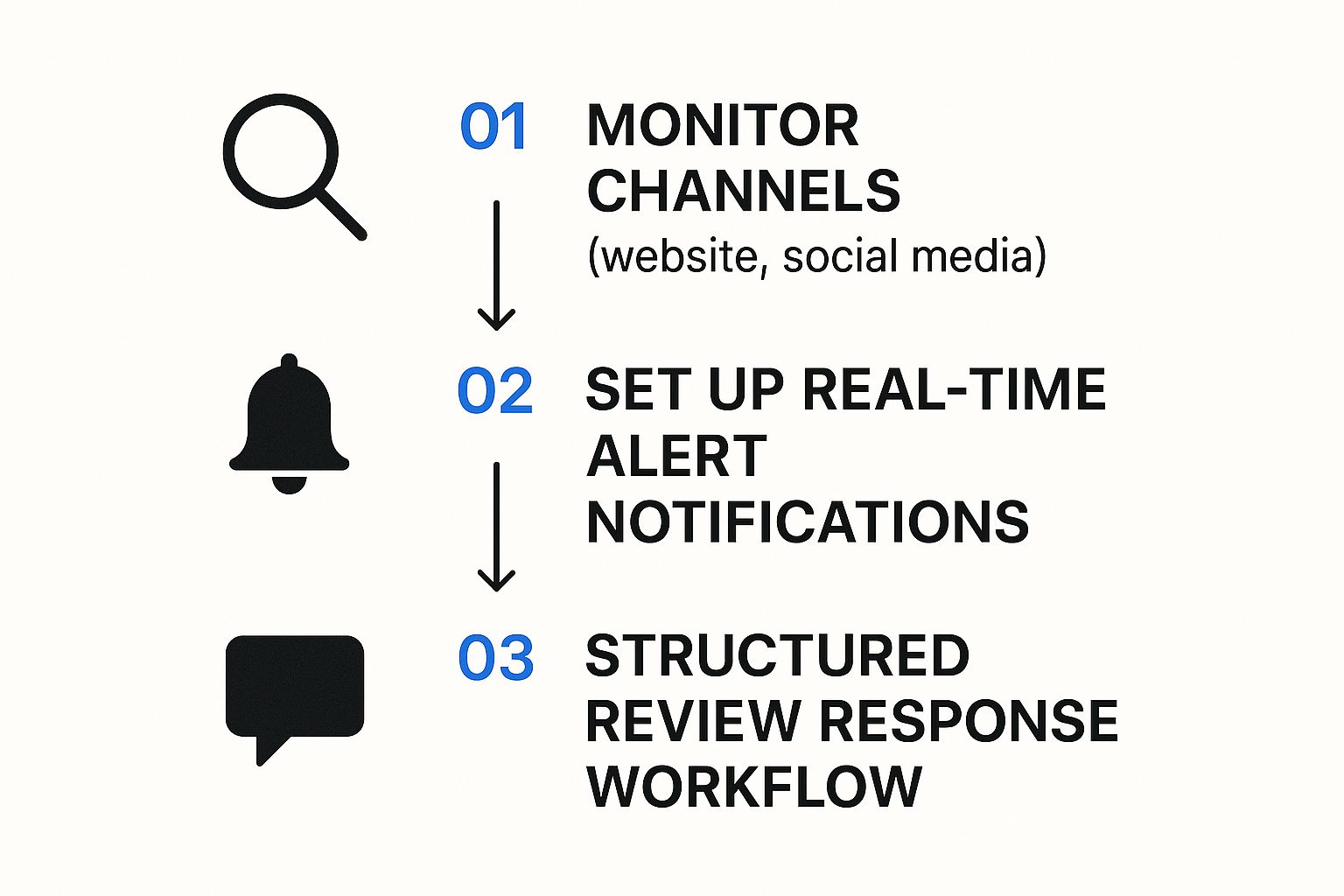
As you can see, a successful strategy doesn’t stop after the audit. It moves from monitoring to setting up alerts and having a structured plan to respond.
Step 2: Analyze Key Digital Territories
Your reputation is spread across many platforms, and each needs a unique approach. Your Google Business Profile is the most powerful touchpoint, as 87% of potential clients trust Google reviews. Ensure your profile is fully claimed, verified, and filled out.
Next, turn your attention to specialized legal directories. An incomplete Avvo profile signals neglect, while inconsistent firm details across platforms confuse clients and hurt your search rankings.
A digital audit isn’t just about finding problems. It’s about creating a clear balance sheet of your online assets and liabilities, which becomes the bedrock of your reputation strategy.
Step 3: Audit Your Owned Assets
Finally, look at the digital properties you own and control. Use a comprehensive website audit checklist to ensure your firm’s site is actively helping your image.
Your website is where you have complete control over the narrative. It should prominently feature your best client testimonials, detailed attorney bios, and recent case results. A professional, up-to-date site acts as the central hub of your digital presence.
The Plan: Generate Positive Reviews Systematically

After your audit, the next move is building a strong defense. The best strategy is to proactively generate a steady stream of positive reviews from your satisfied clients. This creates a powerful buffer that reinforces your firm’s quality and expertise.
For many attorneys, asking for a review feels awkward. But when a client is grateful for a successful outcome, they are often happy to share their experience. It all comes down to asking at the right moment and making it simple for them.
Identifying the Perfect Moment to Ask
Timing is everything. You want to make the request when the client’s positive feelings about your firm are at their absolute peak. Ask too early or wait too long, and your chances plummet.
From our experience, these are the golden opportunities:
- Immediately after a case is successfully resolved.
- When a client expresses unsolicited gratitude.
- Upon reaching a significant positive milestone in a case.
It’s just as important to know when not to ask. Avoid making the request during tense moments, like when discussing billing. For more ideas, our guide on how lawyers can protect their online reputation dives deeper into this.
Crafting an Ethical and Effective Request
Your request should be professional, polite, and completely frictionless. An email often works best, as it lets you provide a direct link that dramatically increases follow-through.
Here’s a simple, field-tested template you can adapt:
Subject: A quick favor regarding your experience
Dear [Client Name],
It was a pleasure working with you, and our team is so pleased we were able to achieve [Mention Positive Outcome].
Your feedback could be incredibly helpful for others in a similar situation. If you have a moment, would you be willing to share your experience on [Platform Name]?
Here is a direct link to make it easy: [Insert Direct Review Link]
Thank you again for your trust in our firm.
Sincerely,
[Your Name/Firm Name]
This script is short and respectful. Most importantly, it gives them a clear, immediate path to action.
Key Takeaway: An automated or systemized email sent at the conclusion of a successful case is the single most effective way to build a steady stream of positive reviews. It removes the guesswork and ensures you never miss an opportunity.
Making the Process Frictionless for Clients
The easier you make it for a client to leave a review, the more reviews you will get. Asking a client to “find us on Google” creates friction and adds steps. Instead, you need to provide a direct link.
- For Google Business Profile: Generate a direct link that opens the review submission box automatically.
- For Avvo or other directories: Copy the specific URL for the “Write a Review” button or section.
By creating a simple system, you turn review generation into a consistent part of your firm’s operations. This is how you build an authentic collection of testimonials that drives growth.
The Plan: Respond to Negative Reviews Professionally
A negative review can feel like a direct assault on your firm’s integrity. But the real test isn’t the criticism—it’s how you handle it. Your response is a golden opportunity to publicly showcase your character and commitment to client service.
Ignoring a bad review is never the answer. A calm, measured response, however, proves you’re attentive and in command. This is a core part of effective online reputation management for lawyers.
The First 48 Hours Are Critical
Your gut reaction will likely be frustration. The most important thing is to pause and resist the urge to fire back. Your objective is to de-escalate, not win a public argument.
Aim for a reply within 24 to 48 hours. This shows you’re on top of your firm’s reputation without looking impulsive. Remember, your audience isn’t just the reviewer; it’s every prospective client who reads that exchange.
The Anatomy of a Professional Response
Crafting the perfect reply is an art. You must remain professional, uphold confidentiality, and never admit fault in a public forum. Every response should follow a simple, repeatable structure.
Here is a straightforward, four-part framework:
- Acknowledge and Empathize: Start by acknowledging their frustration without admitting liability.
- Reinforce Your Standards: Briefly state your firm’s commitment to professional service.
- Move the Conversation Offline: This is crucial. Provide a specific contact to resolve the issue in private.
- Keep it Professional and Brief: Your public reply should be no more than a few sentences.
Responding to negative feedback isn’t about winning an argument. It’s about showcasing your firm’s professionalism to all future clients. A calm, constructive response can be a more powerful marketing tool than a five-star review.
Practical Response Templates You Can Adapt
Having templates ready can be a lifesaver. These serve as a strong foundation you can tailor as needed.
Template for a Vague Negative Review:
“Thank you for sharing your feedback. We are sorry to hear that your experience was not a positive one, as we strive to provide every client with excellent service. We would like to learn more about your situation. Please call our office at [Phone Number] so we can address your concerns privately.”
Template for a Specific (But Not Defamatory) Complaint:
“Thank you for bringing this to our attention. We take all client feedback seriously. To protect client confidentiality, we cannot discuss case specifics online, but we encourage you to contact us directly at [Email or Phone] to discuss the matter further.”
Mastering these interactions is a core skill. For a more detailed breakdown, see our guide on how to respond to negative reviews. For broader issues, a comprehensive social media crisis management guide can help.
Success: Becoming the Go-To Authority
Your online reputation is about more than just managing reviews. The real goal is to become the go-to authority in your practice area. This means shifting from defense to offense, proactively shaping your own narrative across the internet.

You want potential clients to find a library of credible, high-value information with your name on it. When you own the conversation, you attract better clients and build a powerful digital shield. Authoritative content naturally pushes any negative comments down in search results.
Create Content That Answers Urgent Questions
The fastest way to build authority is to create content that speaks to a potential client’s most immediate worries. What questions do you hear in every initial consultation? Those are your roadmap for creating digital assets that prove your expertise.
- In-Depth Articles and Guides: Write comprehensive articles on complex topics like “Navigating Commercial Lease Disputes in Texas.”
- Anonymized Case Studies: With client consent, walk through a case to show your process in action.
- Practical ‘How-To’ Checklists: Offer downloadable PDFs like a “5-Point Checklist for Preparing for Divorce Mediation.”
This approach positions you as a helpful guide, not just another lawyer. You build trust from the very first click.
Distribute Your Expertise Strategically
Creating great content is useless if no one sees it. You must improve website visibility so your expertise is easily found. Your firm’s website should be the central hub for all your best content.
But don’t stop there. You need to amplify that content across other platforms to reinforce your expert status.
A single, well-researched article on your blog can be the source for a dozen other pieces of content. It can become a LinkedIn post, a podcast topic, or a series of social media updates. This maximizes your effort and consistently reinforces your authority.
Authority-Building Content Channels for Lawyers
Choosing the right platform is key. This table breaks down some of the most effective options for lawyers looking to build authority online.
| Channel | Primary Goal | Best For | Effort Level |
|---|---|---|---|
| Firm Blog | Foundational Authority & SEO | Detailed legal guides, case studies, firm news | Medium to High |
| Professional Networking & B2B | Sharing articles, connecting with peers, industry insights | Low to Medium | |
| Guest Posts | Third-Party Endorsement & SEO | Articles on reputable legal or industry-specific blogs | Medium |
| Podcasts/Webinars | Audience Building & Personal Connection | In-depth interviews, Q&A sessions, topic presentations | High |
| Legal Journals | Peer-Reviewed Credibility | Scholarly articles, complex legal analysis | Very High |
By diversifying where you publish, you create a web of credibility. This makes your expertise undeniable.
Leverage Professional and Media Platforms
To truly cement your expert status, you have to earn credibility on platforms you don’t own. Getting published or featured on respected third-party sites sends powerful trust signals.
Pursue these high-impact channels:
- Legal Publications and Journals: Publishing in a bar association journal establishes you as a thought leader.
- Podcast Interviews: Appearing as a guest on business or legal podcasts puts your expertise directly in the ears of a new audience.
- Guest Posts on Reputable Blogs: Contribute an article to a respected blog in an adjacent field.
- Speaking Engagements: Real-world credibility you can promote online.
Most clients rely on perceived authority. Proactively building it is what separates the most successful firms from the rest. For a closer look, see our guide on how online reputation management can transform your business.
Answering Your Top Reputation Management Questions
Even with a solid plan, day-to-day reputation management can raise tough questions. It’s natural to wonder where to focus or how to handle an unfair comment. We’ve gathered the most common questions from attorneys to give you direct, practical answers.
Can I Legally Remove a False Negative Review?
This is a common first question. The short answer is: it’s very difficult, but not impossible. Your first step is to report the review to the platform (Google, Avvo, or Yelp) for violating its terms of service.
A far more effective strategy is to bury that negative review under a wave of new, positive ones. One bad review looks like an anomaly when it’s surrounded by ten or twenty glowing testimonials. This approach fundamentally shifts the narrative and boosts your average star rating.
How Much Time Should My Firm Dedicate Weekly?
After the initial audit, a steady maintenance routine can be handled in just two to three hours per week. That time is spent on high-impact activities.
- Daily Monitoring: A quick 15-minute scan of your alerts and top profiles.
- Prompt Responses: Replying to all new reviews within 24-48 hours.
- Active Outreach: Sending personalized review requests to clients as cases conclude.
The key here is consistency, not intensity. A little time each week delivers far better results than a frantic, all-day effort every few months.
What Are the Most Important Platforms to Monitor?
Three platforms are non-negotiable for virtually every law firm. Focus here first, as they have the biggest impact on how clients find and perceive you.
These are your foundational pillars:
- Google Business Profile: This is your digital front door. It is the single most critical asset for your local search ranking and client trust.
- Avvo: As a respected, lawyer-specific directory, Avvo is where potential clients go for head-to-head comparisons.
- Yelp: Yelp carries significant authority in Google’s search results and remains a go-to review source for many consumers.
Beyond these three, keep an eye on your firm’s LinkedIn page and any niche legal directories influential in your field. For more in-depth answers, explore our comprehensive FAQ page.
Protecting your firm’s reputation is a critical, ongoing process. If you’re ready to stop losing cases to bad reviews and build a digital presence that reflects your true excellence, we are the guide to help you succeed.
