
Are you pouring money into local SEO but have no idea if it's actually working? You're not alone. Many small business owners feel lost in a sea of confusing reports, clicks, and impressions that don't seem to connect to real-world sales.
This uncertainty is stressful. You suspect that a weak online presence or bad reviews are costing you customers every day, but you don't have the clear data to prove it. The stakes are high: continue guessing and risk losing revenue, or get the clarity needed to grow your business with confidence.
We Give You a Clear Plan for Growth
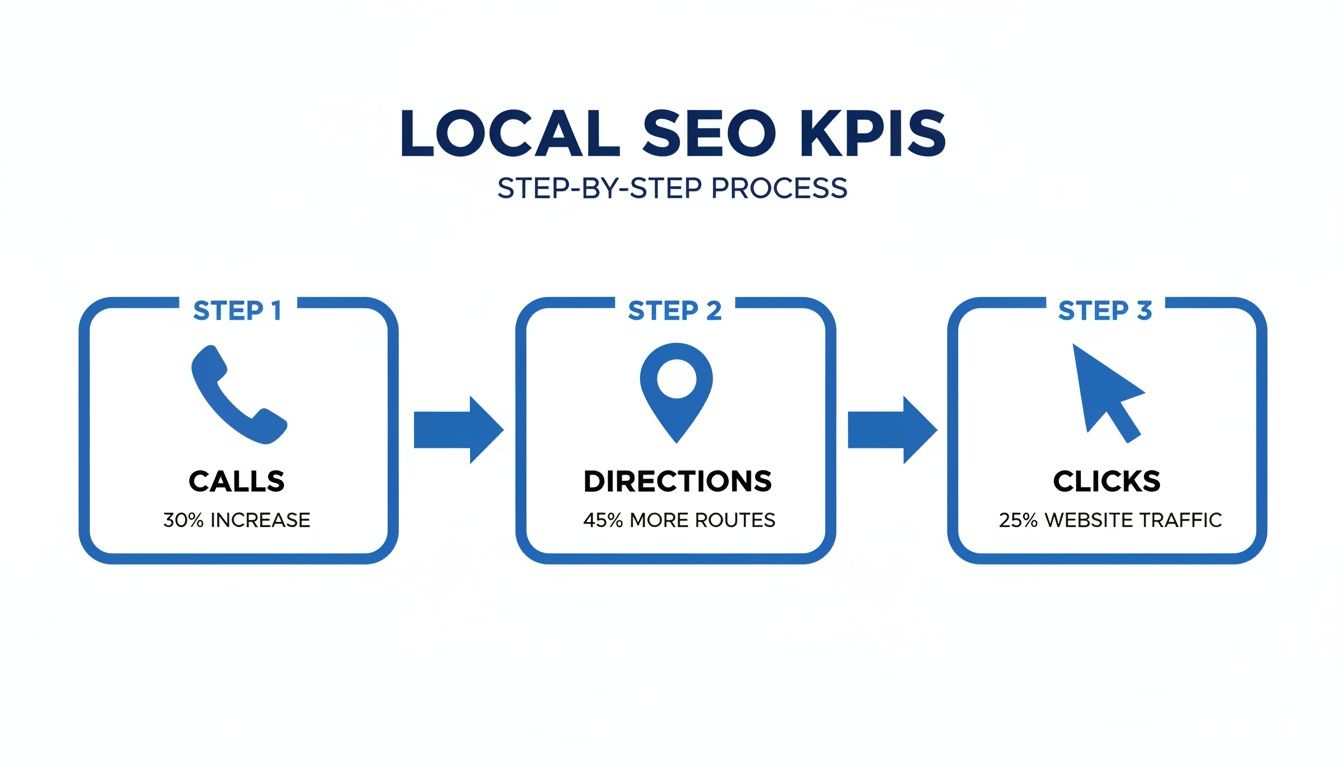
At Review Overhaul, we believe a good local SEO reporting process should tell a simple story about what’s working. Our 3-step plan cuts through the noise and focuses on the metrics that truly matter to your bottom line. We act as your trusted guide to transform confusing data into a clear path forward.
This guide will show you how to focus on the numbers that signal real customer action, like:
- More phone calls from your Google Business Profile.
- Increased direction requests from local customers.
- Website clicks that convert into actual sales.
By focusing on these tangible results, you can finally connect your online efforts to real-world success. This isn't about complex spreadsheets; it's about gaining peace of mind and watching your business thrive.
For a deeper dive into the core strategies, you can learn more about our take on local SEO. Understanding AI's role in improving local SEO campaigns can also sharpen your strategy.
Ready to see where the problem is?
Focus on Metrics That Drive Real Growth

It's easy to get lost in a sea of numbers. Website visits and page views might look good, but they don’t pay the bills. Effective local SEO reporting means shifting away from these "vanity metrics" and zeroing in on Key Performance Indicators (KPIs) that signal real customer intent.
Think about a local customer's mindset. They need a service now. Your report must measure the actions they take when they find you, not just that they saw your name.
From Visibility to Action
Your Google Business Profile (GBP) is where potential customers decide whether to engage or keep scrolling. Instead of just counting impressions, you need to track the metrics that show someone is actively trying to connect with your business.
These are the KPIs that genuinely matter:
- Phone Calls: This is a hot lead. Someone found your profile and was motivated enough to pick up the phone.
- Direction Requests: A fantastic indicator of foot traffic. It shows a customer is literally planning a visit.
- Website Clicks from GBP: These are highly qualified local searchers just one step away from becoming a customer.
When you see these numbers increase, you know your local SEO is successfully turning online visibility into real-world customers.
Tracking What Truly Pays Off
Your report should also track local search rankings for your most profitable, high-intent keywords. Knowing you’re #1 for "emergency plumber near me" is infinitely more valuable than a generic term.
Reviews are also non-negotiable. They are a massive ranking factor and a powerful conversion tool. You must track your review volume, average star rating, and customer sentiment. For a deeper dive, our guide on review management is a great place to start.
Ultimately, a well-built local SEO reporting framework is about proving your return on investment. The data backs this up—by 2025, local SEO is projected to deliver an average ROI of a whopping 250%.
Businesses that skip this layered approach leave money on the table, especially when 91% of consumers trust online reviews as much as a personal recommendation. You can dig into the full guide on local SEO statistics to see the full picture.
Essential KPIs for Your Local SEO Report
This table breaks down the most critical metrics to track, explains what they mean for your bottom line, and tells you exactly where to find the data.
| KPI (Key Performance Indicator) | Why It Matters for Your Business | Where to Find This Data |
|---|---|---|
| Phone Calls from GBP | The most direct lead you can get. Shows immediate interest and intent to purchase. | Google Business Profile Insights |
| Direction Requests | A strong signal of foot traffic and in-person visits. Essential for brick-and-mortar stores. | Google Business Profile Insights |
| Website Clicks from GBP | Captures highly-qualified users who are actively seeking more information to make a decision. | Google Business Profile Insights, Google Analytics |
| Local Search Rankings | Measures your visibility for high-value, location-specific keywords that drive profitable traffic. | SEO Tools (e.g., Semrush, Ahrefs, Local Falcon) |
| Review Volume & Velocity | The number and frequency of new reviews. Shows social proof and influences both rankings and conversions. | Google Business Profile, review management software |
| Average Star Rating | A key decision-making factor for customers. Directly impacts click-through rates and trust. | Google Business Profile, third-party review sites |
| Citation Accuracy & Consistency | Ensures your Name, Address, and Phone (NAP) are consistent across the web, which is vital for local rankings. | SEO Tools (e.g., Moz Local, BrightLocal, Yext) |
| Organic Traffic from Local Search | Tracks website visits from users in your target geographic area, showing the direct impact of your SEO. | Google Analytics (with geo-segmentation) |
Tracking these KPIs gives you a clear picture of your performance, moving you from guesswork to data-driven decisions that grow your business.
How to Build Your Local SEO Report
Knowing which numbers to watch is half the battle. The other half is weaving that data into a story that shows your growth. Building a solid local SEO reporting framework isn't about a giant spreadsheet; it's about getting a clean, actionable snapshot of what’s working.
Think of your report as a quick business check-up. You start with the vitals and then dig deeper into anything that looks off or surprisingly good.
Gathering Your Core Data
The most potent data for any local business comes from three essential and free sources.
- Google Business Profile (GBP) Insights: Your ground zero for customer actions, like phone calls, direction requests, and website clicks.
- Google Analytics 4 (GA4): Tells you what people do after landing on your website, like filling out forms or buying products.
- Your Review Platform: Lets you monitor customer sentiment, review volume, and average star rating across Google, Yelp, and more.
Pulling from these three places gives you the full picture, from discovery to conversion.
Structuring for Clarity and Action
How you organize your data is critical. Always start with a high-level executive summary highlighting the biggest takeaways, like "Phone calls from GBP increased by 15%." This gives any busy owner an instant win. Our guide on GMB management services can help you achieve these kinds of results.
This simple diagram shows how a customer's search translates into real business.
Visualizing the journey makes it clear how your visibility connects to money-making actions.
After the summary, break the report into clean sections: GBP Performance, Website Traffic, and Reputation Management. Use simple charts to show trends, not just static numbers. It’s worth checking out these data visualization best practices for clear reports to make your report easy to understand.
Key Takeaway: Your report should be a strategic tool, not a data dump. Every metric should help answer: "Are we getting more customers from our local online presence?"
Turning Data into Actionable Decisions
A report full of numbers is just noise if it doesn't lead to smarter decisions. This is where your local SEO reporting shifts from a passive summary to an active guide for growth.
What does it mean if your GBP views are high but your phone isn't ringing? Or if rankings are climbing but you haven't gotten a new review in months? These are symptoms telling a story about your customer's journey.
Interpreting Common Scenarios
Let's break down a couple of real-world situations and the actionable steps you can take.
Scenario 1: High GBP Views, Low Phone Calls
People are finding you, but something is stopping them from taking the next step. This is a classic "window shopper" problem.
- Potential Problem: Your listing may lack trust signals. Is your star rating lower than competitors? Are your photos outdated?
- Action Plan: Launch a campaign for more positive reviews. Refresh your profile with high-quality pictures and ensure your business description is compelling.
Scenario 2: Good Rankings, Stagnant Reviews
You're showing up in searches, but without fresh social proof, new customers might hesitate.
- Potential Problem: You likely have no active process for asking for reviews. Happy customers simply forget to leave feedback.
- Action Plan: Implement a simple, automated system. Send a text or email with a direct link to your Google review page after a service is completed.
Connecting the Dots for a Stronger Strategy
Your report is also about finding opportunities. Don't just look for what's broken; identify what’s working so you can amplify it. Maybe a specific Google Post drove a spike in website clicks—that's a clear signal to create more content like it.
A strong report also highlights how critical accurate business information is online. For a closer look at ensuring that consistency, you might be interested in our guide on list management.
The Big Picture: Your local SEO report is your roadmap. The goal isn't just to track numbers but to ask "why" behind every trend and "what" you can do about it.
Communicating Success to Your Team and Partners

You've crunched the numbers and mapped out a plan. Now it's time to share the results. Solid local SEO reporting is a killer tool for keeping your team and partners fired up and invested.
Not everyone needs to see every data point. A busy partner wants the bottom line, while your marketing team needs the details. Nailing your communication means tailoring the report to the reader.
Crafting Reports for Different Audiences
Stakeholders—like investors or your boss—revolve around one thing: Return on Investment (ROI).
Give them a short, high-level summary that cuts to the chase. Focus on metrics that directly impact the business:
- Growth in leads: "We generated 25% more phone calls from Google this month."
- Customer acquisition: "Our improved visibility led to 15 new confirmed bookings."
- Revenue impact: "Positive reviews directly contributed to an estimated $5,000 in new sales."
This approach respects their time and ties your work to real business outcomes.
Empowering Your Internal Team
Your internal team needs the granular data to understand what’s working, what isn't, and what to do next.
Their report should be packed with tactical insights. Show which Google Business Profile posts drove the most clicks or which new reviews mentioned a high-value service. This detail helps them sharpen their strategies and replicate success.
Pro Tip: Get on a consistent reporting schedule, like the first Monday of every month. A reliable cadence keeps everyone aligned and builds momentum.
Your Local SEO Reporting Questions Answered
Even with the best plan, you're going to have questions about local SEO reporting. Let’s clear up some of the most common ones.
How Often Should I Run a Local SEO Report?
For most local businesses, once a month is the sweet spot. This is frequent enough to spot trends and make adjustments, but not so frequent that you get bogged down by daily fluctuations.
If you’re in a highly competitive industry or running a big promotion, you might check key metrics every two weeks.
What Is the Single Most Important Metric to Track?
If you can only focus on one thing, make it the "User Actions" section in your Google Business Profile (GBP) Insights.
This is where the magic happens, tracking the big three:
- Website Clicks: Shows people are intrigued and want to learn more.
- Direction Requests: A massive signal that someone is planning a real-world visit.
- Phone Calls: The clearest sign you have a hot lead on the line, ready to talk.
When these numbers go up, you know your local SEO is doing its job.
What Are the Best Free Tools for Reporting?
You don't need to spend a fortune to get the data you need. You can build a powerful reporting dashboard using only these free Google essentials:
- Google Business Profile Insights: This is ground zero for your most important local asset.
- Google Analytics 4 (GA4): This tells you what people do after they click through to your website.
- Google Search Console: Your keyword goldmine, showing you which local terms bring people to your site.
By pulling data from these three platforms, you can get a holistic view of your performance without spending a dime.
Why Are My Rankings High but Customers Aren't Increasing?
This is a classic—and incredibly frustrating—problem. It means you have a leak in your funnel. People can find you, but something is stopping them from becoming a customer.
First, take a hard look at your Google Business Profile. Are your photos professional? Have you responded to all reviews? Is your description compelling? You also need to get familiar with voice search optimization to meet modern search expectations.
Next, audit the landing page they click through to. Is it mobile-friendly and easy to navigate? More often than not, the problem isn't your SEO—it's the experience you provide after the click.
Bad reviews or a confusing online presence can cost you customers daily. At Review Overhaul, we provide a clear plan to turn your online reputation into your most powerful sales tool. Our 3-step process helps you get more positive reviews, manage feedback effectively, and ensure your business information is accurate everywhere it appears online. The result is more trust, better local rankings, and a steady stream of new customers.
