
Voice search is changing how patients find healthcare. Instead of typing, people now ask devices like Siri or Alexa for help. For example, “Who’s the best dentist near me?” or “Where can I find urgent care?” Voice search is faster, more conversational, and often used for urgent needs. If your practice isn’t optimized for this, you’re missing potential patients.
Key Takeaways:
- 58% of consumers use voice search for local businesses, and 46% do so daily.
- Voice searches are often longer, conversational, and question-based.
- After 9 PM, searches like “emergency dentist” have an 89% conversion rate.
- 40.7% of voice search answers come from featured snippets.
To succeed in voice search:
- Use natural, question-based keywords like “What are flu symptoms?”
- Provide short, clear answers (under 50 words) to common patient questions.
- Update your Google Business Profile with accurate details and patient-friendly FAQs.
- Add schema markup to help search engines understand your content.
- Build trust with positive reviews and respond promptly to feedback.
Voice search isn’t just a trend – it’s a powerful way to connect with patients. Start optimizing your content and profiles today to stay ahead.
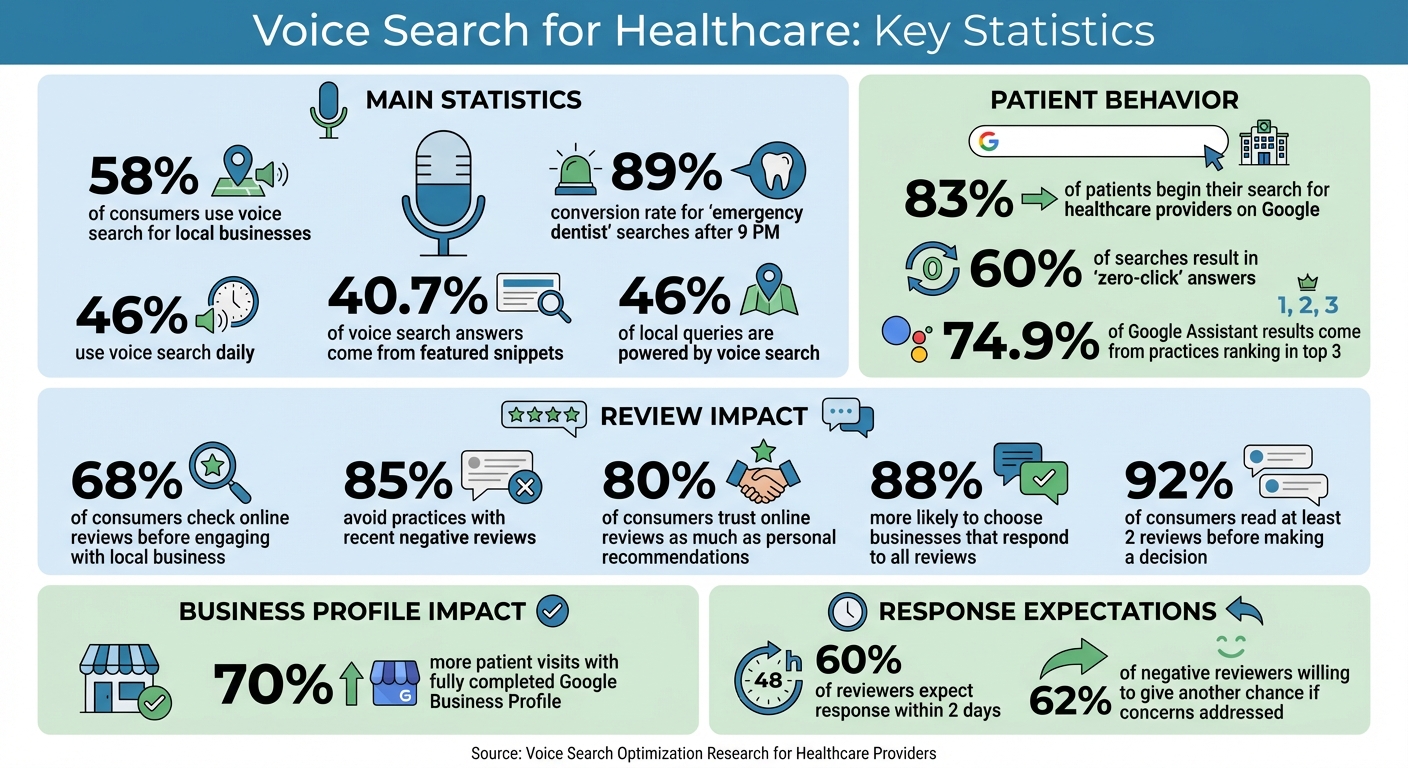
Voice Search Statistics for Healthcare Providers: Key Data and Conversion Rates
Getting Your Content Ready for Voice Search, Ahava Liebtag at HMPS 2018
How to Optimize Healthcare Content for Voice Search
To make your healthcare content voice-search friendly, adopt a natural and conversational approach. These strategies build on the principles of natural language optimization and are essential for standing out in voice search results.
Use Conversational Keywords
Shift your focus from short, generic keywords like "root canal" to longer, question-based phrases that reflect how people naturally speak. For instance, instead of just "flu symptoms", target phrases like "What are the early symptoms of the flu?" Pay attention to how patients phrase their questions during appointments or phone calls to capture their language accurately. If a parent asks, "How long does it take to recover from a root canal?" that exact phrasing can guide your content creation.
Structure your content around the five Ws and one H – who, what, where, when, why, and how – as these are the backbone of most voice search queries. Don’t forget to include common "filler" words like "for the", "to", and "on the", which make voice searches more conversational in tone.
Write Short, Clear Answers
Once you’ve identified conversational keywords, focus on crafting concise answers. Voice assistants prioritize direct, to-the-point responses. Aim to provide a clear answer within the first 40–50 words, and then expand with more details if needed. Write as though you’re speaking directly to a patient, using simple and approachable language. A helpful trick is to read your content aloud: if it feels too formal or awkward, simplify it.
Organize your content with clear, question-based headings like "What are the early signs of diabetes?" This structure makes it easier for both users and voice assistants to find the answers they need.
Add Schema Markup for Healthcare
Schema markup is a behind-the-scenes tool that helps search engines understand your content better, which is crucial for voice search. By adding the right schema types, such as FAQPage, MedicalOrganization, Physician, and LocalBusiness, you increase your chances of being selected as the spoken answer for voice queries.
To implement schema markup, use Google’s Structured Data Markup Helper to generate the necessary code. Add this code to your webpage’s <head> tag and validate it with Google’s Rich Results Test.
"Using structured data helps Google better understand what your page is about. So it can serve your content for relevant voice queries".
Improve Local Search Visibility with Google Business Profile
Your Google Business Profile is the most powerful tool for showing up in voice search results. When someone asks their phone, "Who is the best dentist near me?" Google pulls answers directly from these profiles. Consider this: 83% of patients begin their search for a new healthcare provider on Google, and nearly 60% of searches now result in "zero-click" answers – where voice assistants deliver the information without users visiting a website. This makes it essential to fine-tune every detail of your profile.
Keep Your Listings Accurate and Updated
Voice assistants rely on precise information. That means your Name, Address, and Phone number (NAP) must be consistent across every platform where your practice is listed. If your details don’t match, voice assistants may skip over your business entirely.
A fully completed profile can drive 70% more patient visits. Focus on these key updates: ensure your NAP is consistent, list accurate business hours (including holiday schedules), provide clear directions with nearby landmarks, and fill out the Q&A section with common patient inquiries like "Do you accept new patients?" or "Is there wheelchair access?" These conversational phrases align with how people interact with voice assistants.
Healthcare-specific details also matter. Highlight features like telemedicine options, languages spoken, and parking availability. Keep your profile fresh by uploading new photos every two to three months – showcase your office exterior, waiting area, and staff. Monthly updates about new services or seasonal announcements signal to Google that your practice is active and relevant. For healthcare providers, optimizing your Google Business Profile is a must to capture voice search traffic.
Simplify Updates with Review Overhaul
Keeping your profile optimized can be easier with tools like Review Overhaul. Their Google Business Profile optimization service automates the technical work, ensuring your NAP data stays consistent across all platforms, monitoring your profile’s accuracy, and helping you keep up with the regular updates that voice search algorithms prioritize.
The platform’s voice search optimization feature fine-tunes your profile for conversational queries, making it more likely that voice assistants will recommend your practice. Additionally, Review Overhaul manages your review generation and response process – important because voice assistants often favor practices with the best reviews. With competitive monthly rates, Review Overhaul offers a complete solution for profile management, review generation, and voice search optimization.
sbb-itb-50c3429
Build Trust Through Online Reviews
Once you’ve optimized your Google Business Profile, online reviews become a key factor in boosting your visibility for voice search. Patient reviews heavily influence voice assistant recommendations. For example, when someone asks, "Who is the best dentist near me?" voice assistants evaluate reviews to determine if your practice deserves a mention. Here’s a striking stat: 74.9% of Google Assistant results come from practices already ranking in the top three for that keyword. Much like your content strategy, reviews optimized for voice search provide concise, reliable answers to potential patients.
The numbers speak volumes: 68% of consumers check online reviews before engaging with a local business, and 85% steer clear of practices with recent negative reviews. Voice assistants favor businesses with consistent, positive feedback because it signals reliability. In fact, 88% of marketers agree that a business’s reputation directly impacts its revenue.
Different voice assistants rely on specific platforms for review data. Google Assistant pulls information from your Google Business Profile, Siri uses Apple Maps and Yelp, and Alexa often references Yelp. Building a strong presence across multiple review platforms can significantly improve your visibility in voice search results.
Get More Positive Patient Reviews
Timing is everything when it comes to reviews. Ask for feedback immediately after a positive experience. Your front desk staff can encourage satisfied patients to leave a review before they leave the office. Follow up with an automated email or text within 24 hours, including a direct link to your review page. With 80% of consumers trusting online reviews as much as personal recommendations, every positive review strengthens your position in voice search.
Consider displaying QR codes in your office that link directly to your review page. Encourage patients to highlight specific services in their reviews – phrases like "teeth whitening" or "emergency dental care" help voice assistants connect your practice to relevant conversational queries. Once you’ve secured reviews, professional responses can further enhance your practice’s credibility.
Respond to Reviews Professionally
Replying to reviews isn’t just polite – it’s a crucial factor in rankings. Eighty-eight percent of consumers are more likely to choose a business that responds to all its reviews, and 90% say owner responses influence their decisions to a moderate or significant degree. Practices that actively respond to reviews have seen a 12% increase in total review submissions.
Speed matters. Sixty percent of reviewers expect a response within two days, and 62% of negative reviewers are willing to give a business another chance if their concerns are addressed effectively. Thank patients for positive reviews and include relevant keywords, such as "We’re thrilled you enjoyed your cosmetic dentistry experience." For negative reviews, offer a sincere apology, take responsibility, and invite the patient to discuss the issue offline by providing direct contact information.
"When you reply to reviews, it shows that you value your customers and their feedback." – Google
Always ensure HIPAA compliance when responding to reviews. Avoid confirming a reviewer’s patient status or sharing any personal health details – even if they’ve mentioned them. Stick to general responses like, "We value all feedback" or "Our goal is to provide excellent care to everyone."
If managing reviews feels overwhelming, tools like Review Overhaul can simplify the process. Their platform automates review requests and helps craft HIPAA-compliant responses, ensuring you maintain active engagement. This consistency not only builds trust but also boosts your local and voice search rankings.
Track and Improve Voice Search Performance
Once your content and listings are optimized, the next step is to keep an eye on how well your voice search strategy is performing – and tweak it where needed. While no analytics tool explicitly identifies voice search traffic, you can rely on proxy metrics and signals to gauge how patients discover your practice.
Monitor Voice Search Traffic with Analytics
Google Search Console is a great starting point for spotting conversational queries. Look for searches that begin with natural language phrases like "who", "what", "where", "when", "why", and "how." These mimic the way people interact with voice assistants. You can also search for wake words such as "OK Google" or "Hey Siri" in your query reports.
Check your featured snippet rankings – these are critical since about 41% of voice search answers come from Position Zero. Tools like Semrush can help you track which of your healthcare pages are earning these coveted spots. Additionally, keep a close eye on your Google Business Profile insights. Metrics like direction requests, calls, and messages can indicate voice-driven local searches. Considering that 58% of consumers use voice search to find local business information, these actions can reveal how often patients rely on devices to locate your practice. These insights validate the effectiveness of your conversational content and profile optimizations, helping you fine-tune your voice search strategy.
Use the data you gather to make informed adjustments, as outlined below.
Adjust Your Strategy Based on Data
If you notice that question-based queries are driving traffic but not leading to conversions, consider rewriting your answers to make them more direct and actionable. Test common patient queries on platforms like Google Assistant, Siri, and Alexa to ensure your practice appears as the spoken answer.
"To include Voice Search in your SEO strategy is to accept that you will not be able to understand the true effectiveness of your efforts. Optimizing for search isn’t difficult, but measuring its success is." – Rebecca Krause, SEO Specialist at Seer Interactive
You can also gather insights directly from your patients. Use quick polls to ask if they found your clinic through voice search. This feedback can help you better understand how patients are engaging with your practice through voice assistants.
Conclusion
Voice search now powers 46% of local queries. If your practice isn’t set up to handle conversational searches, you’re likely missing out on potential patients who rely on tools like Siri, Alexa, and Google Assistant.
To stay ahead, focus on creating content that mirrors how people naturally ask questions. Use conversational, question-based answers, keep your Google Business Profile up to date, implement schema markup, and actively manage your online reviews. These steps help voice assistants recognize your practice as the most reliable spoken response. This strategy offers a modern and patient-focused approach to healthcare marketing.
"True innovation in healthcare marketing lies not in chasing algorithms, but in designing digital experiences that echo empathy, ethics, and patient intent." – Vigorant
Reviews also play a huge role in building trust. With 92% of consumers reading at least two reviews before making a decision, it’s clear that reviews influence not only patient trust but also how voice assistants rank your practice. Increasing review requests by just 25% can significantly boost your visibility and attract more patients.
Tools like Review Overhaul make this process easier. It combines Google Business Profile optimization, automated review requests, professional response management, and voice search support to position your practice as the trusted choice when patients are searching for care.
FAQs
What are the best ways for dentists and doctors to optimize their content for voice search?
To make your content stand out in voice search, dentists and doctors should aim for natural, conversational language – the kind that mirrors everyday speech. Think about how patients phrase their questions and incorporate long-tail keywords and question-based phrases like "What causes gum disease?" or "Who is the best doctor near me?"
Another key focus is local SEO. Be sure to include location-specific terms and keep your Google Business Profile updated. This ensures voice assistants can deliver accurate, local results when users search for healthcare services nearby. Lastly, structure your content with clear and concise answers to boost its chances of being featured in voice search results.
How do online reviews impact voice search rankings for healthcare providers?
Online reviews are a key factor in boosting voice search rankings for healthcare providers. Voice assistants tend to recommend businesses with strong reviews because they reflect reliability and quality – qualities that matter to both users and search algorithms.
Healthcare practices with a solid number of positive reviews are more likely to show up in voice search results, making it easier to reach potential new patients. Keeping your practice’s information accurate and actively managing your online reputation can also improve your chances of being featured in voice search recommendations.
Why is it crucial to keep your Google Business Profile updated for voice search?
Keeping your Google Business Profile current is crucial for voice search success. Virtual assistants like Siri, Alexa, and Google Assistant pull information directly from these profiles to deliver accurate and relevant responses to users. Key details such as your business hours, address, and customer reviews play a significant role in helping these assistants recommend local services.
For healthcare professionals – dentists, doctors, and others – keeping profiles updated ensures potential patients can quickly locate your practice when using voice commands to search for nearby services. A well-maintained profile not only boosts your visibility but also helps establish trust with users looking for dependable healthcare providers in their area.
