
Negative reviews can significantly impact hotel bookings, with just one bad review leading to a 22% loss in potential reservations. Ignoring feedback can harm trust, lower search rankings, and push guests toward competitors. But here’s the good news: responding to at least 40% of reviews can double revenue, and 84% of travelers view management replies favorably.
Key Takeaways:
- Quick Responses Matter: Reply to negative reviews within 24–48 hours to show attentiveness.
- Apologize and Offer Solutions: Acknowledge issues, apologize sincerely, and outline steps to resolve concerns.
- Boost Positive Reviews: Use post-stay surveys to encourage more feedback and balance negative comments.
- Monitor Feedback Efficiently: Use tools to track reviews across platforms like Google Business Profile and TripAdvisor.
Effective review management isn’t just about damage control – it’s about turning feedback into a chance to improve and attract more bookings.
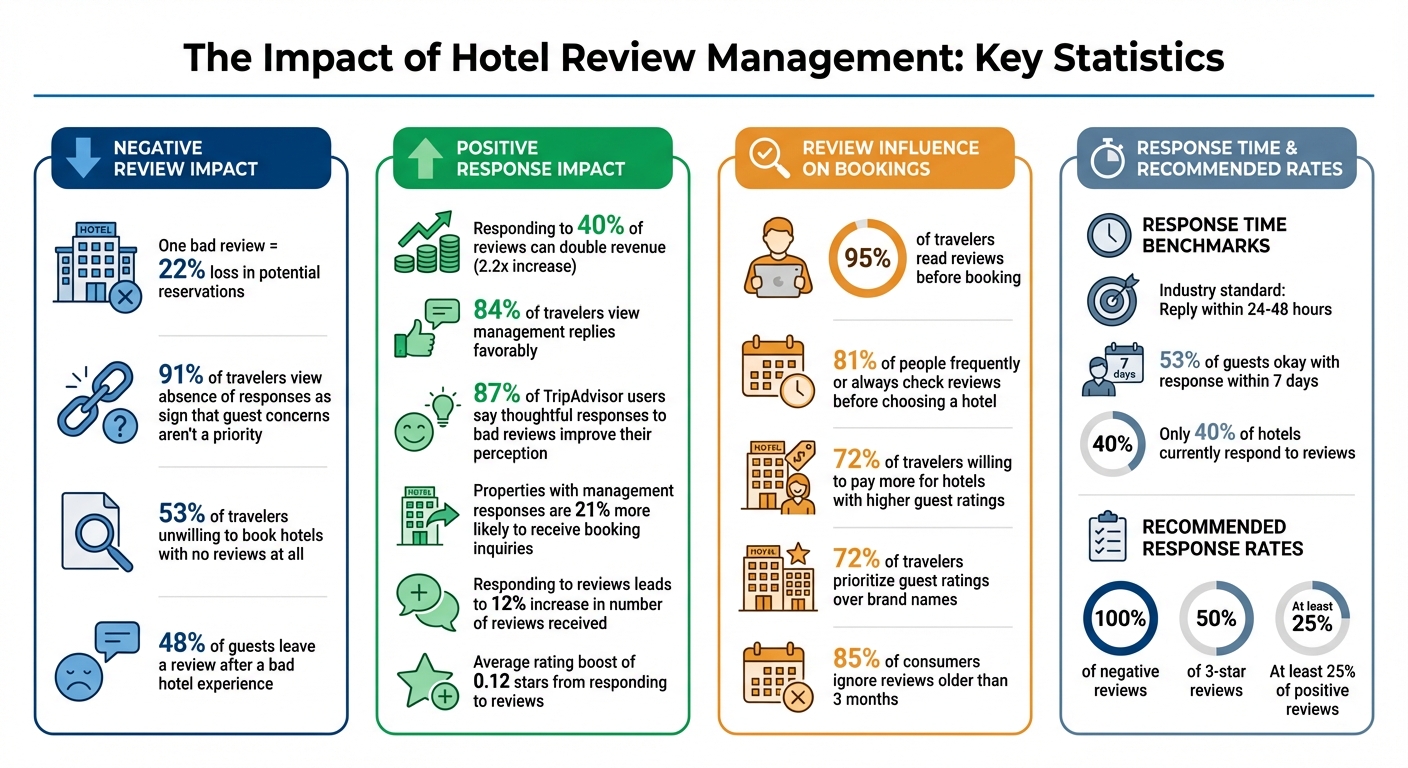
Hotel Review Management Statistics and Impact on Revenue
How To Manage A Hotel Reputation Crisis Effectively?
sbb-itb-50c3429
Problems Caused by Negative Hotel Reviews
Negative reviews don’t just hurt your feelings – they bring real challenges that can affect your hotel’s ability to compete and generate revenue. Recognizing these impacts is the first step toward crafting an effective strategy to address them.
Loss of Customer Trust and Bookings
Negative reviews can erode customer trust and lead to fewer bookings. Today’s travelers rely heavily on peer reviews rather than brand loyalty, often consulting at least three review platforms before deciding where to stay. Failing to address negative feedback sends the wrong message. Around 91% of travelers view an absence of responses to reviews as a sign that guest concerns aren’t a priority.
This isn’t just about losing a few bookings – it’s about losing visibility too. Negative reviews can weaken your hotel’s online presence, making it harder for potential guests to find you.
Damage to Online Reputation and Search Rankings
When trust is shaken, your online reputation and search rankings take a hit. Platforms like Google, TripAdvisor, and major OTAs (Online Travel Agencies) such as Booking.com and Expedia reward hotels with frequent, positive reviews. Strong ratings directly boost visibility and revenue – studies show that positive reviews can increase occupancy rates by 0.54% and revenue per available room (RevPAR) by 1.42%. In markets where hotels offer similar amenities and prices, your review score often becomes the deciding factor for guests.
Managing Public Perception Becomes Tougher
Since guests can’t test out your services before booking, they rely heavily on the shared experiences of others. Reviews have essentially become the industry’s version of currency.
Platforms make this even more critical by showcasing "review snippets" that highlight recurring complaints. For example, if several guests mention "uncomfortable beds" or "unfriendly staff", these issues become glaringly obvious to anyone researching your property. Ignoring such feedback only worsens the situation. As Revinate explains:
In our digital-facing world, silence is often interpreted as indifference, which is the last thing you want in the hospitality industry.
The gap between your established reputation and current guest experiences can grow quickly. For instance, 53% of travelers are unwilling to book a hotel with no reviews at all. This demonstrates how vital it is to actively engage with your online reputation. These issues – declining trust, lower search rankings, and a tarnished public image – require a well-thought-out, proactive approach to prevent long-term damage.
How to Respond to Negative Reviews
Addressing negative reviews effectively can help protect your reputation and rebuild trust with both the reviewer and future guests. After all, potential customers often read reviews before deciding to book, and 91% of travelers believe property managers should respond to negative feedback. By handling these situations thoughtfully, you can turn criticism into an opportunity to show accountability and commitment to improvement. Here’s how to approach it with care and professionalism.
Respond Quickly and Professionally
Timing is everything. Aim to reply within 24 to 48 hours of receiving a negative review. A prompt response not only demonstrates attentiveness but also sets you apart – especially since only about 40% of hotels currently respond to reviews.
Keep your tone calm and professional. Avoid humor, sarcasm, or overly emotional language, as these can come across as dismissive or insincere. Start by addressing the reviewer by name, and end with a specific manager’s name and title to add a personal touch. When responding to negative reviews, use "I" statements to take personal responsibility, rather than "we" statements, which can feel less direct.
Acknowledge the Problem and Apologize
A heartfelt apology can make a world of difference. In fact, 87% of TripAdvisor users say that a thoughtful response to a bad review improves their perception of the business. The key is to validate the guest’s experience without offering excuses. A genuine apology shows you’re listening and care about their concerns.
Avoid phrases like, "I’m sorry if you were offended", as they can come across as dismissive or insincere. Instead, focus on the specific issue raised. For example, when a guest named Patrice described her room as "old, outdated, and in major need of repair", General Manager Elanor L. responded by thanking her for the honest feedback and announcing upcoming renovations, including new mattresses, carpets, and window treatments, to be completed within two months. This approach not only acknowledged the issue but also highlighted steps being taken to address it.
Offer Solutions and Follow Up
An apology is important, but it’s just the first step. Your response should also outline actions you’re taking to resolve the issue. This can reassure future guests and show that feedback leads to meaningful changes. In fact, 56% of consumers say that a business’s response to reviews has influenced their perspective.
If a negative review points to a specific problem that’s being addressed, mention those improvements publicly. For example, if a guest complains about outdated facilities, you might share details about planned upgrades. For more immediate concerns, invite the guest to contact you privately so you can resolve the matter directly. This approach prevents further back-and-forth in public while allowing you to offer compensation or other solutions.
Taking the conversation offline can often turn a dissatisfied guest into a loyal customer. As Apoorv Singhal, Junior Product Manager at Booking.com, explains:
Users are willing to ignore negative comments in reviews if they see a partner response indicating acknowledgment or action.
Tools and Strategies for Managing Reviews
Managing reviews effectively requires the right tools and a consistent approach. With 95% of travelers reading reviews before booking and 81% of people frequently or always checking reviews before choosing a hotel, staying on top of guest feedback is crucial. By using strategic tools and practices, hotels can monitor feedback, maintain visibility, and encourage positive reviews to balance any negative ones. These efforts, combined with proactive responses, help build a strong and dynamic online presence.
Monitor Reviews Regularly
Keeping track of reviews across platforms like Google, TripAdvisor, Expedia, Facebook, and Booking.com can be overwhelming without centralization. Reputation management platforms simplify this by aggregating reviews into a single dashboard, making it easier to identify trends and respond quickly. Setting up real-time alerts ensures you’re notified immediately when a new review is posted, allowing you to meet the industry standard of responding within 24 to 48 hours.
For hotels active on social media, tools like Hootsuite can help monitor mentions and conversations in real time. Some advanced platforms even use natural language processing (NLP) to analyze reviews, identifying patterns in guest feedback about amenities, cleanliness, or service quality. This kind of insight allows you to address recurring issues before they escalate. While the standard response time is 24 to 48 hours, 53% of guests are okay with a response within seven days, making consistent monitoring a priority.
Optimize Your Google Business Profile
Your Google Business Profile (GBP) is often the first impression potential guests have of your property. With 38% of travelers starting their planning on search engines, compared to just 8% who begin with an online travel agency, having a polished profile is essential. A well-maintained GBP showcases star ratings, pricing, photos, and contact information directly in search results and on Google Maps.
Since Google reviews accounted for 70% of the net growth across all review platforms in recent years, this platform is critical for local SEO. Claim and verify your listing to ensure control over your property’s details and to respond to reviews directly. Consistency is key – make sure your Name, Address, and Phone number (NAP) match across your GBP and website to avoid SEO penalties. Even minor errors can lead to missed opportunities. Show engagement by responding to 100% of negative reviews, 50% of 3-star reviews, and at least 25% of positive reviews. Even for reviews without comments, use the opportunity to share updates about renovations or new amenities. If you spot fake or policy-violating reviews, use the flag icon to report them to Google and protect your profile’s credibility.
While regular monitoring ensures no feedback is overlooked, optimizing your GBP strengthens the first impression prospective guests have of your hotel.
Generate Positive Reviews to Balance Negative Feedback
A steady flow of positive reviews can help offset negative ones. Post-stay surveys not only encourage reviews on platforms like TripAdvisor but also improve overall review scores. Automated tools integrated with your Property Management System (PMS) or CRM software can send review requests via email or text shortly after checkout, making it easy for happy guests to share their experiences.
The benefits are clear: responding to reviews can lead to a 12% increase in the number of reviews received and an average rating boost of 0.12 stars. Additionally, 72% of travelers are willing to pay more for hotels with higher guest ratings, directly impacting your bottom line. Sharing glowing 5-star reviews on social media platforms like Facebook, Instagram, and X can further enhance your brand’s online presence. However, keep in mind that 85% of consumers ignore reviews older than three months, so maintaining a steady stream of fresh feedback is essential to staying relevant.
For a streamlined approach, services like Review Overhaul (https://reviewoverhaul.com) offer tools for review generation, GBP optimization, and professional responses. These solutions allow hotels to maintain a positive online reputation while freeing up staff to focus on delivering memorable guest experiences. Together, these strategies not only counteract negative feedback but also strengthen your long-term reputation management efforts.
Creating a Long-Term Reputation Recovery Plan
Recovering your reputation for the long haul requires more than a quick fix – it demands consistent improvements and clear protocols to prevent future crises. According to research, 98% of businesses found their crisis plans effective when implemented. A solid recovery plan not only addresses the root causes of negative reviews but also establishes systems to avoid future mishaps. This involves training your team, setting up clear guidelines, and leveraging professional tools to stay proactive. Here’s how you can rebuild your reputation over time.
Train Staff on Customer Service Standards
The foundation of prevention lies in equipping your team with the right skills. Your front-line staff directly shape guest experiences, making regular training a non-negotiable. Simple practices like the "10 & 5 Rule" – engaging in brief, positive interactions – foster a culture of attentiveness and reduce the chances of disengaged service. Conduct regular training sessions and mock scenarios to identify and address gaps in your crisis response strategy. Considering that 48% of guests leave a review after a bad hotel experience, proactive training is your best defense. When service failures occur, analyze them promptly, refine your protocols, and involve employees in creating crisis plans to ensure they’re prepared and invested during challenging situations.
Create a Review Crisis Protocol
Having a clear, step-by-step protocol ensures your team can handle negative reviews effectively and consistently. When a bad review surfaces, start by thoroughly investigating the guest’s experience internally to ensure your response is accurate. Categorize complaints to distinguish between systemic issues and isolated incidents. This process helps you identify the right operational fixes. In public responses, always include a direct email or phone number to resolve complex issues privately. Use feedback from reviews to set departmental KPIs and incorporate recurring complaints into staff training programs to prevent repeat problems.
Use Professional Reputation Management Services
Balancing the demands of daily operations with managing reviews across multiple platforms can be overwhelming. Professional services like Review Overhaul (https://reviewoverhaul.com) can help by using tools like Natural Language Processing (NLP) and sentiment analysis to uncover recurring operational weaknesses – such as specific department issues or maintenance problems – that might otherwise go unnoticed. These insights guide targeted improvements across your departments. Additionally, these services can automate post-stay surveys to boost review volume and improve your property’s visibility in search rankings. With 77% of travelers more likely to book properties that offer personalized responses, these tools free up your team to focus on guest services while ensuring every review gets the attention it deserves.
Conclusion
Handling negative hotel reviews isn’t just about damage control – it’s about creating a system that turns guest feedback into a competitive edge. The hotels that succeed are those that respond to reviews within 24–48 hours, address guests’ concerns personally, and use the insights to resolve real operational issues. With 81% of travelers reading reviews before booking, how you manage feedback can directly influence your revenue.
Quick and consistent responses are key. Hotels that reply to at least 40% of their reviews see their revenue increase by an average of 2.2 times, and properties with management responses are 21% more likely to receive booking inquiries. These stats underline that addressing feedback isn’t just good practice – it’s a business necessity.
But long-term success requires more than just swift replies. It calls for staff training to prevent recurring issues, clear protocols to ensure every review is handled properly, and tools to identify patterns across hundreds of reviews. As Daniel Edward Craig, Founder of Reknown Marketing, wisely points out:
If you’re not using feedback to improve, it doesn’t matter how good you are at responding to complaints.
For hotels balancing day-to-day operations while tracking reviews across platforms like Google, TripAdvisor, and OTAs, professional tools such as Review Overhaul (https://reviewoverhaul.com) can be game-changers. These services gather feedback from over 100 sites into one dashboard, use sentiment analysis to highlight recurring issues, and help craft personalized responses. With 72% of travelers prioritizing guest ratings over brand names, having the right tools to manage your reputation is no longer optional – it’s essential.
The most successful hotels see every critique as an opportunity, building systems that turn satisfied guests into loyal advocates.
FAQs
How does responding to reviews affect a hotel’s revenue?
Responding to guest reviews plays a key role in boosting a hotel’s revenue by fostering trust and enhancing its online reputation. When you engage with reviews – whether they’re glowing or critical – it sends a clear message to potential guests: their feedback matters, and you’re dedicated to delivering top-notch service.
Improved review scores often translate into more bookings and the ability to charge higher rates. Studies show that even a slight uptick in ratings can lead to measurable revenue growth. This makes managing reviews an essential part of any hotel’s strategy for staying competitive in the hospitality industry.
What are the best ways to handle negative reviews for hotels?
Handling negative hotel reviews takes a mix of empathy, professionalism, and quick action. Start by responding promptly to show guests their concerns are taken seriously. Begin with a genuine thank you for their feedback, followed by a sincere apology for their experience. Address their concerns directly and professionally, steering clear of any defensive or dismissive tone. If a claim seems inaccurate, approach it calmly and tactfully.
Whenever possible, focus on resolving the issue and share what steps the hotel is taking to make things better. Engaging with reviews on various platforms not only shows your commitment to guest satisfaction but can also leave a positive impression on future guests. By actively listening, empathizing, and working on improvements, hotels can turn criticism into a chance to rebuild trust and strengthen their online reputation.
Why should hotels monitor reviews across different platforms?
Monitoring reviews across various platforms is crucial for maintaining a positive online reputation. Travelers share their experiences on different review sites and social media channels, and relying on feedback from just one platform might not give the full picture of guest sentiment. By tracking reviews from multiple sources, hotel managers can spot trends, address recurring issues, and respond to concerns quickly – often preventing small problems from becoming bigger ones.
Reviews play a major role in influencing booking decisions. Just one negative review on platforms like Google or TripAdvisor can turn potential guests away, especially if it goes unanswered. Responding promptly and consistently demonstrates that your hotel values guest feedback and is committed to making improvements. This approach not only helps rebuild trust but also encourages more positive reviews. Actively managing reviews ensures your hotel’s reputation reflects its true quality, boosting visibility and building guest confidence.
