
Analyzing customer sentiment helps businesses understand the emotions behind customer reviews, going beyond star ratings. By using AI and Natural Language Processing (NLP), you can classify feedback as positive, negative, or neutral, and identify specific issues like pricing concerns or service delays. This process enables businesses to address problems, improve customer satisfaction, and strengthen loyalty.
Key Takeaways:
- Why it matters: 95% of shoppers read reviews before buying, and 32% will leave a brand after one bad experience.
- How it works: Sentiment analysis uses AI to interpret emotions in text, assigning scores (e.g., -1.0 to 1.0) to feedback.
- Methods: Manual analysis works for small volumes (<100 reviews/month), while AI tools are ideal for handling larger datasets.
- Benefits: Identify trends, resolve issues quickly, and use positive feedback to highlight strengths in marketing.
Sentiment analysis turns reviews into actionable insights, helping businesses improve operations and build trust with customers.
Marketer’s Guide to Customer Sentiment Analysis
sbb-itb-50c3429
What is Customer Sentiment Analysis?
Customer sentiment analysis uses AI and Natural Language Processing (NLP) to interpret and classify emotions expressed in text-based feedback. By analyzing the specific words and phrases customers use, it provides insights into their emotional state – whether they’re happy, frustrated, or somewhere in between.
The system assigns a polarity score to each piece of feedback, categorizing it as positive, negative, or neutral. For instance, Google’s NLP API assigns scores ranging from -1.0 (negative) to 1.0 (positive), along with a magnitude that reflects the intensity of the emotion. This turns subjective feedback into measurable data that businesses can monitor over time.
How Sentiment Analysis Works
Sentiment analysis relies on machine learning to identify patterns, understand grammatical structures, and interpret the emotional undertones of words and phrases. Unlike earlier rule-based systems that only recognized predefined keywords, modern models can grasp subtleties like context, tone, and even sarcasm.
The process begins with data cleaning – removing elements like HTML tags, emojis, and special characters while standardizing the text for accurate processing. Once prepared, the system classifies the sentiment and can dive deeper with techniques like Aspect-Based Sentiment Analysis (ABSA). ABSA links sentiments to specific topics, such as pricing or customer service. This allows businesses to pinpoint what customers like or dislike about specific aspects, even within the same review.
This intricate analysis creates a foundation for actionable insights, which can be applied to improve various aspects of a business, as we’ll explore next.
Why Service Businesses Need Sentiment Analysis
For service businesses, sentiment analysis goes beyond merely tallying positive and negative reviews. It uncovers the underlying reasons behind customer dissatisfaction – whether it’s long wait times, billing issues, or other operational challenges – so businesses can address these problems effectively. At the same time, it identifies positive feedback, or "praise drivers", that can be highlighted in marketing campaigns by showcasing authentic customer quotes.
"It’s very difficult to convince the rest of the team that something was important when you don’t have the data to back it up." – Anders Reckendorff, CEO, Scandinavian Biolabs
This data-driven approach is especially powerful in building trust with potential customers. Considering that 95% of shoppers read online reviews before making a purchase, sentiment analysis equips businesses with the tools to make informed improvements and stand out in the competitive landscape with Google Business Profile management.
Gathering and Organizing Review Data
To truly understand customer sentiment, you need to collect and organize reviews from all possible channels. Customers share their opinions everywhere – Google Business profiles, Facebook, platforms like Yelp or TripAdvisor, and even through direct communication. Considering that the majority of US consumers check local business reviews before making a purchase, overlooking any channel could mean missing key insights.
Where to Find Customer Reviews
Your customers might be talking about your business in places you haven’t even thought of. Google leads the pack when it comes to reviews, with 79% of people reading reviews there and 66% of reviewers spending most of their time on the platform. Beyond Google, social media and marketplace sites also host a wealth of informal feedback. For service businesses, industry-specific platforms are crucial: healthcare providers should monitor Healthgrades, hotels should keep an eye on TripAdvisor, and B2B companies can turn to G2.
Don’t forget direct feedback channels. Chat logs, email responses, and survey replies often contain raw, unfiltered insights that aren’t shared publicly. These can highlight problems or suggestions that might otherwise go unnoticed. By gathering feedback from all these sources, you’ll build a solid foundation for deeper analysis.
How to Organize Reviews for Analysis
Once you’ve gathered reviews from every relevant source, the next step is to centralize them into a single dataset. This consolidated view allows you to uncover patterns that might be missed if feedback is scattered across different platforms. Tools like the Google My Business API can streamline direct data collection, while web scraping tools can fill in gaps where APIs aren’t available.
To make sense of the data, sort reviews into meaningful categories. Grouping feedback by product line, service type, geographic location, or date can help you spot trends that might otherwise be buried. For instance, a restaurant chain might notice a spike in negative reviews at one location on weekends, or a software company might see that pricing concerns are mostly voiced by small business clients.
Finally, clean up your dataset. Remove duplicates, spam, and irrelevant characters, and convert vague time references like "2 weeks ago" into precise dates (e.g., 01/12/2026). Clean, well-organized data ensures that your analysis will be accurate and actionable, setting the stage for uncovering valuable sentiment trends.
Methods for Analyzing Customer Sentiment
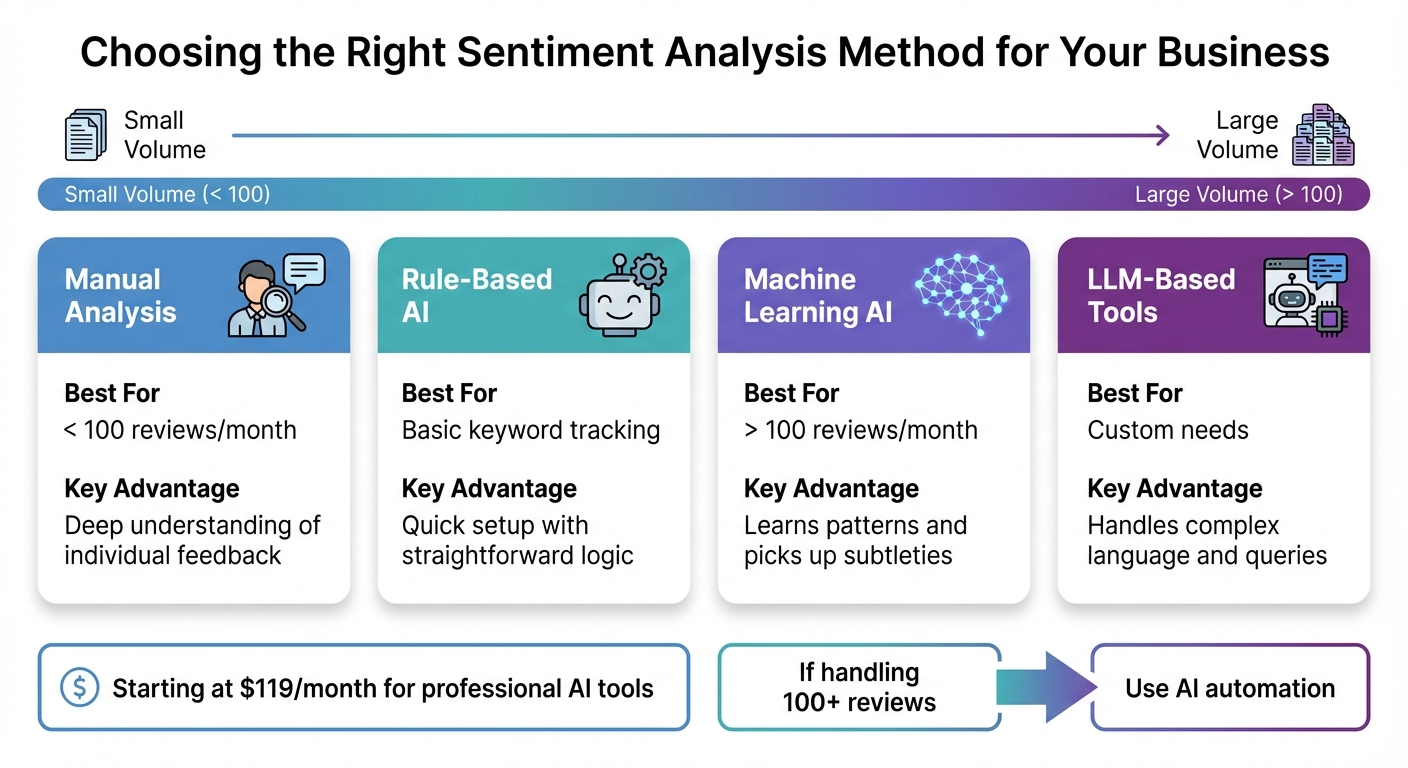
Sentiment Analysis Methods Comparison: Manual vs AI-Powered Tools
Picking the right technique for sentiment analysis depends on how many reviews you’re handling and what your business goals are. Many service-based businesses find that combining multiple methods gives them the most complete picture.
Fine-Grained Sentiment Analysis
Instead of just sorting reviews into "positive" or "negative", fine-grained sentiment analysis digs deeper by using a detailed scale to measure emotional intensity. For example, you can rate customer feedback on a scale of 1 to 5 or 1 to 10, creating categories like very negative, negative, neutral, positive, and very positive. Why does this matter? Because not all negative feedback is equally urgent. A customer who rates their experience a 3 may need a different response than someone who leaves a 1. This approach helps prioritize issues effectively.
For small businesses managing fewer than 100 reviews a month, a manual process can work. Use a spreadsheet with columns for the review text, a topic tag (like "pricing" or "service speed"), and a sentiment score from 1 to 5. But as review numbers grow, automating the process becomes essential for consistency and time savings.
Aspect-Based Sentiment Analysis
Customer feedback is rarely one-dimensional. A single review might praise your pricing but criticize service speed. Aspect-based sentiment analysis (ABSA) breaks down reviews into specific topics – like "cleanliness", "value for money", or "staff friendliness" – and assigns a sentiment score to each. This method highlights exactly what’s driving your ratings, pinpointing both strengths and areas needing improvement.
To try ABSA manually, start by listing 5–10 key aspects relevant to your business. As you go through reviews, tag the aspects mentioned and mark whether the sentiment is positive, negative, or neutral. Patterns will quickly stand out, helping you decide where to focus your efforts.
Using Automated Tools for Analysis
Once you’re handling over 100 reviews a month, manual analysis becomes too time-consuming. AI-powered tools using Natural Language Processing (NLP) can process thousands of reviews in minutes. These tools also eliminate human bias, where one person might label a review as "positive" while another sees it as "negative".
Modern sentiment analysis platforms use advanced machine learning models to understand context, sarcasm, and even slang. Some tools, powered by large language models like GPT-4o, let you ask natural language questions like, "Why did sentiment around our delivery speed drop last week?".
"AI can cut through the subjectivity of human opinion, and no matter how something is said, it can report on the customer issue in a simple way."
- Kirsty Pinner, Chief Product Officer at SentiSum
While AI tools are powerful, it’s a good idea to validate their outputs, especially when starting out. Periodically review a sample of the AI’s classifications to ensure it’s correctly interpreting industry-specific terms and subtle emotional cues. For small businesses, professional sentiment analysis platforms now start at around $119 per month.
| Method | Best For | Key Advantage |
|---|---|---|
| Manual Analysis | < 100 reviews/month | Deep understanding of individual feedback |
| Rule-Based AI | Basic keyword tracking | Quick setup with straightforward logic |
| Machine Learning AI | > 100 reviews/month | Learns patterns and picks up subtleties |
| LLM-Based Tools | Custom needs | Handles complex language and queries |
These methods provide the foundation for turning customer sentiment into actionable insights that can drive meaningful business improvements.
Applying Sentiment Insights to Your Business
Collecting sentiment data is just the first step. The real value lies in transforming those insights into actionable strategies that enhance your operations and deepen customer relationships. Here’s how you can turn sentiment analysis into meaningful outcomes.
Responding to Negative Sentiment
Start by grouping negative feedback into themes. For example, if 15 customers mention slow delivery in a week, it’s a clear sign of an operational issue that needs immediate attention. Sentiment analysis makes it easier to identify these patterns quickly, allowing you to escalate urgent complaints to senior staff or specialized teams for swift resolution.
Take Nestlé Canada, for instance. In 2018, the company faced a backlash after altering a popular tea recipe, with their product rating plummeting to 1.7 stars. Sentiment analysis revealed customer dissatisfaction with the recipe change, prompting Nestlé to revert to the original formula. As a result, their rating rebounded to 4 stars.
"Consumers do the talking for us. They speak, and we listen and take action."
- Lee Beech, Director of Consumer Experience at Nestlé Canada
Once you’ve addressed the issue, follow up with dissatisfied customers to inform them of the resolution. This small gesture shows customers that their opinions matter, often turning critics into loyal advocates.
While tackling negatives prevents long-term damage, leveraging positive feedback can be just as impactful.
Building on Positive Feedback
Positive sentiment highlights what’s working well, offering valuable insights into your strengths. Use this feedback to amplify the features customers love in your marketing efforts. Often, the exact phrases customers use in glowing reviews make for the most authentic and relatable ad copy.
A great example is British Airways Holidays. In 2024, they used SentiSum’s AI-driven sentiment analysis to process hundreds of thousands of reviews. By identifying the key drivers of positive sentiment, they transitioned from manual labeling to a data-focused approach, helping them nurture brand advocates. Similarly, the Atlanta Hawks basketball team used Sprout Social’s sentiment tools to tailor their digital content. Within just three months, they saw a 127.1% increase in video views and a 170.1% growth in their Facebook audience.
Identify your brand promoters – the customers leaving exceptionally positive reviews – and engage them directly. Invite them to participate in case studies, referral programs, or testimonial campaigns. These enthusiastic supporters can spread positive word-of-mouth far more effectively than traditional advertising.
Tracking Sentiment Over Time
Sentiment analysis isn’t just about quick fixes; it’s also a long-term tool for maintaining customer trust. Real-time tracking helps you catch negative spikes immediately. For instance, if sentiment drops sharply after a product launch or policy change, you can respond within the 24-hour window that 73% of customers expect. Visual tools like graphs and charts can make it easier to spot trends and share insights with your team.
Tracking sentiment over time also measures the effectiveness of your improvements. After implementing changes based on customer feedback, monitor sentiment scores in the following weeks to see if they improve. This data not only validates your efforts but also helps demonstrate to your team that customer insights lead to tangible results.
"It’s very difficult to convince the rest of the team that something was important when you don’t have the data to back it up."
- Anders Reckendorff, CEO, Scandinavian Biolabs
How Review Overhaul Supports Sentiment Analysis
Handling sentiment analysis across various platforms can quickly become a daunting task, especially when juggling review monitoring, crafting responses, and keeping tabs on your reputation. Review Overhaul simplifies this process by bringing everything together into a single, organized system tailored specifically for service-based businesses. This unified approach works hand in hand with the sentiment analysis techniques mentioned earlier, seamlessly combining data collection and response management.
The platform uses a three-step framework to transform how businesses gather and analyze customer feedback. It automates review collection through SMS and email, centralizes monitoring with customizable response templates, and boosts positive feedback by showcasing it as social proof – helping businesses grow.
Review Overhaul makes responding to reviews easier without compromising on authenticity. With structured templates, the platform guides you in crafting thoughtful, personalized replies. Whether you’re addressing specific concerns or shifting sensitive discussions offline, these tools ensure your responses match the sentiment behind the review – whether it’s expressing gratitude to a satisfied customer or resolving an issue raised by a dissatisfied one.
For businesses wanting to track sentiment trends over time, Review Overhaul’s monitoring tools provide a clear view of patterns before they become bigger problems. For instance, you can quickly identify when negative feedback clusters around specific issues and make operational changes accordingly. At the same time, the platform helps spotlight your most loyal customers, making it easier to connect with them for testimonials or referrals.
To top it off, Review Overhaul offers pricing starting at $199/month for its essential features and includes a 30-day money-back guarantee, making it a low-risk way to adopt a structured approach to sentiment analysis. Whether you’re in healthcare, hospitality, legal services, or another service-focused industry, this platform adapts to your reputation management needs while keeping things efficient and user-friendly.
Conclusion
Customer sentiment analysis transforms how businesses interpret feedback, offering much more than just a snapshot of star ratings. It digs deeper to uncover the "why" behind customer opinions, turning reviews into actionable insights that can shape everything from product updates to marketing strategies. By leveraging data-driven sentiment analysis, businesses gain a solid foundation to back strategic decisions across all departments.
Understanding how customers feel is more than just a nice-to-have – it’s essential. Sentiment analysis acts as an early warning system, helping you identify patterns before they escalate into larger issues. Whether it’s spotting service gaps, discovering unexpected ways customers use your products, or measuring the effects of operational tweaks, these insights create a clear path for staying competitive in a crowded market.
The impact is real. Companies that embrace sentiment analysis often uncover trends that lead to measurable improvements in customer satisfaction and revenue. Take KidKraft, for example. By analyzing reviews, they noticed that customers were painting their playhouses white. This insight led them to release a factory-white version, which became a significant sales driver.
Tracking sentiment consistently is key to success. It helps distinguish isolated complaints from widespread issues that need immediate attention. Sharing these insights across teams – whether it’s Product, Marketing, or Operations – ensures everyone is aligned and learning directly from customer feedback. And when you act on this feedback, make sure to close the loop by letting customers know their voices were heard. The unified approach outlined in this guide, from centralized monitoring to response management, ensures that these insights lead to real business results.
Don’t wait to start analyzing your reviews. Whether you’re working with a small volume of feedback manually or using automated tools to scale, the insights you’ll uncover can directly improve your bottom line, boost customer loyalty, and set the stage for long-term success.
FAQs
How can sentiment analysis help improve customer satisfaction?
Sentiment analysis plays a key role in boosting customer satisfaction by revealing how people truly feel about your business, products, or services. By diving into feedback from reviews, businesses can spot recurring problems, recognize what’s working well, and tackle areas that need attention.
Taking action on these insights helps companies address concerns swiftly, improve the overall customer experience, and strengthen connections with their audience. In the long run, understanding customer sentiment paves the way for smarter decisions and builds trust in your brand.
What are the best tools for managing and analyzing large numbers of customer reviews?
When businesses face a flood of customer reviews, review management and analysis tools equipped with automation and AI can be game-changers. These tools help by pulling reviews from various platforms into one place, analyzing customer sentiment, and even crafting automated responses to streamline the process.
AI-driven platforms excel at handling massive amounts of data. They can spot trends, uncover patterns, and provide insights that businesses can act on. This not only saves time but also offers valuable feedback to refine services and boost customer satisfaction. For industries that rely heavily on customer service, these tools simplify the challenge of managing large volumes of reviews, making the entire process far more efficient.
How can businesses use customer sentiment insights effectively?
Businesses can tap into customer sentiment insights to truly grasp the emotions and feedback driving reviews. This approach helps pinpoint areas that need attention, whether it’s about improving a product feature or enhancing a service. By categorizing reviews as positive, neutral, or negative, companies can identify patterns and uncover what’s influencing customer satisfaction the most.
Armed with this information, businesses can make smart, data-backed decisions to improve customer experiences and tackle recurring issues. For instance, tracking sentiment trends over time can show if recent changes are actually making a difference in how customers feel. Plus, thoughtfully addressing negative reviews – guided by sentiment analysis – can help rebuild trust and turn criticism into opportunities for growth. By using these insights, businesses can fine-tune their strategies and build a stronger reputation.
