
Online reviews can make or break your business. With 83% of customers relying on reviews before making a purchase, how you approach them matters more than ever. But offering incentives for reviews can quickly cross ethical and legal lines if done incorrectly. Violating the FTC’s Consumer Reviews Rule, effective since October 21, 2024, can result in fines of up to $51,744 per violation, and Google may penalize or remove your business from its platforms, making Google Business Profile optimization essential for recovery and visibility.
Here’s what you need to know to stay compliant and build trust:
- Transparency is mandatory: Disclose any incentives clearly at the start of reviews.
- Avoid tying incentives to positive reviews: Neutral phrasing like "Share your experience for a thank-you gift" is allowed.
- No review gating: Invite feedback from all customers, not just happy ones.
- Google and FTC penalties are steep: Violations can result in fines, SEO penalties, or removal from search results.
- Responding to reviews boosts revenue: Engaging with reviews can increase revenue by 33% and retention by 124%.
This guide covers compliant strategies for incentivizing honest reviews, avoiding penalties, and leveraging reviews to grow your business.
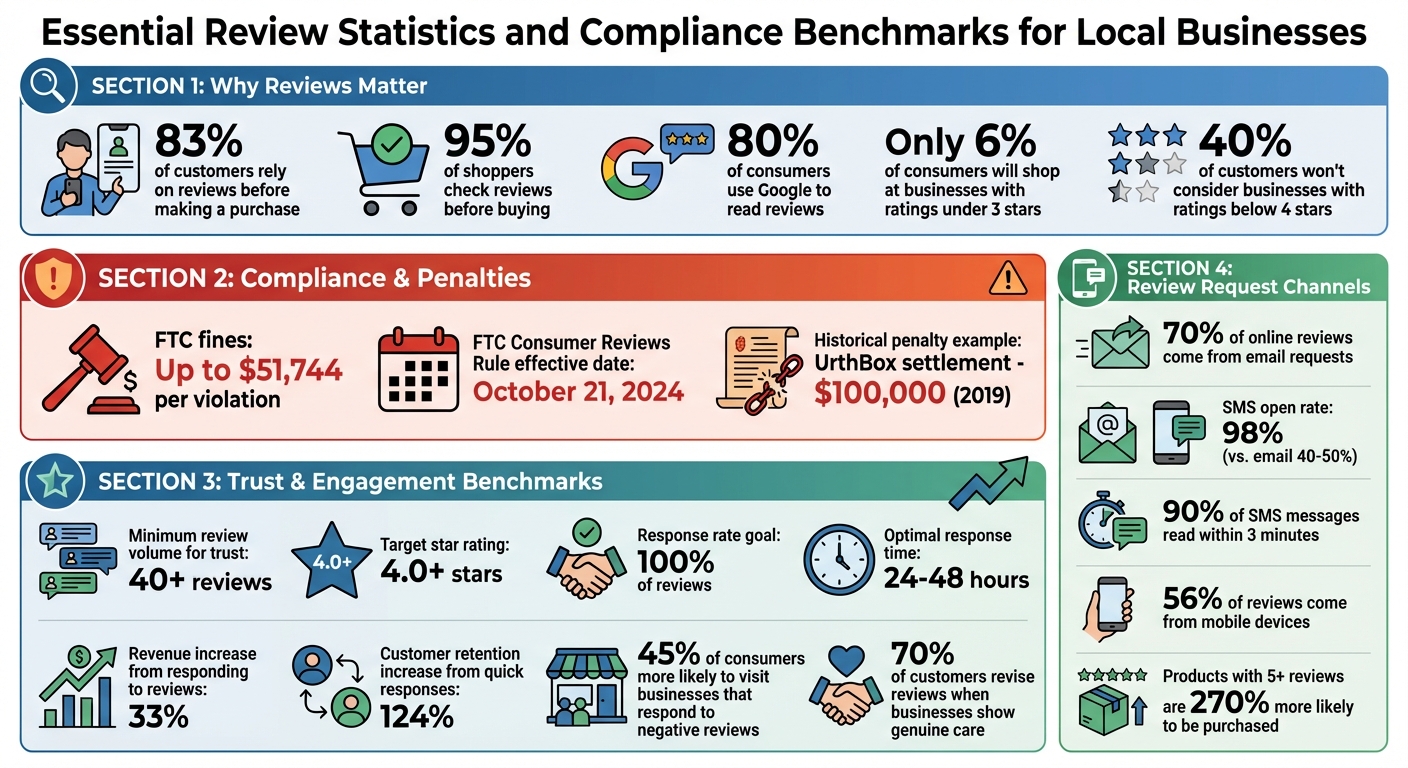
Essential Review Statistics and Compliance Benchmarks for Local Businesses
Is It Illegal To Incentivize Reviews? – BusinessGuide360.com
sbb-itb-50c3429
FTC Guidelines and Legal Requirements for Review Incentives
If you’re planning to use incentives as part of your review strategy, understanding the legal framework is essential. The Federal Trade Commission‘s Rule on the Use of Consumer Reviews and Testimonials, which took effect on October 21, 2024, sets the standard for ethical practices in this area. This rule allows courts to impose civil penalties for intentional violations, emphasizing the importance of compliance to safeguard your business and its reputation. These guidelines are enforced by both the FTC and Google to ensure the integrity of online reviews.
What the FTC Requires for Incentivized Reviews
When offering incentives for reviews, transparency is non-negotiable. The FTC mandates that any form of incentive – whether it’s a discount, gift card, free service, or donation – must be clearly disclosed at the start of the review.
The disclosure must be "unavoidable", meaning it should be immediately visible without requiring consumers to click a link, hover over text, or take any additional steps. For example, a review might begin with: "I received a free sample for this review." This ensures readers are fully informed from the outset.
"The rule does not prohibit giving incentives for reviews, as long as there isn’t an express or implied requirement that the reviews have to express a particular sentiment." – Federal Trade Commission
Incentives cannot be tied to specific outcomes, such as positive ratings or glowing feedback. Statements like "Leave us a 5-star review for a discount" or "Tell us how much you loved your visit to get a coupon" are strictly prohibited. Instead, use neutral phrasing like: "Share your experience for a chance to win" or "Leave us a review and receive a thank-you gift."
The FTC also addresses reviews from employees or individuals with a connection to your business. If someone with a material relationship – such as an employee or a family member – writes a review, they must disclose that connection. A simple note like "My spouse owns this business" satisfies this requirement. Additionally, businesses cannot pay for reviews from people who haven’t actually used their product or service. Every review must reflect a genuine customer experience.
To illustrate the consequences of non-compliance, consider the FTC’s 2019 settlement with UrthBox, Inc., which resulted in a $100,000 penalty for failing to disclose incentivized reviews.
Google’s Review Policies
Google enforces its own strict rules that align with FTC regulations. One key policy is the prohibition of review gating – the practice of soliciting reviews only from satisfied customers. Instead, businesses must invite all recent customers, regardless of their experience, to leave feedback.
Google also requires full transparency for incentivized reviews. Any form of compensation must be clearly disclosed within the review itself. Non-compliance can lead to serious consequences, such as the removal of individual reviews, suppression of your overall rating, or SEO penalties that reduce your visibility in search results. Google uses a combination of automated systems and human reviewers to identify suspicious activity, which could push your business lower in local search rankings.
Penalties for Breaking the Rules
Ignoring these rules can lead to severe penalties. Under the FTC’s 2024 rule, courts can impose civil penalties for deliberate violations.
"The rule authorizes courts to impose civil penalties for knowing violations and is important because fake, false, or otherwise deceptive reviews and testimonials have polluted the marketplace." – Federal Trade Commission
The rule also prohibits review suppression, which includes tactics like threats, intimidation, or baseless legal actions aimed at removing negative reviews. While it’s acceptable to respond professionally to criticism, businesses cannot make false claims about reviewers or pressure them to alter their feedback. Violating the Consumer Review Fairness Act, which protects consumers’ rights to post honest reviews, can result in additional penalties.
It’s worth noting that liability isn’t limited to your business alone. Advertising agencies, PR firms, and reputation management companies can also be held accountable if they engage in practices that breach FTC rules. Even if you outsource review management, your business is ultimately responsible for ensuring compliance with all applicable regulations.
Why Reviews Matter for Local Service Businesses
Before diving into building a review program, it’s important to grasp why reviews have become so crucial for local businesses. Nearly all shoppers rely on reviews before making a purchase. In fact, 83% of potential clients turn to reviews as their first step when searching for professional services. Reviews have essentially replaced traditional word-of-mouth, becoming the go-to way for customers to determine if a business is trustworthy. Let’s take a closer look at how reviews influence customer decisions and search rankings.
How Customers Use Reviews to Make Decisions
When customers read reviews, they’re looking for more than just star ratings – they want detailed insights. Studies reveal that businesses with fewer than 40 reviews are less likely to gain consumer trust, and 40% of customers won’t consider businesses with ratings below four stars. Even more telling, only 6% of consumers are willing to shop at a business with a rating under three stars.
How you handle reviews is just as important as the reviews themselves. For example, 45% of consumers are more likely to visit a business that responds to negative reviews. Additionally, responding quickly to feedback can increase customer retention by a staggering 124%.
How Reviews Affect Local Search Rankings
Reviews don’t just help customers – they also play a major role in shaping your local search visibility. They directly impact where your business ranks in local search results, especially in Google’s "Map Pack." This feature highlights three local businesses alongside a map at the top of search results. With over 80% of consumers using Google to read reviews in 2021, your Google Business Profile has become one of your most important marketing tools. Consistent, authentic review growth is key here. Sudden spikes in reviews can raise red flags for spam detection, so staying steady is critical.
Why Genuine Reviews Build More Trust
Authenticity in reviews goes a long way in building trust. Surprisingly, a few negative reviews can actually enhance credibility, as they show the feedback is genuine rather than manipulated.
On the other hand, incentivized reviews often fall short. When reviewers are motivated by a reward, their feedback may not reflect their true experience. Guylaine Cadorette, Global Marketing Content Manager at Bazaarvoice, emphasizes this point:
"Authenticity is vital in today’s market, and it’s important to have that come across in reviews".
| Metric | Target Benchmark | Why It Matters |
|---|---|---|
| Review Volume | 40+ reviews | Builds the minimum trust needed |
| Star Rating | 4.0+ stars | Meets expectations for 40% of consumers |
| Response Rate | 100% of reviews | Can boost revenue by 33% |
| Response Time | 24–48 hours | Shows commitment to customer service |
This breakdown highlights why ethical, customer-focused strategies are essential for building trust and driving engagement through reviews.
How to Incentivize Reviews Ethically
Encouraging reviews the right way means offering incentives that don’t pressure customers into leaving only positive feedback. The Federal Trade Commission (FTC) is very clear on this: "If you offer an incentive for a review, don’t condition it, explicitly or implicitly, on the review being positive". In other words, your program should welcome all feedback – whether it’s glowing praise or constructive criticism.
Incentive Ideas That Stay Within the Rules
There are several ways to offer incentives while staying compliant. For example:
- Prize drawings: Every customer who submits a review, regardless of its tone, gets an equal chance to win.
- Loyalty points: Customers can redeem these later, ensuring the reward isn’t tied to the sentiment of their review.
- Charitable donations: Some businesses pledge to donate to a cause for each review received, removing any direct benefit to the reviewer.
What to avoid? Cash payments or immediate gift cards, as these can create undue pressure for positive reviews. Also, keep in mind that platforms like Google, Yelp, Amazon (outside its Vine program), and Trustpilot strictly ban incentivized reviews altogether. If you’re using these sites, skip incentives and focus on gathering reviews through your own channels or third-party platforms that allow them.
Clear Communication About Incentives
Transparency is key. Any time you offer an incentive for reviews, you must include a clear and upfront disclosure. According to the FTC, "a disclosure is avoidable when a consumer must take any action, such as clicking on a hyperlink or hovering over an icon, to see it". This means the disclosure needs to be front and center in your review request – not buried in fine print or hidden behind a "read more" link.
When asking for reviews, use neutral language. For instance, say something like, "We’d love your honest feedback", instead of leading with phrases like, "Tell us why you loved your visit". Neutral wording shows you value all opinions equally.
Also, make sure to send review requests to all customers, not just those who had a good experience. Selectively targeting satisfied customers, a practice known as "review gating", is not only prohibited by Google but also undermines the credibility of your reviews.
Timing and Audience for Review Requests
When you ask for reviews can significantly affect how many responses you get. The best window is between 12:00 PM and 7:00 PM, aligning with peak hours in the afternoon and early evening. Ideally, send requests within 24–48 hours after the customer’s experience or transaction.
As for who to ask? The answer is simple: everyone. While it might seem tempting to only reach out to happy customers, compliance requires that you invite feedback from all customers. However, you can still use internal surveys to identify "brand promoters" – those highly satisfied customers who are naturally more likely to leave detailed and enthusiastic reviews.
Lastly, consider how you reach out. Research shows that 70% of online reviews come from post-transactional email requests, but SMS is quickly gaining traction with its 98% open rate, compared to email’s 40–50%. Use these insights to build a review program that’s both effective and compliant.
Steps to Set Up an Ethical Review Incentive Program
How to Launch Your Program
Start by defining what you want to achieve. Are you aiming to gather more reviews, improve your star ratings, or collect detailed feedback about your services? Once you’ve nailed down your objectives, choose a sentiment-neutral incentive that aligns with FTC and platform guidelines. Keep in mind that Google explicitly prohibits offering direct incentives like free products, discounts, or services in exchange for reviews. Make sure to use incentives only on platforms where they’re allowed.
Next, create a clear disclosure statement. This should appear at the beginning of every incentivized review, with wording like, “I received a loyalty point for leaving this review”. When asking for reviews, use neutral and honest language, such as, “We’d love to hear your feedback about your experience.” Avoid anything that might suggest you’re only looking for positive reviews.
To maximize effectiveness, integrate your review requests with your CRM or point-of-sale system so you can reach out to customers within 24–48 hours of their interaction. This timing keeps their experience fresh in their minds and increases the likelihood of a response. Be sure to track responses and avoid any form of review gating. Tools like Review Overhaul can help automate this process, making it easier to stay compliant while managing your reputation.
Once your program is running, shift your focus to monitoring and responding to reviews.
How to Monitor and Respond to Reviews
Keeping an eye on reviews is essential for maintaining trust and addressing concerns quickly. Use a centralized system to monitor all platforms, including Google, Facebook, industry-specific sites, and your own website. This approach helps you spot recurring issues, such as frequent complaints about long wait times, so you can address them proactively.
Responding to reviews – both positive and negative – goes beyond good manners. It’s also a smart business move. Companies that actively engage with their reviews see 33% higher revenue compared to those that don’t. For positive reviews, take the time to personalize your responses by referencing specific details from the feedback. Avoid generic replies like “Thank you for your review.” For negative reviews, keep your reply professional and concise: thank the reviewer, apologize briefly, and invite them to discuss the issue offline. Studies show that 70% of customers who revise their reviews do so because the business demonstrated genuine care and resolved their concerns.
Using Multiple Channels to Request Reviews
Email remains a powerhouse for driving reviews, accounting for about 70% of them. It allows for personalization and ensures you can include clear disclosures. SMS, however, is even more immediate – boasting a 98% open rate, with 90% of texts read within just 3 minutes of being sent.
For in-person interactions, QR codes are a simple yet effective way to connect customers to your review platforms. These can be added to receipts, business cards, or service documents, making it easy for customers to leave feedback while their experience is still fresh. This method works particularly well for service-based businesses. You could also set up tablets at checkout stations to capture immediate feedback. The goal is to make the process as seamless as possible. The fewer steps between the request and the review page, the higher the chances of customers completing the process. Since 56% of online reviews come from mobile devices, ensure your links and landing pages are mobile-friendly.
Building a Long-Term Review Generation System
Providing Service That Encourages Reviews Naturally
The foundation of generating consistent reviews lies in delivering outstanding customer experiences at every interaction. When you actively resolve customer concerns and go above and beyond, positive reviews often follow naturally.
Your frontline staff are key players in this process. By offering genuine, friendly engagement and addressing issues on the spot, they can help prevent negative feedback from surfacing online. Small gestures, like a complimentary service upgrade, can leave a lasting impression and inspire customers to share their experiences. Statistics show that 73% of customers leave reviews to share their experiences, and 63% do so to express gratitude.
"The businesses that do best on Yelp are the ones that provide a great customer experience to everyone who walks in the door without any expectation or encouragement that they write a review." – Yelp
This organic approach to reviews not only enhances your reputation but also creates a self-sustaining cycle of positive feedback, complementing strategies for showcasing reviews effectively.
Displaying Your Reviews to Encourage More Feedback
Once you’ve built a strong base of positive reviews, displaying them strategically can amplify their impact. Potential customers are more likely to share their own feedback when they see others doing the same.
Consider dedicating a page on your website to showcase customer reviews, which promotes transparency and builds trust. Highlight glowing testimonials on your homepage and service pages to establish credibility instantly. Adding a "Leave a Review" button to your testimonials page can also make it easier for customers to contribute. Did you know that products with at least five reviews are 270% more likely to be purchased than those without any reviews?
Using tools like JSON-LD structured data markup can help your reviews appear as star ratings in search results, boosting visibility and trustworthiness. Including details like the reviewer’s name and photo, when possible, makes reviews feel more authentic. Additionally, 26% of customers hesitate to leave reviews because they think businesses won’t read them. Actively responding to feedback can counter this perception and encourage more engagement.
Displaying reviews thoughtfully not only strengthens trust but also fosters a sense of community among your customers.
Creating a Customer Community That Reviews Regularly
To encourage ongoing feedback, focus on building deeper relationships with your customers. Let them choose where they feel most comfortable leaving reviews, whether it’s Google, Facebook, Yelp, or another platform.
Social media can be a powerful tool to make reviewing feel less like a task and more like a conversation. Instead of sending generic review requests, try asking specific, engaging questions like, “What’s the most challenging situation our team helped you solve?”. This approach invites storytelling and makes the process more enjoyable.
By weaving review generation into your overall community-building efforts, you show customers that their opinions truly matter. When they see you actively acknowledging their feedback and making improvements, leaving a review becomes a natural part of their ongoing connection with your business. Focus on creating a steady flow of reviews over time, rather than sporadic bursts, to avoid triggering spam filters.
This consistent and community-driven approach ensures that your review system remains authentic and sustainable.
Conclusion
Creating a review strategy that promotes growth while maintaining integrity is a balancing act. Offering ethical incentives for reviews allows you to gather meaningful customer feedback while staying aligned with FTC regulations and platform guidelines. The focus should always be on encouraging customers to share their honest experiences.
Keep in mind, the stakes are high – violating FTC rules can lead to fines of up to $51,744 per incident. Beyond fines, noncompliance could result in the removal of reviews and a hit to your revenue. On the flip side, responding to reviews can boost revenue by about 33%. Considering that 95% of shoppers check reviews before making a purchase, building and protecting your reputation is crucial.
"It’s unwise to incentivize consumer reviews… To avoid a review snafu, marketers should exercise care not to skew the system."
- Lesley Fair, Senior Attorney, FTC Bureau of Consumer Protection
FAQs
What makes a review incentive program ethical and compliant?
An ethical and compliant review incentive program prioritizes fairness, honesty, and staying within legal boundaries. It’s crucial that incentives are never linked to positive reviews, as doing so can mislead potential customers and breach regulations like the FTC’s guidelines. Instead, businesses should focus on encouraging genuine feedback, whether it’s glowing praise or constructive criticism.
Being upfront is non-negotiable – if incentives are offered, they must be clearly disclosed to ensure customers aren’t misled. Steer clear of tactics like review gating, where only satisfied customers are encouraged to leave reviews, as this skews the overall review profile. The goal should always be to build trust by delivering outstanding customer experiences and maintaining ethical practices that invite authentic, unbiased feedback.
What’s the right way for businesses to offer incentives for reviews without breaking FTC rules?
Businesses can ethically encourage reviews by being transparent and following FTC guidelines. The golden rule? Avoid anything deceptive, like paying for glowing reviews or fabricating testimonials. Incentives should never sway the reviewer’s opinion.
To stay within the rules, make sure to clearly disclose any incentives and stress that all feedback – positive or negative – is appreciated. For instance, you might thank customers for taking the time to share their experience and offer a small reward as a token of appreciation, regardless of the review’s tone. This method not only builds trust but also aligns with FTC regulations, which aim to ensure reviews remain honest and credible.
What happens if you don’t comply with FTC or Google’s review policies?
Failing to comply with FTC guidelines can have serious repercussions. This includes the possibility of fines, legal sanctions, and other penalties. Common violations include posting fake reviews, offering incentives without clearly disclosing them, or failing to reveal significant connections between your business and reviewers.
Similarly, breaking Google’s review policies can lead to the removal of reviews, suspension of your account, or even limitations on your business profile. To steer clear of these issues, it’s essential to keep your review practices honest, transparent, and in line with legal and platform requirements.
