
When it comes to local SEO, backlinks are critical. But the big question is: should you focus on a few high-quality backlinks or aim for a large number of links? The answer is clear – quality beats quantity every time. Here’s why:
- High-quality backlinks (e.g., links from trusted local news outlets or industry leaders) carry more weight with Google. They improve your rankings and build trust with search engines.
- Low-quality backlinks (e.g., links from spammy directories or irrelevant sites) can harm your rankings, trigger penalties, and offer little value.
Research shows that top-ranking pages often have 3.8x more high-quality backlinks than lower-ranking ones. A single authoritative link can outperform hundreds of weak ones. Plus, quality links ensure stable rankings, protect against algorithm updates, and drive targeted traffic.
Quick Overview:
- Focus on Quality: Links from trusted, relevant sources boost rankings and credibility.
- Avoid Quantity for Quantity’s Sake: Spammy links can lead to penalties and unstable results.
- Long-Term Wins: Quality links ensure consistent growth and visibility over time.
For local businesses, building strong, relevant connections within your community is the key to long-term SEO success. This includes optimizing your Google Business Profile to capture local intent.
Backlinks That Don’t Work (And Where to Get the Ones That Do)
What Makes a Backlink High-Quality for Local Businesses
High-quality backlinks play a crucial role in showcasing trust, relevance, and authority to search engines, especially through Google Business Profile management for local businesses. The best backlinks come from sources that are both geographically relevant to your area and aligned with your industry. For example, a link from a local newspaper or your city’s chamber of commerce carries far more weight than a generic link from an unrelated national directory. Let’s dive into the traits that define a strong backlink for local SEO success.
Characteristics of High-Quality Backlinks
The most effective local backlinks share several key characteristics. First, they come from credible domains with solid authority. Typically, these are websites with a domain authority (DA) score of 35 or higher and steady organic traffic of at least 1,000 visitors per month. Alex Horowitz, Digital PR Specialist at NP Digital, explains:
"A good backlink comes from a site with solid domain authority (DA 35+), consistent organic traffic of at least 1,000 visitors a month, and content that’s trustworthy and relevant to the client."
Second, placement matters. Backlinks embedded naturally within the main content of a page outperform those tucked into footers, sidebars, or comment sections. Third, the anchor text used in these links should be natural and diverse. This means using a mix of your brand name, descriptive phrases, and relevant keywords, rather than relying on repetitive, over-optimized anchor text that might trigger spam filters.
Geographic and topical relevance are also critical. For instance, a business based in Austin will benefit more from backlinks on local industry-related sites than from unrelated, high-authority sources. This combination of local ties and industry alignment sends powerful signals to search engines, reinforcing that your business is an active part of the community.
How Quality Backlinks Affect Local Rankings
Quality backlinks directly enhance your local "Prominence" by signaling your business’s authority through links from credible, local sources. These signals not only build trust with search engines but also improve your visibility in "near me" searches and location-specific queries.
The impact of quality over quantity is clear. A well-placed, relevant backlink can outperform thousands of low-quality ones. As Uberall highlights:
"A single quality backlink from a topically relevant site can actually prove more powerful than 1000 low-quality backlinks." – Uberall
Additionally, prioritizing quality backlinks reduces ranking volatility. High volumes of poor-quality links may lead to inconsistent outcomes, while focusing on strong links ensures more stable and reliable rankings.
Quality backlinks also prepare your business for the future of search. With AI-driven tools like ChatGPT and Google’s AI Overviews gaining traction, backlinks from trusted sources increase the likelihood that your brand will appear in AI-generated answers. For local businesses, this means that building quality links today is an investment in staying visible as search technology evolves.
Backlink Quantity in Local SEO
Focusing on quality backlinks is essential for building authority, but some strategies emphasize sheer quantity instead. This approach is based on the idea that more backlinks – regardless of their source – can increase visibility. For local businesses, especially those just starting or competing in crowded markets, prioritizing link volume can serve specific goals.
Benefits of High-Volume Backlink Strategies
For new businesses, having a large number of backlinks helps establish an online presence. It signals to search engines that your business is active within the local landscape.
Consider this: Over 96% of websites ranking in Google’s top 10 have more than 1,000 backlinks from unique domains. In competitive industries like legal services or finance, small businesses often need a high volume of links to compete with established players who already have hundreds – or even thousands – of backlinks.
A diverse backlink profile can also make your site look more natural. If you’re expanding into new markets or launching new products, having a variety of backlinks, even from mid-tier sources, can help. Strategies like tier-2 link building, where you point links to pages that already link to your site, can also boost the authority passed to your main website. That said, while focusing on volume can improve visibility, it does come with some serious risks.
Risks of Focusing on Quantity
The downside of this strategy lies in its potential inefficiency and risks. Google’s algorithms are designed to ignore low-quality or irrelevant links, so a large portion of your efforts may not impact rankings at all. As John Mueller, a Senior Search Analyst at Google, explained:
"The total number [of backlinks] doesn’t matter at all. Because you could go off and create millions of links across millions of websites if you wanted to, and we could just ignore them all."
Worse yet, focusing too much on quantity can lead to penalties. Practices like using link farms, automated tools, or purchasing cheap backlinks often trigger Google’s spam filters. In severe cases, this can result in manual penalties, causing your website to drop in rankings – or even be removed from search results entirely. For example, a sudden increase in backlinks – going from 50 to 5,000 in just one month – can raise suspicion and signal unnatural behavior.
Additionally, a backlink profile filled with spammy, irrelevant domains (those with high spam scores, over 30%) can harm your website’s credibility. Overusing keyword-rich anchor text, a common tactic in volume-focused strategies, may also be flagged as manipulative by Google. Instead of steady growth, these practices often result in unstable rankings that fluctuate unpredictably, undermining long-term success.
Quality vs. Quantity: Direct Comparison
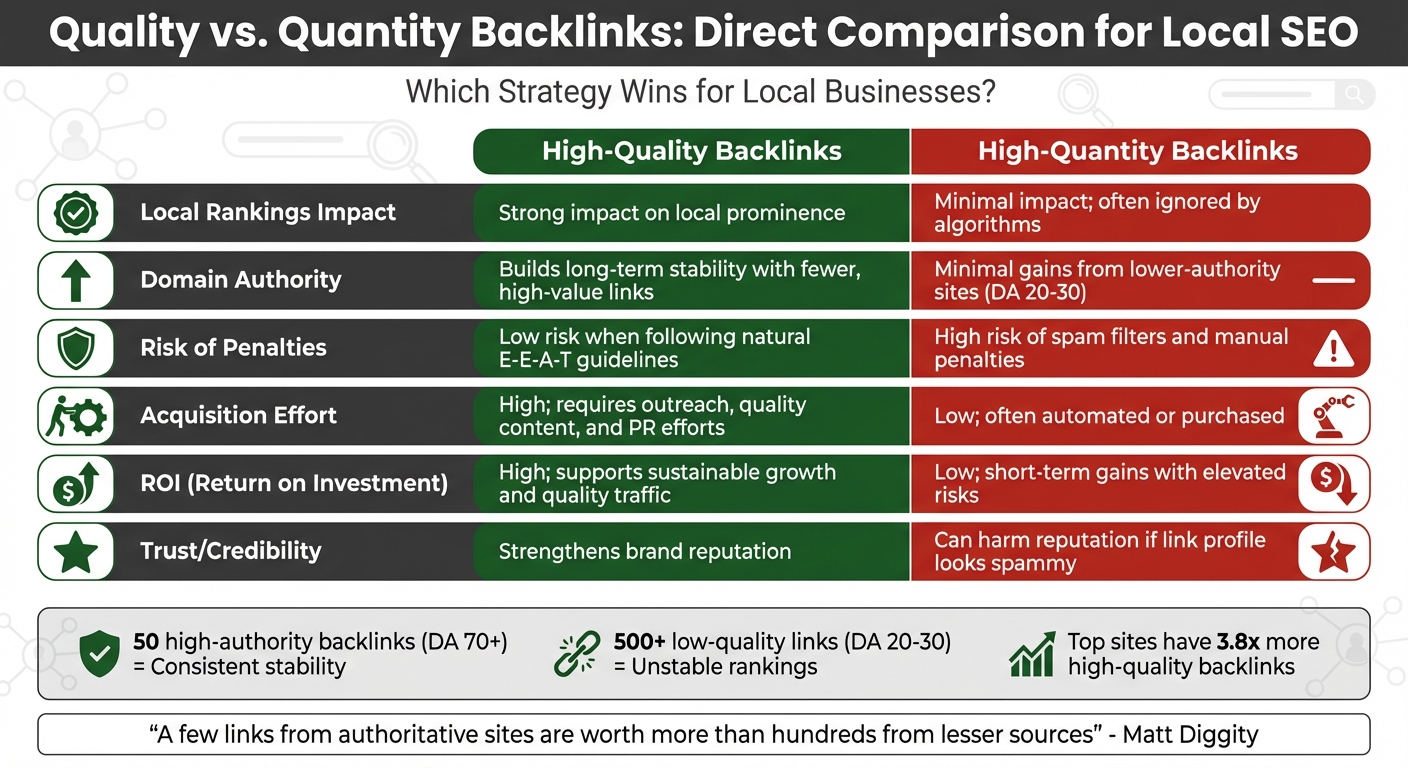
Quality vs Quantity Backlinks for Local SEO: Direct Comparison
Let’s break down the debate between quality and quantity when it comes to backlinks. Each approach has its strengths and weaknesses, but the choice often depends on your goals and the stage of your website’s growth.
Pros and Cons of Each Approach
Focusing on quality backlinks delivers long-term benefits. These links build trust and stability, helping your site withstand algorithm updates while boosting authority. Plus, they bring in targeted referral traffic from websites your audience already visits. The downside? Quality backlinks take time, effort, and resources. You’ll need strong content, strategic outreach, and patience to see results.
On the flip side, quantity-focused strategies can deliver quick wins, especially for new sites looking to gain visibility fast. They’re often easier to automate or outsource. However, this approach comes with major risks. Relying on a high volume of low-quality links can trigger spam filters and offer little in terms of real ranking power. As SEO expert Matt Diggity explains:
"A few links from authoritative sites are worth more than hundreds from lesser sources".
The table below highlights the key differences between these two strategies.
Comparison Table: Quality vs. Quantity
| Metric | High-Quality Backlinks | High-Quantity Backlinks |
|---|---|---|
| Local Rankings | Strong impact on local prominence | Minimal impact; often ignored by algorithms |
| Domain Authority | Builds long-term stability with fewer, high-value links | Minimal gains from lower-authority sites (e.g., DA 20–30) |
| Risk of Penalties | Low risk when following natural E-E-A-T guidelines | High risk of spam filters and manual penalties |
| Acquisition Effort | High; requires outreach, quality content, and PR efforts | Low; often automated or purchased |
| ROI | High; supports sustainable growth and quality traffic | Low; short-term gains with elevated risks |
| Trust/Credibility | Strengthens brand reputation | Can harm reputation if link profile looks spammy |
Why Quality Wins in the Long Run
Sites ranking at the top of Google typically have 3.8x more backlinks from high-quality domains compared to lower-ranked sites. On the other hand, websites relying on over 500 low-quality links (from DA 20–30 sources) often experience unstable rankings. Meanwhile, just 50 high-authority backlinks from DA 70+ sites can provide consistent stability. For local businesses, this kind of reliability is far more valuable than fleeting visibility spikes.
sbb-itb-50c3429
Why Quality Beats Quantity for Local SEO
Evidence Supporting Quality Over Quantity
When it comes to backlinks, quality outshines quantity every time. Research shows that pages ranking at the top of search results tend to have nearly 3.8 times more high-quality backlinks compared to lower-ranking pages.
In August 2024, Joy Hawkins from Sterling Sky demonstrated the power of a single authoritative backlink. Her case study revealed that one strong link could propel a site from 10th position – or even unranked – to 3rd place for target keywords within just two weeks.
Another large-scale study backs this up: earning backlinks from high-authority domains (with Domain Power scores of 90-100) leads to significant traffic and ranking improvements. In fact, these links resulted in a 150% jump in keyword rankings and a 275% boost in search impressions.
Metrics like Domain and Page Authority also have a stronger correlation with rankings (0.328 and 0.307, respectively) compared to sheer link volume (0.259). This underscores a simple truth: Google cares more about who’s linking to you than how many are linking. Eric Enge from Stone Temple explains it best:
"This data confirms that obtaining links from more authoritative sites has more value than obtaining a large quantity of links".
These findings highlight not just the immediate benefits of quality backlinks but also their lasting impact.
Long-Term Benefits of Quality Backlinks
The advantages of quality backlinks go beyond quick ranking boosts – they also ensure long-term stability. Websites built on strong, high-authority links are better equipped to weather Google’s algorithm updates. On the other hand, sites relying on a high volume of low-quality links often experience erratic rankings and constant fluctuations.
Google’s algorithm evaluates backlinks over time, monitoring how they appear, how long they last, and whether similar links continue to show up. This process includes a "Rank Transition Function", which can delay stable results for up to 70 days as it weeds out manipulative link-building tactics.
High-quality backlinks also drive targeted referral traffic, especially when they come from relevant local sources like community news sites or industry organizations. These links enhance your reputation, positioning your business as a trusted local authority. This aligns perfectly with the local partnerships and community connections discussed earlier. A 2026 survey of local SEO experts found that 63% believe link quality matters more than quantity, a trend that continues to grow as Google’s AI-driven search prioritizes expert-curated content.
To put it in perspective, 50 high-authority backlinks from domains with a DA of 70+ can provide consistent growth and stability. In contrast, 500+ low-quality links from DA 20-30 sources often bring more risk than reward. For local businesses, investing in quality backlinks is the key to securing long-term leadership in your market.
How to Build High-Quality Backlinks for Local SEO
Partner with Local Businesses and Organizations
Collaborating with other local businesses is a smart way to earn authoritative backlinks that can boost your local SEO. Look for non-competing businesses that share your audience. For instance, a wedding photographer could team up with a florist, or a plumber might connect with a real estate blog. Tap into your existing network – like accountants or lawyers – to uncover backlink opportunities. A great example of this is Shep’s Plumbing in Tacoma, WA. By securing links from the Tacoma Chamber of Commerce and local real estate sites, the business saw a staggering 1,100% increase in Google Business Profile impressions and generated over $100,000 in revenue in just six months.
"Local link building isn’t just about SEO metrics… It’s about weaving your business into the fabric of your community’s online presence."
- Gombos Atila Robert, PhD, CEO, Jasmine Business Directory
Getting involved in your community can also lead to strong backlinks. Sponsoring events, offering scholarships, or joining your local Chamber of Commerce often results in stable links from .edu or .org domains. Securing coverage in local media – whether it’s a newspaper, TV station, or business journal – is another powerful strategy. Editorial links from these sources are five times more impactful than standard directory listings, and 73% of consumers are more likely to trust businesses featured in local news. Hosting a workshop or organizing a charity event can create buzzworthy moments that attract this kind of attention.
These partnerships and community activities strengthen your online presence and work hand-in-hand with an optimized Google Business Profile.
Optimize Your Google Business Profile for Natural Backlinks
Your Google Business Profile (GBP) is a cornerstone of your local backlink strategy. A fully optimized GBP not only boosts your local credibility but also encourages other websites to link to you. Take Austi Wellness Acupuncture in Austin, TX, as an example. By focusing on backlinks from complementary health businesses and local bloggers, they saw an 88% boost in visibility and gained over 60 new patient leads each month.
Start by ensuring your GBP has accurate and consistent NAP (Name, Address, Phone), URL, and business hours. Consistency is key – businesses ranking in the top 10 local search results average 81 backlinks, compared to just 53 for those in positions 11–20.
"Think of your Google Business Profile (GBP) as your digital storefront for local search. It’s often the first thing potential customers see when they look for businesses like yours."
To further enhance your GBP, actively manage reviews, upload high-quality geotagged photos, and regularly post updates about promotions or events. An informative Q&A section can also engage potential customers and improve your chances of being featured in local guides or community resources.
While optimizing your GBP is a great start, tools like Review Overhaul can simplify and enhance the process.
Use Review Overhaul for Local SEO Support
Building quality backlinks for local SEO takes time and effort, but tools like Review Overhaul can make the process more manageable. This platform helps service-based businesses optimize their GBP, manage reviews, and maintain accurate listings, all of which are essential for earning high-quality backlinks.
Review Overhaul ensures your NAP information stays consistent across directories, which strengthens your authority and helps secure better citations. Its review management features build social proof, naturally attracting more backlinks. Plus, the tool keeps your business information accurate across multiple platforms, reinforcing the signals Google uses in its local ranking algorithm – where link signals account for 29% of the overall ranking factors.
For industries like healthcare, hospitality, and legal services, this comprehensive approach creates a strong digital foundation that supports long-term backlink strategies. Pricing starts at $299/month and includes features like reputation management, crisis response, and even voice search optimization. It’s a solid investment for businesses aiming to prioritize quality over quantity in their backlink-building efforts.
Conclusion
Google doesn’t care about how many backlinks you have – it’s all about the quality. As John Mueller, Google’s Search Advocate, explains:
The total number [of backlinks] doesn’t matter at all. Because you could go off and create millions of links across millions of websites if you wanted to, and we could just ignore them all
.
The data backs this up. A single link from a high-authority site (think Domain Authority 70+) can easily outshine dozens of links from lower-quality sources. These high-quality backlinks offer more than just better rankings – they provide stability, protect against algorithm updates, and reduce the risks associated with relying on large volumes of poor links.
For local businesses, this means putting effort into building meaningful connections within your community. Collaborate with local organizations, get featured in regional media, and create content that naturally earns citations. These efforts not only boost your search rankings but also drive valuable referral traffic and position your business as a respected local leader.
As discussed earlier, quality backlinks do more than stabilize rankings – they enhance your credibility in today’s AI-powered search landscape. Links from trusted sources help AI models, like ChatGPT, verify your authority, increasing the likelihood of being referenced in AI-generated content. By focusing on authoritative, trustworthy backlinks, you’re setting the stage for long-term growth, avoiding the pitfalls of quick fixes that often lead to inconsistent visibility.
FAQs
How can I tell if a backlink is high-quality?
A strong backlink originates from a trusted, relevant domain and includes anchor text that feels natural and fits seamlessly into the surrounding content. To assess the quality of a backlink, use tools that can analyze factors like domain authority and potential toxicity. Prioritize links that match your niche, boost your site’s credibility, and look organic to search engines.
How many quality backlinks does a local business need to compete?
The number of backlinks you need can vary based on your industry and the level of competition. However, the focus should always be on getting high-quality, relevant backlinks. For local SEO efforts, targeting about 72 referring domains that have local relevance can make a noticeable difference in rankings. Ultimately, it’s not about how many backlinks you have, but how authoritative and relevant they are to your site.
What should I do if my site already has spammy backlinks?
If your website has questionable backlinks, it’s essential to take action. Start by reviewing your backlink profile to pinpoint any harmful or low-quality links. Once identified, you can either disavow these links using Google’s Disavow Tool or work to have them removed entirely. This process helps protect your SEO performance. There are plenty of tools and resources available to guide you through analyzing and cleaning up your backlink profile efficiently.
