
It’s a tough spot for any small business owner. You’re pouring your heart and soul into your work, certain you’re delivering great service, but you’ve got this nagging feeling that some customers just aren’t coming back.
Maybe a few unexpected bad reviews have popped up, costing you both new clients and revenue. Suddenly, you’re second-guessing everything, and that uncertainty is keeping you up at night.
Why Even Happy Customers Silently Leave
This kind of quiet churn slowly eats away at your confidence and, more importantly, your bottom line. You start feeling like you’re just guessing what customers truly want, and it's incredibly frustrating when all your hard work doesn't seem to translate into unwavering loyalty.
The truth is, today’s customers have incredibly high expectations. A single misstep can overshadow an otherwise positive experience, sending them looking for another option without a second thought. This isn't about one-off bad days; it’s about understanding the subtle friction points that quietly drive people away.
The Small Issues That Cause Big Problems
More often than not, the reasons customers leave aren't dramatic confrontations. They’re a series of small, frustrating moments that add up over time. These are the silent killers of customer loyalty.
Think about things like:
- Inconsistent Service: One visit is fantastic, but the next feels rushed or completely impersonal.
- Minor Inconveniences: A confusing website, an unexpectedly long wait, or a return process that feels like jumping through hoops.
- Feeling Unheard: When feedback seems to disappear into a black hole or complaints are met with generic, scripted responses.
These seemingly minor issues build up. Poor experiences lead to quick churn—in fact, 70% of customers will abandon a brand after just two bad experiences. Every single interaction really does count.
Gaining Clarity and Taking Control
This is where customer experience benchmarking comes in. Don’t let the term intimidate you—it’s not some complex corporate strategy. It’s a straightforward way for you, the business owner, to stop guessing and pinpoint exactly where those friction points are happening.
By systematically comparing your service against your own past performance and what your competitors are doing, you get the clarity you need to make real, impactful changes. It’s the first step in turning negative feedback into an opportunity for growth, a key part of learning how to handle customer complaints effectively.
In this guide, Review Overhaul will walk you through our simple 3-step process to build a business that customers don’t just use, but one they are genuinely excited to support.
Step 1: Find Your Starting Point (Internal Benchmarking)
Before you even think about the competition, you need a clear, honest look at your own performance. This is where internal customer experience benchmarking comes in. Think of it as your starting line—it’s all about using the data you already have to see your business through your customers' eyes.
Forget about complicated software. This process starts by digging into the goldmine of your existing customer interactions. We're talking about support tickets, online reviews, social media comments, and even feedback from your frontline staff.
Uncover Insights From Existing Data
Your first real task is to start organizing all this feedback. Look for patterns. Is everyone complaining about a slow checkout process? Are your 5-star reviews constantly praising a specific employee for their amazing service?
This is how you create your initial 'CX Scorecard.' It's a simple way to organize what you find and give you a tangible baseline to build on. It's your private dashboard for tracking what truly matters to your customers.
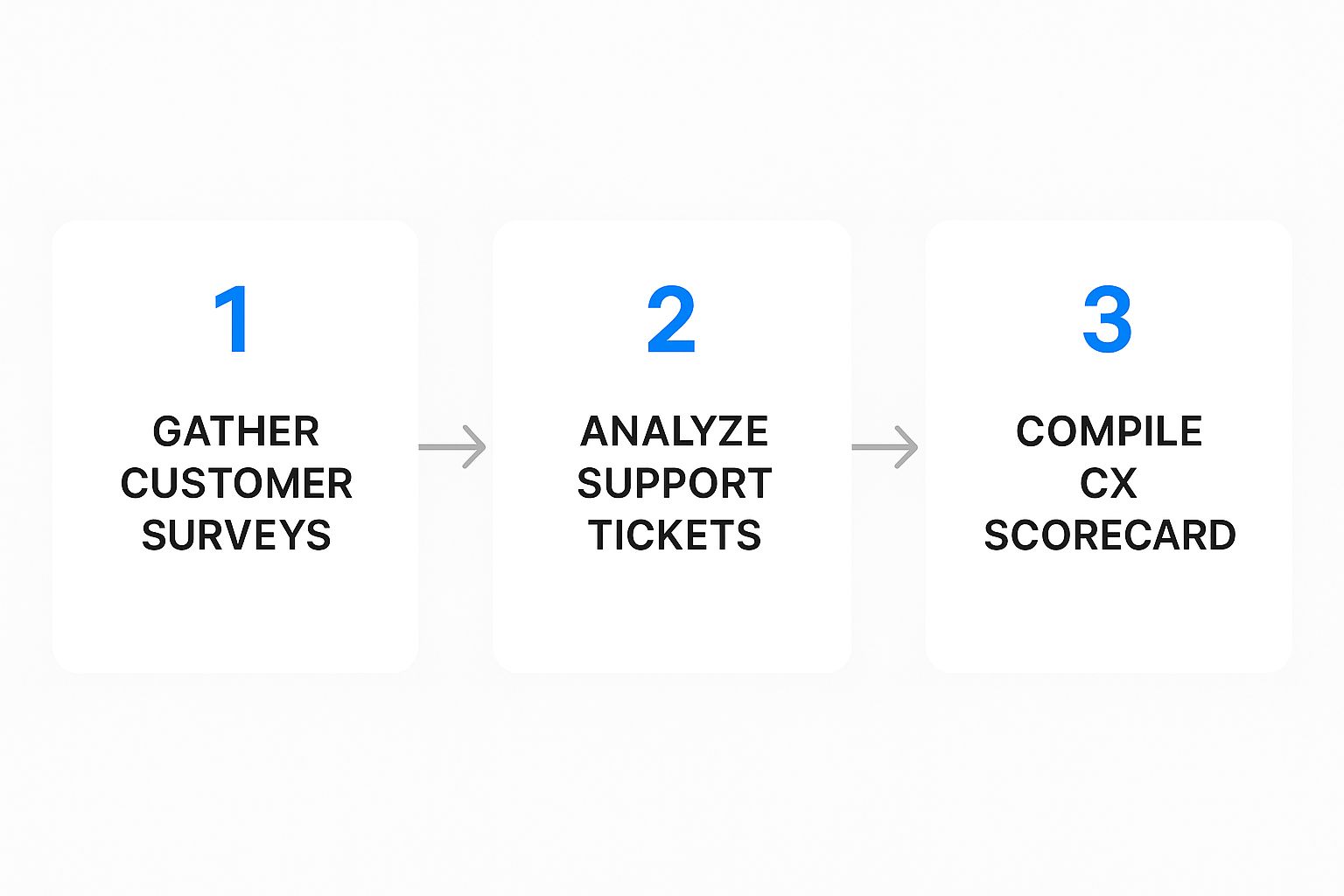
As you can see, it’s about turning disconnected data points into a single, clear benchmark that can guide your efforts to improve.
What's at Stake with a Single Bad Experience
Getting this initial data isn't just a "nice-to-have" exercise—the stakes are incredibly high. It’s a huge mistake to assume that a loyal customer will just forgive and forget.
The data is pretty jarring. Research from Plivo's contact center report shows that one in three consumers will leave a brand they love after just a single poor experience. For a small business, that’s a risk you just can’t afford to take.
"The first step to exceeding your customer's expectations is to know those expectations." – Roy H. Williams, Author and Marketing Expert
To really know those expectations, you have to measure them. This goes beyond just passively reading reviews; it means actively collecting feedback using simple tools. There are many excellent customer satisfaction measurement tools that can help you get this up and running without a heavy investment.
Step 2: See What Your Competitors Do Differently

Now that you’ve got a handle on your own performance, it’s time to peek over the fence. You can't operate in a bubble, especially when potential customers are sizing you up against your competition every single day.
This is where competitive customer experience benchmarking becomes your ace in the hole. It's all about turning their public feedback and processes into your private roadmap for getting ahead.
Let’s be clear: the goal isn’t to just copy what they do. It’s to spot the gaps. Where are they delighting customers in ways you haven't thought of yet? And, just as importantly, where are they fumbling the ball? That’s your golden opportunity.
Map Out the Competitive Landscape
First, pick one to three direct competitors. Now, your mission is to (ethically) walk a mile in their customers' shoes and see what the journey feels like.
Go through their entire customer process:
- Website and Digital Vibe: Is their website a breeze to use, or is it a confusing mess?
- First Contact: Give them a call with a simple question. Do they sound genuinely happy to help?
- Ongoing Communication: Sign up for their email list. Is it useful stuff, or just spam?
This kind of hands-on "mystery shopping" gives you a gut feeling for their service quality that raw numbers can never capture.
Dig Into Their Customer Reviews
Your competitors' online reviews are an absolute goldmine. Platforms like Google and Yelp give you a front-row seat to what people truly love and hate about doing business with them.
Did you know that 70% of customers now choose brands based on the expectation of an excellent experience? This global trend, highlighted in recent Ipsos customer experience research, shows just how critical this is.
Systematically go through their 5-star and 1-star reviews. Look for patterns. If they're praised for speed but blasted for their return policy, you now know where to focus your own marketing. This is a core part of building effective reputation management strategies for your business.
Step 3: Turn Your Insights Into Action
Alright, you've gathered all this fantastic data. Now what? Piles of data are just… piles of data. The real magic happens when you turn those insights into action that actually improves your business.
This is where the rubber meets the road. It's time to translate what you've learned into a straightforward plan that makes customers happier and grows your bottom line.
The trick is not to get bogged down. You don't have to fix everything overnight. The goal here is to build momentum by tackling the most glaring issues first.
Start with the Quick Wins
First things first, look for the "quick wins." These are the low-effort, high-impact changes you can make almost immediately.
For instance, imagine you run an auto repair shop. You see a pattern of 1-star reviews for competitors who leave customers in the dark. The quick win? Implement a policy to send a simple text message update at the end of each day. It costs you nothing but builds incredible trust.
“The most dangerous poison is the feeling of achievement. The antidote is to every evening think what can be be done better tomorrow.” – Ingvar Kamprad, Founder of IKEA
This is the exact mindset you need. Small, consistent improvements stack up over time and create a massive gap between you and the competition.
Map Out Your Next Moves
After you've checked off a few quick wins, it's time to plan for the bigger projects. Just list out the improvement ideas you’ve uncovered. Then, rank them based on customer impact and business effort.
Your roadmap should clearly outline:
- The Action: What, exactly, are you going to do? Get specific.
- Who’s in Charge: Even in a tiny team, someone needs to own each task.
- A Realistic Timeline: Set deadlines that are achievable.
This simple structure turns vague "we should…" ideas into a concrete to-do list. To keep this process fueled with fresh insights, you'll need a solid way to collect feedback. Take a look at our guide on customer feedback management systems to see some tools that can help.
A Better Reputation and More Sales
You’ve done the heavy lifting—you’ve dug into the data, uncovered some truths, and started making real changes based on your customer experience benchmark. But this is the exact spot where many businesses take their foot off the gas.
The real magic of benchmarking isn’t found in a one-time project. It’s about weaving this mindset into the very fabric of your business, making excellence your default setting.
From Guessing to Growing
Think of it this way: a great customer experience isn’t a finish line you cross. It’s a continuous loop of listening, adapting, and improving. Getting this right means you stop playing defense against customer complaints and start proactively building a reputation that does the selling for you.
You'll know your hard work is paying off when you start tracking a few key numbers. Keep an eye on:
- Net Promoter Score (NPS): A powerful snapshot of customer loyalty.
- Average Review Rating: The number potential customers see first.
- Customer Effort Score (CES): A low-effort experience is a huge driver of loyalty.
Watching these numbers move in the right direction is incredibly motivating. It provides tangible proof that the changes you're making are actually making a difference for your customers and your business.
Making Continuous Improvement Your Superpower
The final piece of the puzzle is turning this cycle into a core part of your operations. It’s about building repeatable systems that deliver quality and consistency without you having to think about it every second of the day.
For business owners who are ready to get more formal, implementing structured quality control processes provides a fantastic framework for keeping standards high.
The choice is yours: keep losing customers and reacting to bad reviews, or build a proactive system that fuels your growth and gives you peace of mind. By making customer experience benchmarking a habit, you’re not just solving today's problems—you’re building a stronger, more respected business for years to come.
Your Questions Answered
Diving into something new like this always kicks up a few questions. As a business owner, your time is precious, so you need straight answers.
How often should I actually do this?
For the big, deep-dive competitive analysis, a full benchmark every 6 to 12 months is a solid rhythm. But you should be keeping a much closer eye on your internal metrics, like surveys and reviews, on a weekly or monthly basis to catch small hiccups before they become big problems.
What are the best metrics to track first?
It’s incredibly easy to get buried in data, so start simple.
Focus on these three to get going:
- Net Promoter Score (NPS): Your loyalty metric.
- Customer Satisfaction (CSAT): Perfect for a real-time pulse check.
- Your Average Star Rating: Your first impression on platforms like Google.
How do I find competitors to benchmark against?
No direct local competitors? No problem. Think about "aspirational" competitors in other cities or even online-only companies you admire. You can also look at businesses in different industries that serve a similar customer base. The most valuable insights often come from looking outside your immediate bubble.
What if I can't afford fancy survey software?
Good news: you absolutely don't need it. Many business owners get incredible results using free tools. Google Forms is a fantastic way to create simple, clean surveys that get the job done without costing a dime.
Feeling like you need a hand cutting through the noise? The team at Review Overhaul provides the expert guidance to help you build a reputation that drives real, measurable growth. Let's figure out a plan together.
