Is it incredibly frustrating to watch a few negative reviews drag down years of your hard work? As a small business owner, you know the quality your team delivers, but a handful of online comments are telling a different, damaging story—one that costs you real customers and hard-earned revenue. You feel like your online reputation is out of your control, and it's starting to impact your bottom line.
At Review Overhaul, we act as your trusted guide to help you take back that control. We believe you are the hero of your own story. Our role is to provide a clear, simple plan to turn your online reputation from a source of constant stress into your most powerful marketing asset.
Our Simple 3-Step Plan to Success
We provide a clear path to transform your online presence. Our simple but powerful process is designed to give you back control and confidence.
- Step 1: We Audit Your Current Reputation. First, we’ll uncover what customers are really saying about you across every platform that matters, establishing a clear baseline.
- Step 2: We Optimize Your Digital Storefronts. Next, we’ll ensure every online profile presents a polished, professional, and trustworthy image to make a perfect first impression.
- Step 3: We Build a System for Positive Feedback. Finally, we'll implement a system to proactively generate the 5-star reviews your great work truly deserves.
Imagine the peace of mind you’ll feel when your online reputation finally reflects the real-world excellence of your business, attracting a steady stream of new customers. The stakes are clear: you can either continue losing business to competitors or build a foundation for sustainable growth and peace of mind.
“Review Overhaul took us from a 3.8 to a 4.9 on Google in six months. The impact was immediate. Our phones started ringing more, and our team felt a renewed sense of pride. They gave us the plan, and it worked.” – John D., Owner of a Local Service Business
This isn't just about damage control; it's about building a lasting digital legacy of trust that drives real results. For a deeper look at the core principles, our guide on online reputation management for small business covers the fundamentals in more detail.
Ready to see how your reputation measures up?
Conducting Your Online Reputation Audit
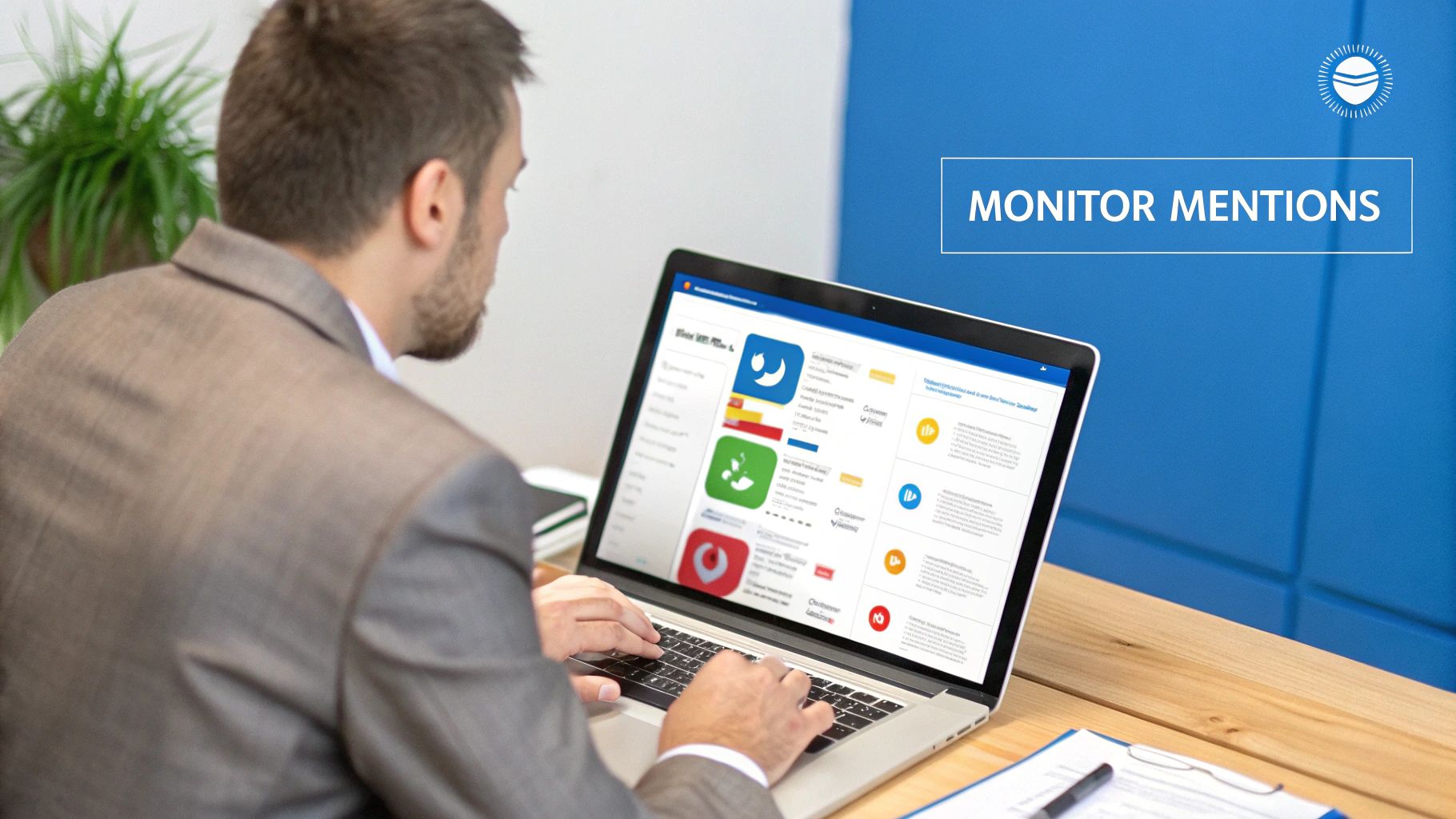
Before you can build a five-star reputation, you must know where you stand right now. Think of this initial audit as establishing your baseline—an honest, clear-eyed look at what customers are actually saying about you online. It’s about moving beyond what you think people feel and diving into the hard data.
This isn't a step you can afford to skip. Without a proper audit, you're just guessing, and you can't build a winning strategy on guesswork.
Systematically Searching for Your Business
First, you need to see your business through a customer's eyes. Go incognito and start searching. Your goal is to uncover every single place online where an opinion about your brand is being formed, for better or for worse.
Start with the usual suspects, then get more specific.
- Major Search Engines: Search your business name on Google and Bing. Pay close attention to your Google Business Profile, star ratings, and any news articles or blogs.
- Key Review Platforms: Dig into your profiles on high-traffic sites like Yelp and Facebook. This is where you'll find a goldmine of detailed customer feedback.
- Industry-Specific Sites: Don't forget the platforms that matter most in your niche, like TripAdvisor for a restaurant or Healthgrades for a doctor's office.
A pro tip: always search for common variations and misspellings of your business name. You'd be surprised how many mentions you can miss otherwise, preventing you from getting the full picture.
Categorizing Feedback to Find Patterns
Once you've gathered all this feedback, the real work begins. It's not about a simple "good vs. bad" count; the magic is in spotting the recurring themes.
I recommend creating a simple spreadsheet to track what you find. Note the source of the review, the overall sentiment, and the specific points mentioned. This simple act turns chaotic comments into organized, actionable intelligence.
As you sort through the data, you'll start answering crucial questions. Maybe customers love your friendly staff but complain about parking. These are the insights that lead to meaningful change.
Don't underestimate this feedback. 85% of consumers trust online reviews as much as a personal recommendation. What’s more, 92% of users will only consider businesses with at least a 4-star rating, according to ReputationX's detailed analysis.
Building Your Reputation Scorecard
The final piece of your audit is to consolidate everything into a reputation "scorecard." This document is your at-a-glance summary, the foundation upon which your entire strategy will be built.
Your scorecard should cleanly lay out:
- Overall Star Ratings: Your average score on Google, Yelp, Facebook, and other key sites.
- Sentiment Breakdown: A simple tally of your positive, negative, and neutral reviews.
- Key Strengths: The top 3-5 things customers consistently praise you for.
- Critical Weaknesses: The top 3-5 problems that keep cropping up in negative feedback.
With this scorecard in hand, you're no longer flying blind. You have a data-driven map of your reputation, showing you exactly where to focus your efforts for the greatest impact.
Optimizing Your Digital Storefront for Trust

Think of your business profiles on Google, Yelp, and Facebook as your digital front doors. If that door is unkempt and the signage is wrong, potential customers will simply walk on by. Incomplete or inconsistent online listings erode trust before a customer ever sees a single review.
For a small business owner, this is where you seize control of that crucial first impression. Presenting your business as credible and professional online is a foundational step in building the confidence a customer needs to choose you.
Mastering Your Google Business Profile
Your Google Business Profile (GBP) is, without a doubt, the most critical piece of your digital real estate. It's often the very first interaction a potential customer has with your brand. An unmanaged or incomplete profile is a major red flag for both customers and search engines.
The first, non-negotiable step is to claim and fully verify your GBP. Once that’s done, your mission is to treat every section as an opportunity, filling it out with accurate, compelling, and up-to-date information. A sparse profile suggests neglect; a detailed one signals professionalism.
For a comprehensive walkthrough, our detailed guide on Google My Business listing optimization breaks down the entire process into actionable steps.
Your business description is not just a field to be filled; it's your opportunity to tell your story. Use it to communicate what makes you different and connect with your ideal customer.
The Critical Importance of NAP Consistency
One of the most common and damaging mistakes businesses make is having inconsistent Name, Address, and Phone Number (NAP) information scattered across the web. Imagine a customer finding one phone number on Google and a different one on Yelp. It creates immediate confusion and distrust.
Search engines rely on this NAP data to verify your business's legitimacy. Identical information across all platforms sends a powerful signal of trust and is a cornerstone of local SEO.
I always recommend a meticulous audit of your NAP details.
- Standardize Your Format: First, decide on one official format for your address (e.g., "Street" vs. "St.") and stick to it everywhere.
- Update the Majors: Start with Google, Facebook, Yelp, and Bing Places.
- Check Niche Sites: Don't forget industry-specific directories relevant to your field.
This cleanup process might seem tedious, but its impact on customer confidence and search visibility is enormous. It’s the digital equivalent of ensuring the sign above your door matches your business card.
Showcasing Your Business with High-Quality Visuals
In an online world, you have to bring the experience to your customers. High-quality photos and videos are essential for building trust and setting accurate expectations. Profiles with photos receive significantly more clicks and requests for directions.
Your visuals should tell a complete story.
- Your Location: Use high-resolution images of your storefront, interior, and unique features.
- Your Team: Professional (but approachable) photos of you and your staff help humanize your brand.
- Your Work: Showcase your products or the results of your services in action. This is your proof of quality.
Avoid generic stock photos at all costs. Authentic images build a genuine connection and provide tangible evidence of your quality. A steady stream of new photos also signals to Google that your business is active and relevant.
Building a Proactive Review Generation System
If you're waiting for happy customers to leave reviews on their own, you're fighting a losing battle. The reality is that your satisfied clients—the silent majority—often move on. Meanwhile, a single unhappy customer is far more motivated to share their experience.
It's time to stop leaving your reputation to chance and start actively shaping the conversation. A proactive review generation system turns random feedback into a predictable, steady stream of positive social proof that attracts new business.
Timing Your Request Perfectly
The single most important factor in getting a glowing review is asking at just the right moment. You need to make your request when the value you've provided is still fresh and top-of-mind. Wait too long, and that initial "wow" factor has faded.
Think about the peak satisfaction point in your customer journey.
- For a restaurant: This might be right after they’ve paid the bill following a fantastic meal.
- For an auto repair shop: It could be a day after they’ve picked up their smoothly running car.
- For a dentist: This could be during checkout after a successful appointment. See how it works for online reputation management for doctors.
Pinpointing this "moment of peak happiness" is your first move. This thoughtful timing is what separates a successful request from one that gets ignored.
Choosing the Right Channels and Tools
Once you know when to ask, you have to decide how. The best method is always the one that’s most convenient for your customer. Simplicity is your greatest ally here; a convoluted process is the fastest way to get someone to abandon the effort.
This table compares common methods for requesting reviews.
| Channel | Typical Response Rate | Implementation Effort | Best For |
|---|---|---|---|
| 5-15% | Low | Businesses that already collect customer emails (e-commerce, service providers). | |
| SMS (Text Message) | 15-30% | Medium | Businesses with a direct, personal client relationship (salons, contractors). |
| QR Code / In-Person | 5-10% | Low | Brick-and-mortar locations (restaurants, retail shops, clinics) for in-the-moment feedback. |
Choosing the right channel is about meeting your customers where they are. Don't be afraid to experiment to see what yields the best results.
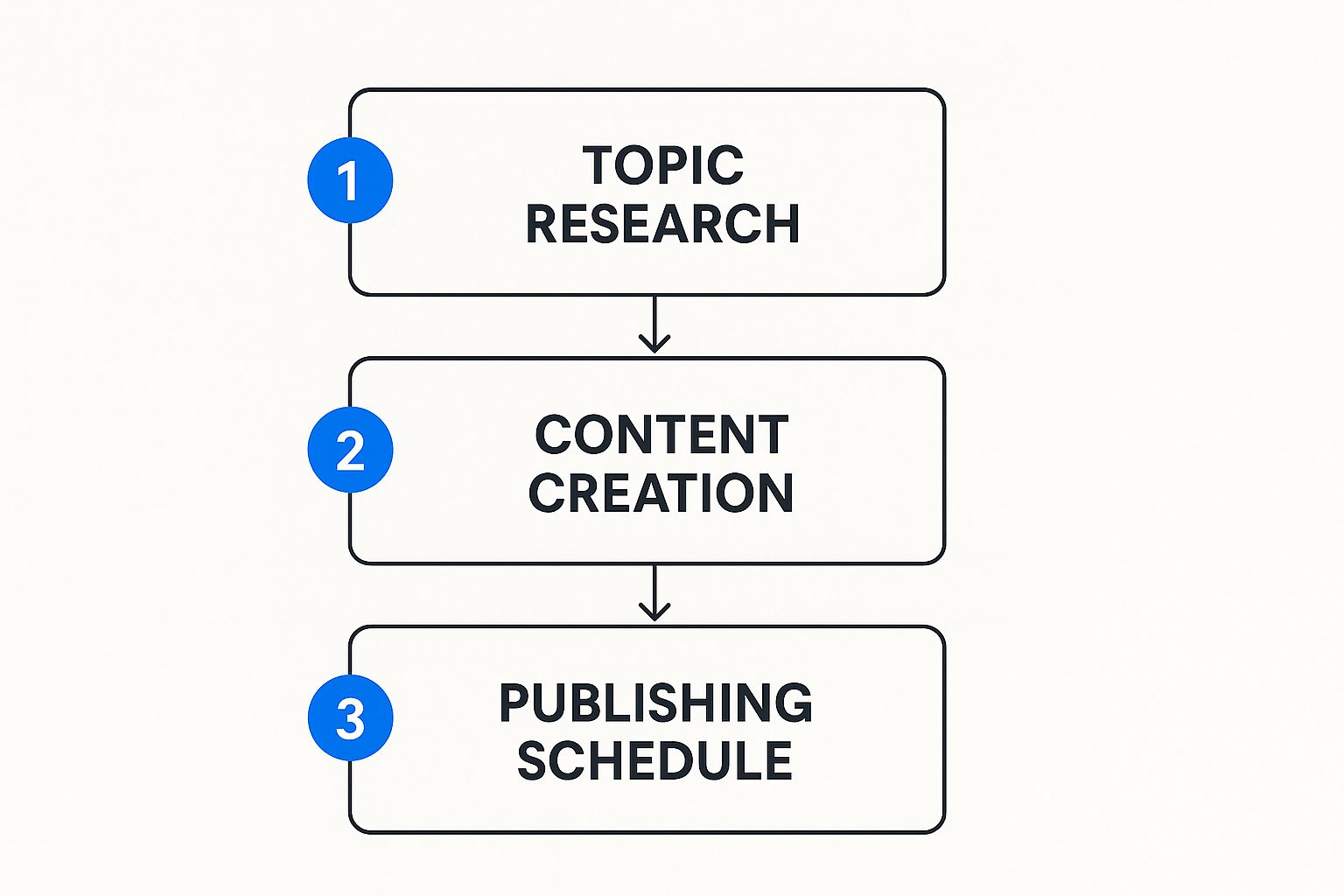
The flow in this graphic is a great reminder that a structured approach is far more effective than a random one.
Automating the Process for Consistency
Manually sending every review request can quickly become overwhelming. This is where automation tools become a true game-changer, ensuring no satisfied customer ever slips through the cracks.
A proactive system ensures your reputation is built on consistent, positive feedback, not left to luck. It transforms review collection from a sporadic task into an automated asset that works for you 24/7.
Modern platforms can integrate with your CRM or scheduling software to automatically trigger a review request. This doesn't just save you hours; it guarantees your requests are sent at the optimal time, every time. To truly make this work, you have to increase customer engagement at every step.
Mastering the Art of Responding to Reviews

Your replies to online reviews are much more than just customer service; they're a public demonstration of your company's character. Your response isn't just for the person who left the review. It’s for every potential customer who scrolls through that feed.
This is your chance to turn a potentially damaging situation into a win. It’s how you transform a static star rating into a dynamic conversation that builds real trust.
The High Stakes of Engagement vs. Silence
When a negative review pops up, it’s tempting to ignore it. That’s a mistake. Silence looks like guilt, or worse, indifference. A prompt reply immediately shows you’re listening and that you care.
The numbers don't lie. Research shows 53% of customers expect a response to a negative review within a week. Yet, an astonishing 75% of businesses don't reply at all. That silence is a massive missed opportunity, as you can discover more stats that prove the power of online reviews at Chatmeter.com.
A Framework For Responding To Negative Reviews
A one-star review can feel like a punch to the gut. The worst thing you can do is fire back an emotional response. The key is to stay calm, professional, and follow a clear plan.
We walk our clients through a simple framework to de-escalate conflict.
- Acknowledge Their Point: Start by thanking them and specifically mentioning their complaint. This shows you've actually read and understood their issue.
- Give a Sincere Apology: Apologize for the specific failure. Don't make excuses—a simple, "We apologize for the frustration this caused," is incredibly powerful.
- Take It Offline: Provide a direct line of contact—a manager's email or phone number—to move the discussion out of the public square.
For a deeper dive, our guide on how to respond to negative reviews is packed with more detailed strategies.
Remember: The primary audience for your response is not the unhappy customer; it’s every future customer. Your goal is to show them you are a reasonable, professional, and accountable business owner.
Turning Positive Reviews Into Your Best Marketing
Responding to positive reviews is just as crucial. A generic "Thanks!" is a missed opportunity. A personalized response can turn a happy customer into a genuine advocate for your brand.
Here’s how to make your positive replies really count:
- Use their name. This makes the interaction feel genuine, not like a cut-and-paste job.
- Reference a specific detail. Mention something specific from their review, like "We're so glad you enjoyed the spicy tuna roll!"
- Invite them back. A warm invitation like, "We can't wait to welcome you back again soon!" strengthens the relationship.
Your Path to a Stronger Reputation and Business Growth
You now have a complete plan to take control of your online reputation. That feeling of anxiety that hits with every negative review can be replaced with the confidence that your online presence reflects your quality work. Soon, new customers will find you through authentic, glowing recommendations.
Your business will no longer be defined by a few disgruntled voices. You've earned the peace of mind that comes from knowing your digital reputation is a powerful asset, not a liability. This journey is about building a secure foundation for your business's future.
Maintaining Your Success
To keep this momentum going, you have to stick with the core principles: Auditing, Optimizing, and Engaging. Think of this not as a one-time project, but as a fundamental part of your business operations.
Sometimes, a bigger strategic move is needed. For some excellent real-world inspiration, you can explore iconic rebranding examples and strategies and see how established companies completely revitalized their public image.
The stakes are clear: you can either continue losing customers to competitors, or you can embrace a proactive strategy that builds trust, drives growth, and gives you peace of mind. Your reputation is the cornerstone of that choice.
This structured approach has a direct, measurable impact on your bottom line. To see the numbers, learn more about how reputation management drives revenue for small businesses in our detailed guide.
Answering Your Top Reputation Management Questions
When you commit to improving your online reputation, a lot of questions pop up. As a business owner, you need straight answers to feel confident. Let’s walk through some of the most common questions we hear.
Getting these details right is what separates a successful strategy from a frustrating one. These answers will help you make sure your efforts are effective and built for long-term success.
https://www.youtube.com/embed/nBMee0ewY5E
How Long Until I See Real Results?
This is a common question. Cleaning up your business profiles gives you an immediate visual lift. Your listings will look more professional right away.
However, moving the needle on your actual star rating is a longer game. To see a meaningful, measurable increase in your overall rating, a realistic timeframe is anywhere from three to six months. The secret ingredient is consistency—diligently asking for new feedback and responding to every single review.
Success in reputation management is not a sprint; it's a marathon. Consistent, daily actions compound over time to build a strong, resilient online presence.
Can I Offer Incentives for Reviews?
This is a hard no. Offering compensation for a review might seem like a clever shortcut, but it violates the terms of service for nearly every major review platform, including Google and Yelp.
The consequences can be severe, from having all your reviews wiped to having your business listing suspended. It’s just not worth the risk. The best approach is to create an experience so good that people genuinely want to share their positive feedback.
What Is the Best Way to Handle a Fake Review?
It’s infuriating to see a fake negative review. The key is to respond with a calm, strategic head, not with emotion.
Here’s a simple, three-step process:
- Investigate First. Before doing anything, check your records. Confirming you have no record of the reviewer gives you the confidence to act.
- Flag and Report. Use the platform’s built-in tools to flag the review for removal. If it violates policies, you have a solid case.
- Respond Professionally. Post a short, calm public reply. Something like, "We take feedback seriously, but we can't find any record of your visit in our system. Please contact us directly so we can look into this."
This measured response demonstrates your commitment to real customers while using the proper channels to fight fraud.
Are you ready to stop worrying about negative reviews and start building a reputation that drives growth? The experts at Review Overhaul can help. Schedule your free reputation audit today and get a clear plan for success.
