
That sinking feeling when a negative review notification pops up? You're not alone. As a small business owner, you pour your heart into your work, and a single unhappy comment can feel like a direct hit, threatening to undo all your effort.
These aren't just words on a screen; they're public testimonials actively costing you customers and revenue. Each unanswered review is a missed opportunity, chipping away at your reputation and your peace of mind. But you have the power to turn this around.
With Review Overhaul as your guide, we'll give you a simple, 3-step plan to take control of the conversation. You'll learn how to transform negative feedback into your biggest win and amplify positive reviews to build unshakable trust. The result? A stellar reputation that drives more sales and lets you get back to doing what you love.
Our clients see it every day. By implementing our strategies, businesses like yours have turned their online reputation into their most powerful marketing asset. They've stopped losing sleep over bad reviews and started attracting more customers than ever before.
What's at stake? You can continue letting unanswered criticism drain your revenue, or you can build a resilient reputation that fuels growth. Schedule a free consultation with Review Overhaul today and let us show you how to make every review work for you, not against you.
Why Your Reputation Is On the Line
Each review is a direct line to your customers—and a golden opportunity. A staggering 87% of consumers feel more confident in a purchase after seeing positive reviews. When you learn how to respond to reviews effectively, you build that critical trust.
Remember, every review is a chance to directly engage with your customers. This is a core part of effective strategies to improve customer experience and build loyalty. Simply responding shows you’re present and that you take all feedback seriously.
When you reply to a guest review, you’re not just responding to the person who wrote it—you’re writing to all the potential future guests who’ll be reading it to see how you handle feedback.
Taking Control of the Narrative
As a business owner, you're the hero of your brand's story. Managing feedback is a massive part of that. This isn't just damage control; it's about actively guiding how your business is seen by the public.
This is exactly what reputation management is all about. By learning what is reputation management and why does it matter, you can turn what feels like a chore into a powerful tool. A thoughtful response can:
- Turn a critic into an advocate by showing you solve problems.
- Encourage repeat business from customers who feel appreciated.
- Put your company values on full display for everyone to see.
The choice is clear: keep losing customers to unanswered criticism or start building a resilient reputation. This guide provides the straightforward plan you need to succeed.
The Hidden Opportunity in Every Review
What if you started looking at every single review—good or bad—as a marketing opportunity? This simple mindset shift turns a dreaded task into one of your most powerful tools for growth. It's about actively shaping your public reputation, one thoughtful response at a time.

When you craft a great response, you’re showing every potential customer that you genuinely care. It’s your chance to prove your commitment to excellence, turning a complaint into a live demonstration of fantastic customer service. Suddenly, critics become advocates and happy customers become lifelong fans.
Turning Feedback Into Fuel
Every piece of feedback you get is packed with insights. A negative review can shine a light on a weak spot in your operations. A glowing review tells you exactly what to double down on.
Responding shows you’re present, engaged, and that you take feedback seriously—whether it’s a glowing review or a slightly more “constructive” one.
By engaging, you prove you're a business that listens, learns, and adapts. That kind of transparency builds trust that advertising can't buy. When you start harnessing customer feedback for business growth, you make real improvements that lead to better experiences.
The High Stakes of Silence
Ignoring reviews is one of the worst things a business owner can do. Your silence is often interpreted as indifference, which can tank customer trust in a heartbeat. The numbers don't lie.
When brands respond to complaints, customer advocacy can jump by as much as 25%. But if you ignore them? Customer advocacy can plummet by a staggering 50%. You can dig into more of these powerful customer service statistics to see what's on the line.
Every review response is a public display of your company's values. It's a chance to either stand by your commitment to quality or let a negative story write itself.
How to Make Your Positive Review Responses Really Count
A glowing five-star review rolls in. It's easy to drop a quick "Thanks!" and move on. But overlooking your happy customers is a huge mistake.
Think of your response as a public "thank you" card. It makes the original reviewer feel great and amplifies their experience for everyone to see. When potential customers see you engaging with fans, it builds massive trust and turns a happy customer into a lifelong advocate.

Crafting a Reply That Feels Real
The secret is personalization. Ditch the copy-paste replies. Mention a specific detail from their review to prove you actually read what they wrote.
Let's say you run an auto shop and a customer praises your team's honesty. Your reply should echo that sentiment.
A great example: "We're so glad to hear you had a great experience, especially with our diagnostic service! Our team takes real pride in providing honest and clear communication, so your feedback means the world to us. We look forward to helping you again!"
This makes the reviewer feel genuinely appreciated. It also puts one of your core strengths—honesty—on display for future customers. For more ideas, check out our playbook on crafting the perfect Google review response.
Best Practices for Your Positive Replies
So, how do you make every response a winner? It boils down to a few simple tactics that show genuine appreciation while subtly marketing your business's best features. These little efforts go a long way.
- Get specific. Always reference something unique they mentioned, like a specific dish, a helpful team member, or speedy service.
- Echo your brand values. If they loved the food, you can say, "We're so passionate about using fresh, local ingredients!" This reinforces what makes you great.
- Invite them back. Always end on a high note with a warm invitation like, "We can't wait to see you again soon!"
Turning Negative Feedback Into Your Biggest Win
We've all been there. That sinking feeling when a one-star review pops up. But what if that negative review is actually a golden opportunity? Learning how to respond to negative reviews the right way can win you more loyal customers than a dozen five-star ratings.
This isn't damage control; it’s about demonstrating your company’s character. When you handle criticism with grace, you’re sending a powerful message: you're a business that cares, listens, and takes responsibility. A thoughtful response turns a public complaint into a public display of your commitment to excellence.
The Acknowledge, Apologize, and Act Method
Here is a simple but incredibly effective framework for these tough conversations. It's all about de-escalating the situation and shifting the focus toward a solution.
First, acknowledge their frustration. Put your ego aside and show them you’re listening. Their perception is their reality.
Next, offer a genuine apology. You can almost always apologize for their bad experience. A simple, "I'm so sorry to hear your visit didn't live up to expectations," can work wonders.
Finally, act. Provide a clear path to resolve the issue offline. This shows you’re ready to fix the problem and protects your business from a public argument.
Here's a quick visual breakdown of how this simple, three-step process works in practice.
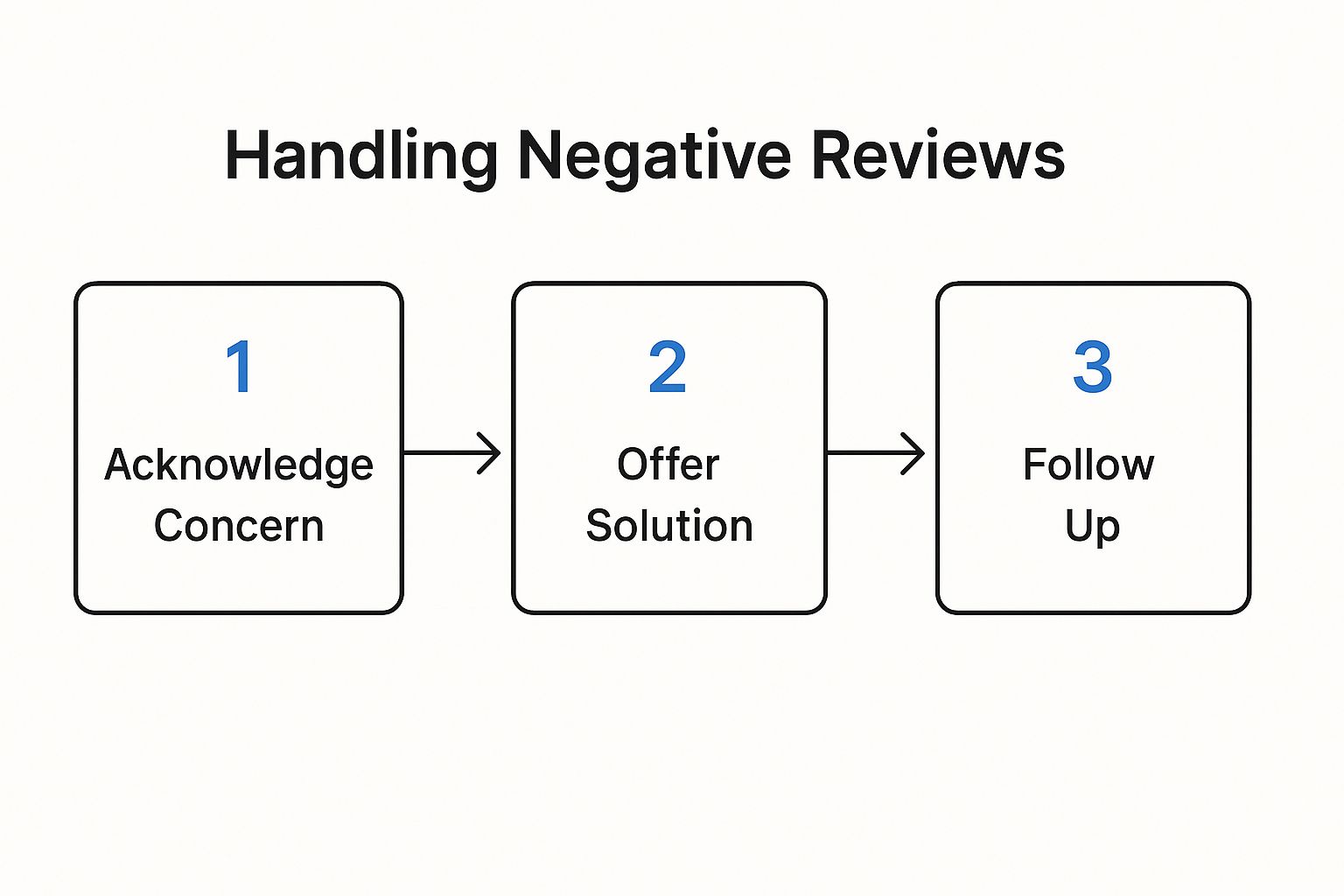
By consistently following this method, you create a repeatable system for turning a potentially damaging situation into a positive one.
Real-World Scenarios and Phrases
Imagine you run a restaurant and get this review: "The service was painfully slow and my food arrived cold." A defensive reply would be a disaster. A great response puts the method into action.
Powerful Response Example: "Hi [Customer Name], thank you for taking the time to share this with us. I'm truly sorry to hear that both the service and the quality of your meal fell short of our standards. This isn't the experience we ever want for our guests, and I'd really appreciate the opportunity to learn more and make this right. Could you please give our manager, Sarah, a call at [phone number] or email her at [email address] at your convenience?"
It's personal, apologetic, and moves the conversation toward a private resolution. For a deeper dive, check out our guide on how to expertly handle customer complaints.
Negative Review Response Dos and Don'ts
| Do | Don't |
|---|---|
| Respond quickly, ideally within 24 hours. | Get defensive or make excuses. |
| Use the customer's name. | Use generic, copy-paste responses. |
| Acknowledge their specific complaints. | Discuss sensitive customer info publicly. |
| Offer a sincere apology for their experience. | Offer discounts or freebies in the public reply. |
| Provide an offline contact to resolve the issue. | Engage in a public back-and-forth argument. |
Following these guidelines will put you miles ahead of the competition. Only about 5% of businesses respond to their online reviews at all. Just by engaging thoughtfully, you have a massive advantage.
Why a Timely Response Is Your Secret Weapon
When it comes to online reviews, speed is your superpower. A quick reply shows you’re on the ball and genuinely care about what your customers say. A delayed response can send a message that feedback doesn't matter, eroding trust.
This isn't just a "nice to do"; it's what people expect. Research shows that 63% of consumers expect a response within a few days at most. You can dive deeper into these expectations and find other local consumer review insights for yourself.

Setting Up a System for Speed
You can't monitor review sites 24/7. That's why having a simple system is the secret to responding promptly without getting buried. The goal here is consistency, not constant stress.
A timely, thoughtful response can completely change the narrative of a negative interaction and pour gasoline on the fire of a positive one. It's one of the highest-impact things you can do for your reputation.
This doesn't have to be complicated. Your plan can boil down to setting up alerts and carving out time each day to manage your online reputation.
- Turn on Email Alerts: Go into your profiles on Google, Yelp, and Facebook and switch on email notifications. This is non-negotiable.
- Pick a Point Person: Decide who owns this. Giving one person responsibility ensures nothing slips through the cracks.
- Draft Some Go-To Frameworks: Have a few solid starting points for common positive and negative situations. This saves time and helps you get a thoughtful reply out the door much faster.
By putting a simple workflow like this in place, you shift from playing defense to offense. You’ll be ready to engage when it counts.
Common Questions About Managing Reviews
Knowing how to handle reviews can be tricky. As a business owner, you're already juggling a million things, so a fake or vague review can really throw a wrench in your day. Let's tackle some of the most common questions we get from people just like you.
What Should I Do If a Review Is Fake?
If you're sure a review is fake, report it to the platform immediately. Most review sites have a process for this. It's your best first move.
While you wait, post a calm, professional reply. This shows potential customers you're paying attention without validating the bogus claim. For a deep dive, check out our guide on how to dispute a review on Google.
"We take all feedback seriously, but we can't seem to find any record of this customer or transaction in our system. We'd appreciate it if the reviewer would contact our management team directly at [email/phone] so we can look into this further."
Should I Offer a Refund Publicly?
The short answer? Never. Don't offer discounts, refunds, or freebies in your public response. It sets a dangerous precedent and can invite a line of "unhappy" customers looking for a handout.
Your public response has one main job: get the conversation offline. This lets you sort out the details privately and professionally.
A go-to phrase I always recommend is:
- "We're genuinely sorry your experience didn't meet your expectations. Would you please contact our manager, [Name], at [email/phone]? We want to learn more and make this right."
This shows you're committed to a resolution without opening the floodgates for public compensation demands. If you're looking for help crafting replies, utilizing AI prompts for customer service can be a good way to get ideas flowing.
Ready to stop stressing over reviews and start building a powerful reputation? The experts at Review Overhaul can create a custom strategy that turns your customer feedback into your greatest marketing asset. Schedule your free consultation today at https://reviewoverhaul.com.
