
Want more customers for your local business? Start here: Local SEO and paid ads are two of the most effective ways to attract customers online. But which one works better?
- Local SEO delivers a higher return on investment (ROI) over time. Businesses spent $539,000 on SEO in early 2025 and earned $10.75 million in revenue – a 19.9x ROI. Plus, the cost per paying customer was just $126.09.
- Paid Ads offer immediate results. Spending $2.26 million on ads generated $10.08 million in revenue during the same period – a 4.4x ROI. However, the cost per paying customer was much higher at $552.93.
If you need quick leads, paid ads are the way to go. But for long-term growth and lower costs, Local SEO for home services is unbeatable. The best strategy? Combine both to maximize visibility and results.
Google Ads vs Local SEO – What You NEED To Know in 2025?
sbb-itb-50c3429
What is Local SEO? How It Drives Customers
Local SEO focuses on improving your business’s presence in unpaid, location-based search results on platforms like Google Search and Google Maps. Unlike broader SEO strategies aimed at national or global audiences, Local SEO targets customers in your immediate area who are actively searching for services nearby or in a specific city.
This approach zeroes in on high-intent leads – people who are ready to take action. For instance, when someone searches for “24-hour repair” or “dentist open now”, they’re often looking to call or visit a business within hours. In fact, 76% of people who perform a “near me” search end up visiting a related business within 24 hours. That makes Local SEO a key player in driving customer acquisition.
Google determines local search rankings based on three main factors: Relevance (how well your business matches the search query), Distance (how close you are to the searcher), and Prominence (how well-known and well-reviewed your business is). The ultimate goal? To land a spot in the “Local Pack” – the top three business listings displayed alongside a map at the top of Google search results. Why is this important? The #1 spot in the Local Pack grabs 33.7% of all clicks, compared to 28.5% for the top organic result.
“Local search offers visibility to high-intent local customers… conversion from this channel is high.”
– Myles Anderson, Founder and CEO, BrightLocal
Local SEO is especially effective because 30% of all mobile searches are tied to a specific location, and 28% of these searches lead to a purchase.
Core Components of Local SEO
Several key factors can help boost your Local SEO visibility:
- Google Business Profile (GBP) Optimization: Think of this free tool as your online storefront. It displays your hours, photos, reviews, and contact details. Nearly half (47%) of GBP visitors call the business directly, compared to just 12% from traditional organic search.
- Review Management: Actively collecting and responding to reviews not only builds trust but also signals prominence to Google.
- NAP Consistency: Ensuring your business’s name, address, and phone number (NAP) are consistent across all online directories helps establish credibility with search engines.
Other strategies include local keyword research, creating location-specific content, building links from neighborhood sources, and using LocalBusiness schema markup to make your business details easier for search engines to understand.
Together, these tactics don’t just improve visibility – they can lead to measurable business growth.
Benefits of Local SEO for Local Businesses
Unlike paid ads that disappear when the budget runs out, Local SEO offers long-term value. For example, Cascade Dental in Portland, OR, shifted 80% of its $2,500/month marketing budget to GBP optimization between January and June 2023. As a result, new patient inquiries jumped from 34 to 127 per month, and the cost per patient dropped from $441 to $118.
Another advantage of Local SEO is the trust it builds. When your business appears organically in search results, it feels like a recommendation from Google – not a paid placement.
The quality of leads generated through Local SEO is also impressive. Local search accounts for 26% of all phone calls to local businesses, outperforming paid channels. Apex Plumbing in Phoenix, AZ, is a great example. By reallocating 70% of its $1,800/month budget to GBP optimization between January 2023 and December 2024, the company climbed to the #2 position in the Local Pack and increased annual revenue from GBP-driven leads by a staggering 1,042%, jumping from $12,000 to $137,000.
Local SEO’s impact grows over time. While GBP optimization can show results in as little as 7–14 days, its benefits compound as your online presence strengthens. Summit Law Firm in Denver, CO, conducted a 12-month A/B test ending in late 2024 with a $4,000/month budget. The team that focused 80% of its efforts on GBP optimization generated 134 qualified leads and $843,000 in case value, compared to just 45 leads and $267,000 in case value from traditional SEO efforts.
In competitive local markets, Local SEO is more than just a strategy – it’s essential for sustained growth.
What are Paid Ads? Their Role in Customer Acquisition
Paid ads, often referred to as PPC (Pay-Per-Click) advertising, give businesses the ability to secure immediate visibility on search engines, social media platforms, and other digital spaces. Unlike Local SEO, which takes time to yield results, paid ads place your business directly in front of potential customers as soon as you launch a campaign. For example, if someone searches for “emergency AC repair” or “24-hour locksmith”, your ad can appear above organic search results, grabbing attention right when they need your service most.
These ads operate on a bidding system, where you target specific keywords or demographics and pay only when someone interacts with your ad – whether that’s a click, an impression, or a direct contact. For local service providers, Local Services Ads (LSAs) are especially effective. These ads sit at the very top of Google Search and Google Maps, feature trust-building elements like the “Google Guarantee” badge, and charge you only when a customer calls, texts, or books through the ad.
While Local SEO can take 3 to 6 months to show results, paid ads can drive traffic within hours. This makes them perfect for time-sensitive needs, such as launching a new service, promoting a seasonal offer, or filling gaps during a slow period. Statistics back up their effectiveness: about 14% of local searchers choose a business through Google Ads, and these platforms account for roughly 12% of phone calls to local businesses.
Key Features of Paid Ads
Paid ads offer precise targeting options, allowing you to focus on specific ZIP codes, areas around your business, or even GPS-based locations. Beyond location, you can refine your audience by factors like age, gender, interests, and past behaviors – ensuring your message reaches the people most likely to act.
Another powerful feature is retargeting. If a potential customer visits your website but doesn’t take action, retargeting lets you display ads on social media or other websites to bring them back. This way, your business stays top-of-mind without relying on them to remember your name and search for you again.
Budget control is another advantage. Platforms let you set daily or monthly spending limits, so you never spend more than you can afford. However, costs can vary significantly depending on the industry. In competitive fields like real estate or insurance, a single click might cost as much as $20. That’s why keeping a close eye on performance metrics like cost-per-lead and conversion rates is essential to avoid wasting money on clicks that don’t lead to results.
These features make paid ads a fast and measurable way to drive traffic and conversions.
Advantages of Paid Ads for Local Businesses
The speed and measurability of paid ads make them a standout choice for businesses. They’re especially useful for testing strategies – allowing you to A/B test headlines, offers, and landing pages in real time. Once you identify what works, you can apply those insights to your long-term SEO efforts.
However, there’s a trade-off: paid ads only work while you’re actively funding them. Once you stop spending, your visibility vanishes. Still, the potential return can be impressive. For instance, a $100,000 investment in PPC is estimated to generate around $23,275.86 in revenue. Additionally, businesses that combine PPC with organic strategies see a 31% boost in clicks compared to those relying solely on organic methods. This shows that paid ads are most effective when used as part of a larger marketing plan rather than a standalone tactic.
“Paid ads shine in high-intent, time-sensitive situations. For example, someone searching for ’emergency AC repair’ is likely ready to book.”
– Team WGU, We Got U
Local SEO vs Paid Ads: Direct Comparison
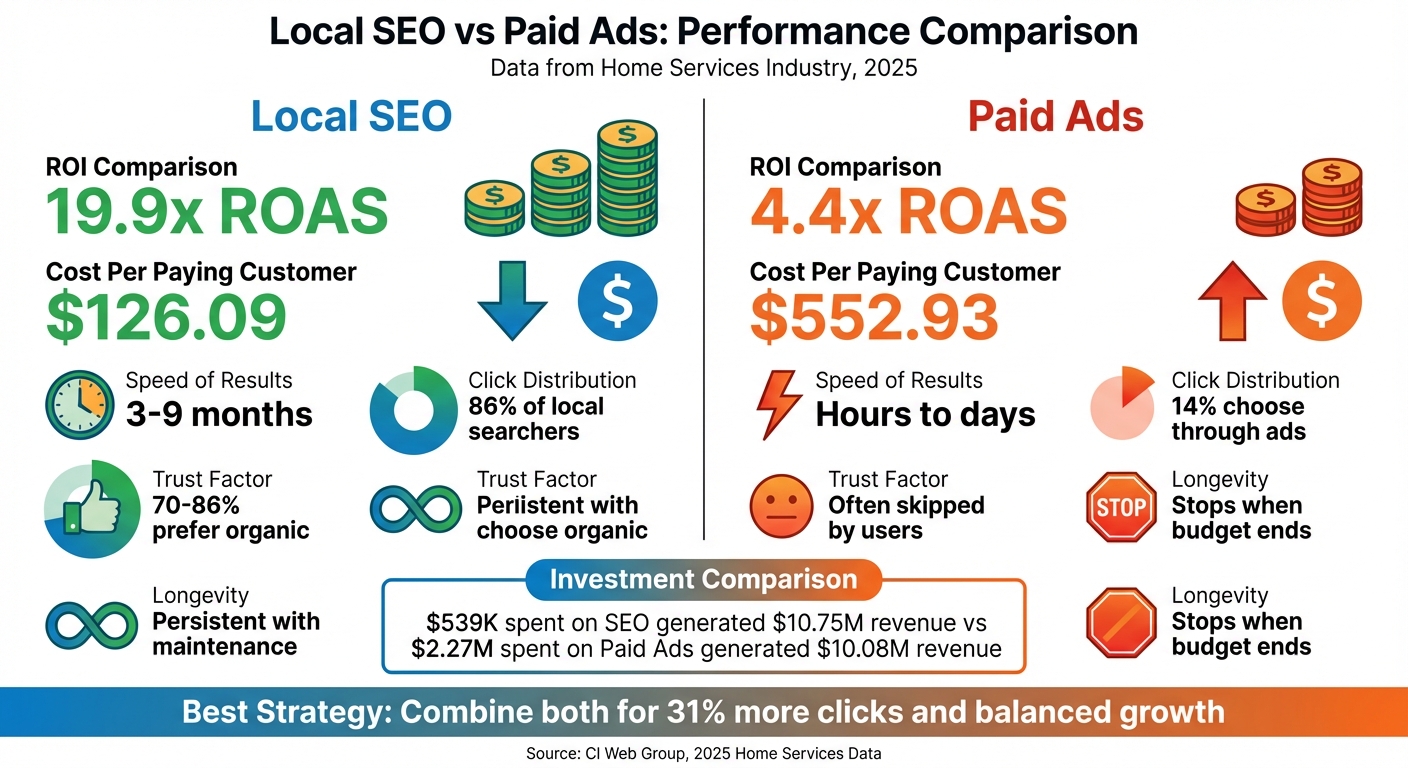
Local SEO vs Paid Ads: ROI and Performance Comparison for Local Businesses
When deciding between Local SEO and Paid Ads, understanding how each aligns with your business goals is crucial. These two strategies cater to different needs, depending on your timeline, budget, and objectives.
Comparison Table: Metrics to Consider
Here’s a breakdown of how Local SEO and Paid Ads compare based on factors that are most relevant to local service businesses:
| Metric | Local SEO | Paid Ads (PPC/LSA) |
|---|---|---|
| Speed of Results | Slow (3–9 months) | Immediate (hours to days) |
| Cost Model | Upfront investment; diminishing long-term cost | Continuous spend; pay-per-click or pay-per-lead |
| ROI (Home Services, 2025) | 19.9x ROAS | 4.4x ROAS |
| Cost Per Paying Customer | $126.09 | $552.93 |
| Trust Factor | High (70–86% prefer organic) | Lower (often skipped by users) |
| Longevity of Results | Persistent with maintenance | Stops immediately when budget ends |
| Click Distribution | 86% of local searchers choose organic | 14% choose through ads |
| Management Effort | High (content, links, technical) | Varies (LSA is low; PPC is high) |
| Scalability | Limited by search volume and authority | High; scales instantly with budget |
Between January 1 and April 24, 2025, data from CI Web Group revealed that home service businesses spent $2.27M on Paid Ads compared to $539,651 on SEO. Despite the higher ad spend, SEO delivered $10.75M in revenue and a $426.84 lower cost per paying customer.
Strengths and Weaknesses of Each Approach
The table highlights quantitative differences, but let’s dive deeper into the unique strengths and challenges of each strategy.
Local SEO is your long-term ally for building trust and generating sustainable leads. With 86% of local searchers favoring organic results, a optimized Google Business Profile and website can drive consistent traffic even if you pause active efforts. However, patience is key – results typically take 3 to 9 months to materialize. If you’re looking for immediate leads, SEO alone won’t meet that need.
Paid Ads, on the other hand, are the go-to option for quick results. Whether you’re launching a new service, filling a slow season, or testing messaging, ads can deliver leads almost instantly. But speed comes at a cost. In competitive industries like insurance or real estate, a single click can run as high as $20, making it a pricey option for ongoing lead generation.
“When you rely only on paid ads, you’re renting your visibility, not building it.” – CI Web Group
For the best results, consider blending both strategies. Use Local SEO to create a strong, lasting foundation and turn to Paid Ads during critical growth periods or when you need a short-term boost. This combined approach ensures steady, balanced growth over time.
Key Metrics: ROI, Conversion Rates, and Click-Through Data
Examining these metrics helps pinpoint where to allocate resources effectively. They don’t just show which strategies work – they explain how and when each tactic delivers results.
ROI: Long-Term vs. Short-Term Gains
When comparing returns, the numbers tell a clear story. Paid Ads provide a 4.4x return, while SEO delivers a much stronger 19.9x return. The cost per paying customer? $552.93 for Paid Ads versus just $126.09 for SEO. That’s nearly five times better ROI with SEO. For every $100,000 invested, SEO generates around $51,724 in revenue compared to $23,275 from PPC campaigns. However, SEO takes time – typically 3–6 months to gain traction – while Paid Ads can start generating leads in just a few hours.
“SEO is one of the only marketing investments that continues to work, compound, and pay off well into the future.” – CI Web Group
If your goal is to quickly fill appointment slots or generate immediate leads, Paid Ads are the go-to solution. But if you’re focused on building a sustainable revenue stream without ongoing ad spend, SEO proves to be the better long-term investment. This ROI difference sets the stage for a deeper look into how click-through and conversion patterns further distinguish these methods.
Conversion Rates and Local Intent
Beyond ROI, click-through and conversion data highlight how user behavior varies between strategies. Organic search results capture 43.9% of all clicks on local search pages, even when Local Services Ads are present. The top organic result alone garners a 25.5% click-through rate, compared to just 8.5% for the first paid ad position.
Conversion rates also differ significantly. Local service businesses achieve 5% to 10% conversion rates through Google Ads, outperforming the cross-industry average of 2.35%. However, organic search pulls ahead in value, generating $5.35 in revenue per dollar spent versus $2 per dollar with Google Ads. Trust plays a big role here – about 70% of users bypass paid ads entirely to click on organic results.
Google Business Profile (GBP) optimization shows even stronger intent. 47% of GBP visitors make a phone call, compared to just 12% of organic website visitors. This effectiveness also comes at a lower cost: GBP optimization for contractors costs $487 per 100 leads in home services, while website SEO costs $1,243. With its combination of high trust, strong local intent, and reduced acquisition costs, Local SEO is particularly well-suited for businesses focused on their nearby communities.
Why Local SEO Outperforms Long-Term: Performance Data
When it comes to building sustainable growth, the numbers speak for themselves: local SEO delivers results that compound over time, unlike the quick but fleeting wins of paid advertising. The data clearly shows how local SEO can be a game-changer for local service businesses, offering lasting benefits that directly impact revenue.
Case Studies: Local SEO in Action
Take Cascade Dental in Portland, OR, for example. Between 2023 and 2024, they tested two approaches. First, they put their entire budget into traditional website SEO, which brought in 34 new patient inquiries at a cost of $441 per patient. Then, they shifted gears – allocating 80% of their budget to optimizing their Google Business Profile (GBP) and 20% to website SEO. The results? A staggering 127 new patient inquiries at just $118 per patient. That’s a 273% jump in inquiries and a 73% drop in cost per patient.
Apex Plumbing in Phoenix, AZ saw equally impressive results. They redirected 70% of their $1,800 monthly budget toward GBP optimization. While there was a slight dip in organic search leads, their GBP-driven revenue skyrocketed – from $12,000 to $137,000 annually. Overall, their total yearly revenue increased from $79,000 to $193,000 – a jaw-dropping 1,042% growth.
Meanwhile, Summit Law Firm in Denver, CO ran a 12-month A/B test with a $4,000 monthly budget. The group focused on GBP optimization generated 134 qualified leads, translating to $843,000 in case value – a 1,756% ROI. Compare that to the SEO-heavy group, which brought in 45 leads worth $267,000, or a 557% ROI. The GBP-focused strategy delivered three times the return.
These examples highlight how powerful local SEO can be when executed strategically. But they also reveal the limitations of relying solely on paid ads.
The Downsides of Paid Ads Alone
While paid ads can offer instant visibility, they come with a major drawback: they stop working the moment you stop spending. Over time, customer acquisition costs tend to rise as competition intensifies and ad platforms adjust their pricing. This means maintaining the same lead volume becomes more expensive, cutting into profitability.
On the other hand, local SEO creates digital assets that keep working for you long after the initial investment. With lower ongoing maintenance costs, it provides a sustainable foundation for continued growth, making it far more cost-effective in the long run.
Paid ads may deliver quick wins, but they can’t match the enduring impact of a well-executed local SEO strategy. It’s the difference between renting visibility and owning a long-term traffic source.
Recommendations for Local Service Businesses
Use these strategies wisely to create a marketing plan that blends quick wins with sustainable growth.
Prioritize Local SEO for Long-Term Growth
Start with your Google Business Profile (GBP). If your monthly marketing budget is under $1,000, focus nearly all your efforts – about 90% – on optimizing your GBP. Why? GBP offers a faster return on investment (ROI) at 40-60% lower costs compared to traditional website SEO. As your budget grows, adjust your strategy. For budgets between $1,000 and $3,000, allocate 70% to GBP and 30% to website SEO. If you’re spending $10,000 or more monthly, a 50/50 split ensures you dominate local search results.
Ensure your business details are consistent everywhere. This includes adding LocalBusiness schema markup to your website so search engines can easily understand your location, hours, and other key information. These technical tweaks might seem minor, but they’re the backbone of a solid local SEO strategy.
SEO creates a long-term asset. On average, a Google Business Profile attracts over 1,200 views per month, and nearly half – 47% – of those visitors call the business directly. That’s free traffic and leads you don’t have to keep paying for, making it a smart investment for sustained growth.
While SEO builds a foundation for long-term success, it’s wise to balance it with short-term strategies.
Use Paid Ads for Short-Term Gains
Run ads during high-demand periods. Paid ads are especially effective for emergency services, seasonal promotions, or when launching a new location. For time-sensitive services like emergency plumbing or HVAC repair, Local Services Ads are a better choice than traditional pay-per-click (PPC). You only pay when someone contacts you, and the “Google Guaranteed” badge adds an extra layer of trust.
Use paid ads to bridge the gap while SEO ramps up. SEO can take 3-6 months to deliver results, so paid campaigns can generate immediate revenue during that waiting period. Plus, the data from these campaigns – like high-conversion keywords and headlines – can inform your SEO content strategy.
Follow the 70/30 rule. Dedicate 70% of your budget to your primary goal, such as long-term growth through SEO, and 30% to secondary efforts like paid ads for immediate leads. This approach allows you to capture quick wins while building a strong foundation for the future. Running both strategies together also boosts your visibility on search results pages, potentially increasing your total clicks by 31% compared to relying on organic results alone.
“The most powerful digital marketing strategy isn’t choosing between SEO and paid ads – it’s understanding how to leverage each at the right moment in your business cycle to create compounding growth.” – Eric Siu, Founder, Single Grain
Don’t forget retargeting campaigns. Use platforms like Facebook, Instagram, or Google Ads to re-engage people who visited your site but didn’t convert. This keeps your business top-of-mind without requiring them to search for you again, maximizing the value of your existing SEO traffic.
Conclusion: The Balanced Approach to Driving More Customers
Combining Local SEO and paid ads can unlock the best of both worlds for your business. Local SEO is your go-to for steady, long-term growth. In fact, 86% of local searchers choose businesses from organic results. Once set up, it keeps working for you – even when you’re not actively spending.
Paid ads, on the other hand, are perfect for instant visibility. Whether you’re launching a new product, navigating a slow season, or testing a fresh offer, ads deliver results fast. The magic happens when you use both strategies together. Businesses that do this experience a 31% boost in clicks compared to relying solely on organic traffic. This approach ensures you capture both the steady flow of leads over time and those quick wins when you need them most.
“If you’re serious about growth, you shouldn’t be choosing one or the other, you should be leveraging both.” – Team WGU
Start by laying a solid foundation with Local SEO. Optimize your Google Business Profile and ensure your business details are consistent across the web. This creates a lead source that doesn’t come with ongoing per-click costs. Once that’s in place, use paid ads strategically – for seasonal promotions, retargeting visitors, or handling unexpected slow periods. Aligning these strategies with your business needs creates a marketing plan that’s both steady and flexible.
From a cost perspective, Local SEO shines with a lower customer acquisition cost ($126.09) compared to paid ads ($552.93). But the smartest move isn’t about picking the cheaper option – it’s about knowing when to use each. Local SEO builds a lasting foundation, while paid ads help you seize immediate opportunities. Together, they ensure your business stays visible and ready to capture every potential customer.
FAQs
How can I choose between Local SEO and Paid Ads to attract more customers?
Choosing between Local SEO and Paid Ads comes down to your business goals, how quickly you need results, and what budget you’re working with. If your priority is building steady, long-term visibility while keeping expenses manageable, Local SEO is the way to go. By refining your Google Business Profile, securing local citations, and producing location-specific content, you can draw in organic traffic that grows steadily over time. This is especially effective for businesses targeting “near me” searches and aiming to establish lasting growth.
On the flip side, Paid Ads are ideal when you need fast results. Whether you’re launching a new service, promoting seasonal deals, or filling last-minute openings, platforms like Google Ads or Facebook can put you at the top of search results instantly. The downside? Traffic halts the moment you stop investing. Paid Ads work best for short-term campaigns or as a supplement while your SEO strategy gains momentum.
Many businesses see the best outcomes by combining both approaches. Use Local SEO for consistent, long-term growth, and layer in Paid Ads strategically for immediate wins. Revisit your strategy every 3–6 months to ensure you’re balancing short-term goals with long-term efficiency.
How can I optimize my Google Business Profile to attract more local customers?
To get the most out of your Google Business Profile (GBP), start by claiming and verifying your listing. Once that’s done, make sure all your information is accurate and matches what’s on your website and other platforms. This includes your business name, address, phone number (NAP), hours of operation, and service area. Choose a primary category that best describes your business (like Plumbing Service) and add secondary categories to reflect other services you offer.
Make your profile stand out by adding high-quality photos and videos. Showcase your storefront, team, or even examples of completed projects. Use the “Posts” feature regularly to share updates, promotions, events, or tips. When posting, naturally include keywords (like emergency AC repair in Dallas) to make your updates more relevant for local searches. Also, craft a detailed business description that highlights your services and location.
Don’t overlook the importance of reviews. Encourage satisfied customers to leave feedback, respond to reviews professionally, and use the Q&A section to address common concerns. Keeping your profile active with engaging content and gathering positive reviews can boost your visibility in local search results and help draw more customers to your business.
How should I allocate my marketing budget between Local SEO and Paid Ads?
To make the most of your budget, think of Local SEO and Paid Ads as two sides of the same coin, working together rather than competing. Local SEO focuses on building a solid, long-term presence by enhancing your online visibility. Meanwhile, Paid Ads are perfect for delivering quick wins, especially when targeting high-intent customers or promoting time-sensitive deals.
A practical starting point is a 60% SEO and 40% Paid Ads split, which you can tweak monthly based on performance metrics like cost-per-acquisition (CPA) and return on ad spend (ROAS). For example, if you notice that your paid ads are driving up your CPA compared to SEO, it might be time to shift more resources toward SEO efforts. This could include creating more content, optimizing your Google Business Profile, or improving your local citations. On the flip side, if you’re launching a new promotion or service, temporarily increasing your Paid Ads budget can help you gain traction quickly.
The secret lies in staying adaptable. Regularly analyze your data to ensure both strategies complement each other, with SEO fueling sustainable growth and Paid Ads stepping in for short-term boosts whenever needed.
