
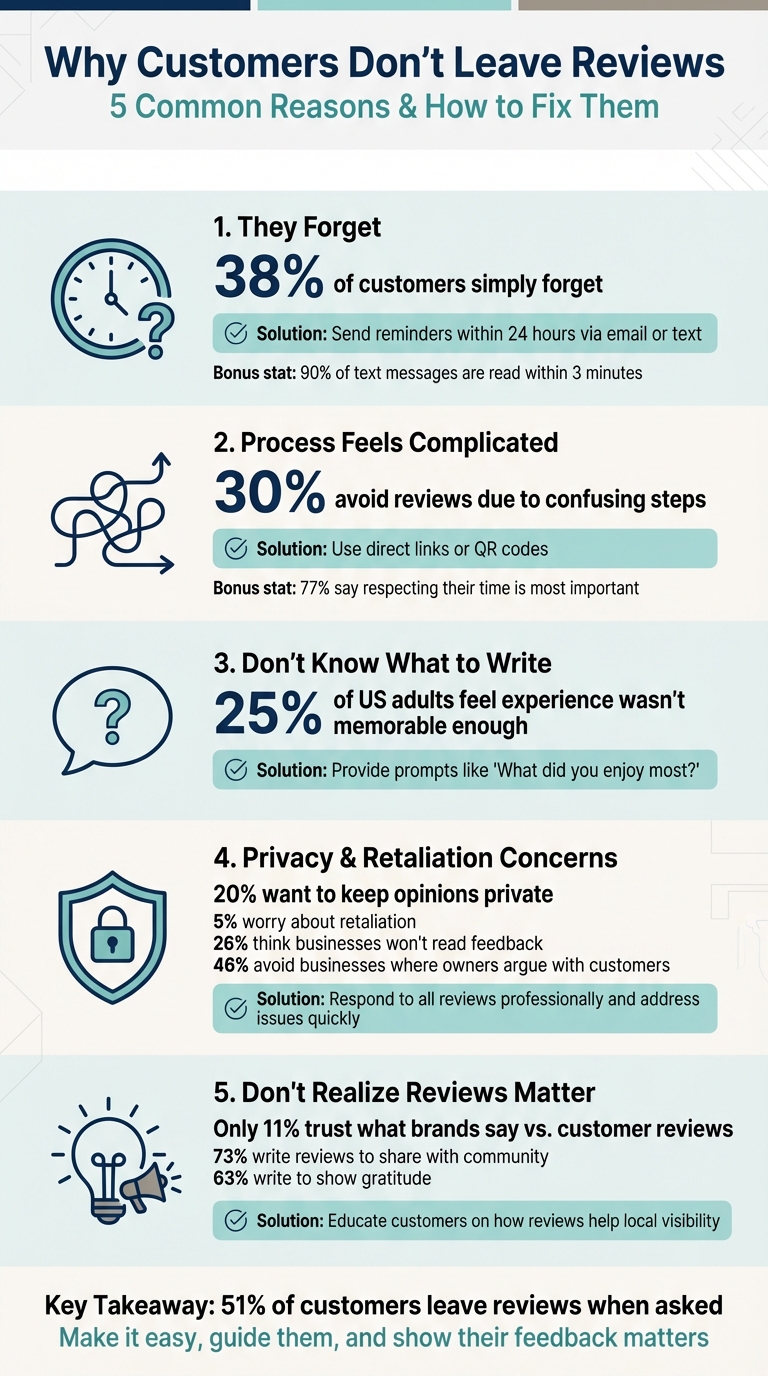
Most customers don’t leave reviews, even when they’re satisfied. Why? It often comes down to forgetfulness, confusion, or not knowing what to say. Here are the five main reasons people skip leaving reviews – and how to address them:
- They Forget: 38% of people simply forget after the service ends. A quick reminder via email or text within 24 hours can solve this.
- The Process Feels Complicated: 30% avoid reviews because the steps are confusing. Simplify it by sharing direct links or QR codes.
- They Don’t Know What to Write: Many feel unsure about what to say. Offering prompts like “What did you enjoy most?” helps break the ice.
- Concerns About Privacy or Feedback: Some hold back due to fear of retaliation or thinking their feedback won’t matter. Show you value their input by responding to all reviews and addressing issues quickly.
- They Don’t Realize Reviews Matter: Customers often don’t know how much reviews help small businesses. A simple explanation – like how reviews improve local visibility – can encourage them to share.
The takeaway? Make the process easy, guide customers on what to write, and show them their feedback matters. These small actions can lead to more reviews and a stronger online presence.
5 Reasons Customers Don’t Leave Reviews With Statistics
How to get more (positive) customer reviews
sbb-itb-50c3429
1. They Forget After the Service Ends
One of the biggest reasons customers don’t leave reviews isn’t dissatisfaction – it’s forgetfulness. A whopping 38% of consumers admit they simply forget to write reviews. As Miriam Ellis, Local SEO Subject Matter Expert at Moz, explains:
“The top reason customers don’t review your business is because they forget to.”
Here’s what happens: after the service is complete, customers may have every intention of leaving a review. But as they dive back into their daily routines, that intention fades – quickly. Without a prompt or reminder, the review often gets left undone.
Timing plays a crucial role here. Research shows that review-writing activity is at its lowest in the morning and peaks during the early afternoon and evening. This is why sending review requests shortly after a transaction, and at the right time of day, can make all the difference.
How do you make sure they remember? Automate your review reminders. Send an email or text requesting a review within 24 hours of their visit, ideally during the afternoon or evening. Text messages are particularly effective – 90% of them are read within just 3 minutes. You can also include QR codes on receipts or business cards as an easy, visual nudge.
While addressing forgetfulness is a great first step, there’s another hurdle to tackle: sometimes, the review process itself feels unnecessarily complicated.
2. The Review Process Seems Complicated
Let’s face it – many customers skip leaving reviews because the process feels like a hassle. In fact, 30% of customers avoid writing reviews simply because they find the steps confusing. On top of that, 77% of customers say that respecting their time is the most important part of good service. When the review process feels like a chore, it’s no surprise that people lose interest.
One common issue is requiring customers to jump through too many hoops. For example, they might need to search for your business across different platforms, figure out which profile is yours, and hunt down the “write a review” button. Other pain points include asking them to log in to their personal accounts on a business device, sending out surveys that feel like homework, or failing to give clear instructions. And when customers are forced to use platform-specific logins, the frustration only grows.
The fix? Keep it simple. Send customers a direct link that takes them straight to the review form – no searching, no extra steps. Give them a choice of 2–3 platforms, like Google, Facebook, or Yelp, so they can pick one they’re already familiar with. SMS is a great tool for this, as 90% of text messages are read within 3 minutes. If you’re using an in-store tablet, skip the login hassle – just collect their contact info and text them the link later.
While online reputation management matters for growth, streamlining the process is a big step forward, but another challenge remains: helping customers figure out what to say in their reviews.
3. They Don’t Know What to Write
Even when customers are willing to leave a review, they often hit a wall when faced with an empty text box. In fact, nearly 25% of US adults feel their experience wasn’t memorable enough to write about. They think, “Everything was fine, but what can I even say?” This happens a lot when the service was satisfactory but not extraordinary.
As BrightLocal explains, “Sometimes it can be hard to find the words to describe certain experiences or interactions with businesses”. Without a little guidance, many people simply give up before they start typing.
Once you’ve made the review process simple, the next step is asking customers for reviews in a way that helps them figure out what to say. One way to do this is by giving them a starting point. Ask specific, engaging questions like “What was the best part of your visit?” or “Did a staff member stand out during your experience?”. If you’re a plumber, you might ask, “What was the worst mess our team helped you clean up?” For restaurants, something like, “Which dish would you recommend to a friend?” can spark ideas. These kinds of prompts jog memories and make the task feel less daunting.
Another effective approach is showing examples of reviews on your “Leave a Review” page. When customers see that just a few sentences are enough, it makes the process feel much more manageable. Some businesses even take it a step further with microsurveys – three to five quick questions that guide customers through their experience without requiring them to write paragraphs.
4. They Have Unspoken Concerns About Their Experience
Sometimes, customers hold back from sharing their concerns openly. In fact, 20% of people avoid writing reviews to keep their opinions private, 5% worry about possible retaliation, and 26% believe businesses won’t bother reading their feedback. On top of that, 46% of consumers steer clear of businesses where owners argue with customers in review responses.
So, how can you address these silent concerns? Start by showing that you genuinely value every piece of feedback. Make it a habit to respond to all reviews – acknowledge issues publicly and then follow up privately to resolve them. This not only respects customer privacy but also shows that you’re committed to making things right.
But don’t stop there. Being proactive can help prevent these situations from arising in the first place. Train your staff to address problems immediately. After all, 28% of negative reviews result from unaddressed issues, and 65% stem from poor service. By tackling concerns on the spot and highlighting improvements based on past feedback – like adjusting operating hours, adding new services, or fixing recurring problems – you can turn frustrations into positive experiences. This level of openness builds trust and reassures customers that their voices truly matter.
5. They Don’t Understand How Much Reviews Help Small Businesses
Many customers don’t realize just how critical their reviews are for small businesses. Nearly every potential customer who stumbles upon a business online checks out reviews before making a decision to call or visit. Here’s the kicker: only 11% of people trust what a brand says about itself compared to what real customers share in reviews. That means no matter how polished your marketing is, it can’t compete with the authenticity of customer feedback. Miriam Ellis, Local SEO Subject Matter Expert at Moz, sums it up perfectly:
“Review management deserves serious investment from local businesses because it is the customers who are now writing the most trusted brand narratives”.
This gap in awareness doesn’t just affect feedback – it can impact your business’s visibility online, too.
Google factors in both review ratings and the number of reviews to rank businesses in local searches. So, when customers skip leaving reviews, they unintentionally make it harder for others in the community to find your business. Here’s something encouraging, though: 73% of customers write reviews to share their experiences with the community, and 63% do it to show gratitude to businesses that treated them well. Sometimes, all they need is a small nudge. Train your team to say something like, “It would be helpful if you’d leave a review; we’re working on spreading the word to our neighbors.” Framing the request as a way to support the community, rather than a personal favor, resonates with people who want to see local businesses succeed. These little gestures go a long way in boosting your visibility online.
Don’t stop there – use receipts, packaging, or even social media to remind customers how their reviews help improve your local search rankings. When people understand the real impact of their feedback, they’re much more likely to take a few moments to write one.
Conclusion
Improving customer reviews doesn’t have to be complicated. The five challenges we’ve discussed – forgetfulness, a confusing process, uncertainty about what to write, unspoken concerns, and a lack of awareness about the importance of reviews for small businesses – all have practical fixes. For example, sending timely reminders via SMS or email can address the 51% of customers who simply forget to leave reviews. Simplify the process with direct links or QR codes, helping the 30% who find it too confusing. Give hesitant customers a nudge with prompts like, “What did you enjoy most about our service today?”.
If customers have concerns, resolve them quickly to avoid negative feedback. And don’t forget to respond to reviews – 60% of consumers expect a reply within two days. Educate your team on how reviews improve local search rankings and help connect with nearby customers. Since 51% of customers leave reviews when asked, these small, consistent actions can make a big difference.
Improving your online reputation takes time, but every positive review gets you closer to earning trust with new customers. Start simple: automate SMS reminders or add QR codes to receipts. As you refine these strategies, you’ll make it easier for happy customers to share their experiences, ultimately strengthening your local presence and attracting more business.
FAQs
What’s the best way to remind customers to leave a review?
The secret to getting more reviews lies in sending timely, polite reminders that seamlessly fit into your customer’s journey. Start by reaching out within 24–48 hours of their purchase or service – while the experience is still fresh in their minds. A simple, personalized email or text thanking them and providing a direct link to leave a review can work wonders. If they don’t respond, a gentle follow-up about a week later can encourage them to share their feedback.
Keep the process as straightforward as possible. Use direct links that lead customers straight to the review page, or include a QR code on receipts or thank-you cards, allowing them to leave a review in just a few seconds. Automating these reminders with a review management tool can save time and ensure consistency. Adding a personal touch – like referencing the specific service they received – can make your request feel more authentic and boost engagement.
What are the easiest ways to help customers leave a review?
Making the review process as effortless as possible can turn a “maybe later” into an immediate response. Start by offering a clear call-to-action that takes customers straight to a mobile-friendly review page. This could be a button on a receipt, a QR code on a flyer, or a short link included in a follow-up email. The key is to keep the page simple – ask for a star rating and a brief comment. Most people can complete it in less than a minute.
To streamline things further, send a friendly reminder within 24–48 hours of their experience. Include a pre-filled link and keep the form short, focusing on just 1–2 quick questions. Giving customers multiple platform options, like Google or Yelp, lets them pick the one they’re most comfortable with. A warm message such as “We’d love your quick feedback – it’ll only take 30 seconds!” can make the process feel inviting and easy to complete.
Why should customers understand how their reviews impact small businesses?
Customer reviews are a big deal for small businesses. They can shape how a business is perceived, impact its online visibility, and even influence whether new customers walk through the door. Research shows that most people check reviews before deciding where to shop, eat, or hire services – making every single review count.
For small businesses, reviews go beyond simple feedback. They help build trust and credibility. Positive reviews can improve a business’s local search rankings, bring in more customer inquiries, and even drive up sales. At the same time, constructive feedback gives businesses valuable insights to improve and better serve their community. When customers understand the power of their reviews, they’re more likely to leave thoughtful and honest feedback that helps the businesses they love thrive.
