
Ensuring your business’s Name, Address, and Phone number (NAP) is consistent across all platforms is essential for local SEO and customer trust. Inconsistent NAP details can hurt your search rankings, confuse customers, and even lead to negative reviews. Here’s what you need to know:
- Why it matters: Inconsistent NAP data can drop your local search rankings by 2-3 positions and cause 73% of consumers to lose confidence in your business.
- What to do: Define a standard NAP format, audit your listings, fix errors on key platforms, and monitor regularly.
- Key platforms: Focus on Google Business Profile optimization, Yelp, Facebook, Apple Maps, and Bing Places.
- Tools to help: Services like Review Overhaul simplify NAP management by syncing updates across directories and removing duplicates.
Bottom line: Consistent NAP details build trust, improve local search visibility, and prevent customer confusion. Follow this checklist to maintain accuracy and stay ahead in local search results.
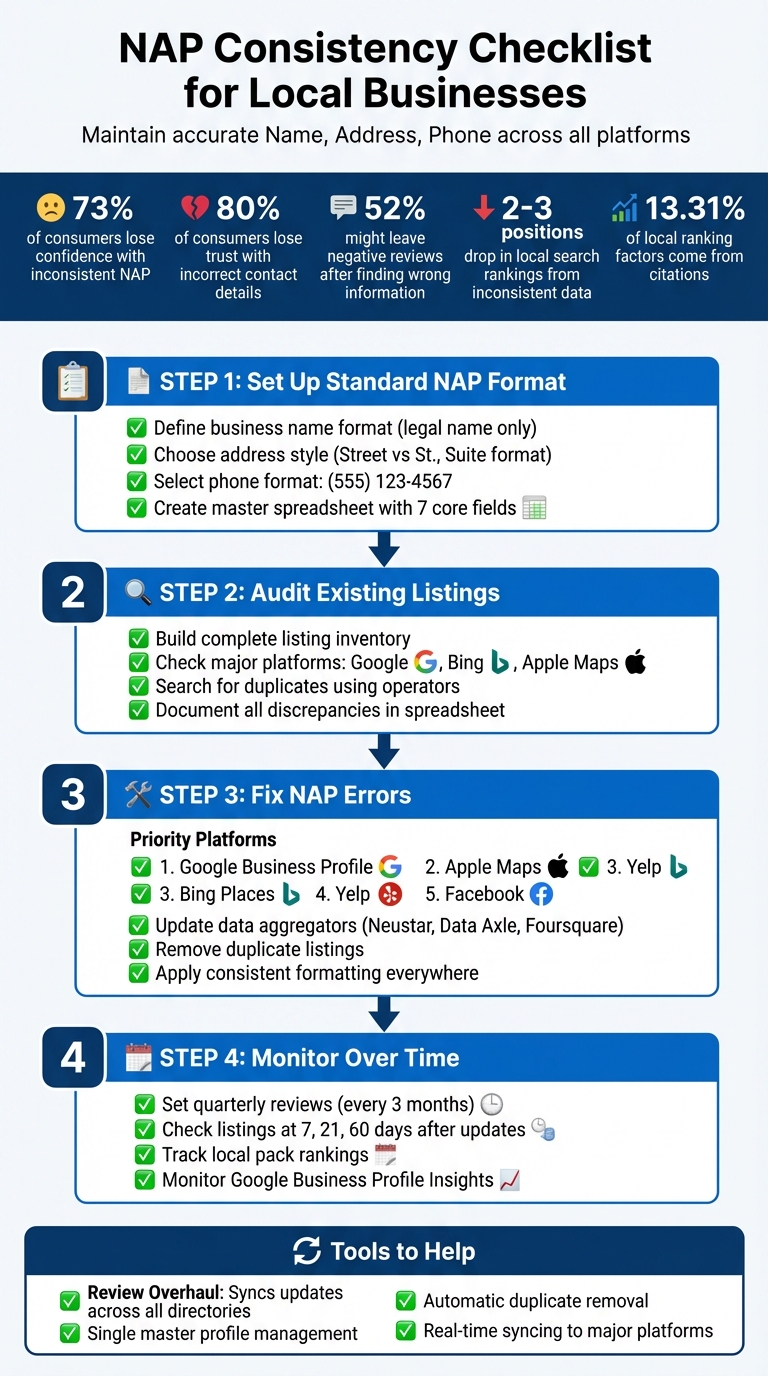
NAP Consistency Checklist: 4-Step Process for Local SEO Success
The Important of Business Directories and NAP in Local SEO (2025 Tutorial)
sbb-itb-50c3429
Set Up Your Standard NAP Format
Before tackling inconsistencies in your business information, it’s crucial to define a standard NAP format (Name, Address, Phone Number). This will serve as your go-to reference for how your details should appear across all platforms – whether it’s your website, Google Business Profile, or social media accounts.
Choose Your Formatting Standards
Start by deciding on a consistent format for each part of your NAP:
- Business Name: Stick to your legal or brand name without adding extra keywords or taglines. For instance, if your registered name is "Smith & Jones Solicitors Ltd", don’t use variations like "Smith and Jones Solicitors." Consistency is key.
- Address: Choose a specific style for abbreviations and suite numbers. Will you use "Street" or "St."? Should it be "Suite 100", "Ste 100", or "#100"? Pick one and apply it everywhere.
- Phone Number: Opt for a primary local number, as local area codes often perform better for local SEO than toll-free numbers. Also, decide on a punctuation style, such as (555) 123-4567, 555-123-4567, or 555.123.4567, and stick with it.
"NAP consistency means maintaining identical business information everywhere it appears. Not similar. Not close enough. Identical." – Ali Coleman, Senior Developer, Amigo Studios
Once you’ve nailed down these standards, you’ll have a solid foundation to ensure your business details are consistent across all platforms.
Record Your Official NAP
Document your finalized NAP details in a master spreadsheet or include them in your brand guide. This will act as your "single source of truth", ensuring everyone in your organization – or any external marketing partners – uses the exact same format when creating or updating listings. Many businesses rely on their verified Google Business Profile as the baseline and replicate that format everywhere else.
Your master record should include these seven core fields:
- Business Name
- Street Address
- Suite/Unit
- City
- State (e.g., "NJ" or "New Jersey")
- ZIP Code
- Primary Phone Number
You can also add your website URL to the record, deciding whether to include "www" or not. Having this comprehensive reference will make it much easier to maintain consistency across all platforms.
Audit Your Existing Online Listings
With your standard NAP (Name, Address, Phone number) ready, auditing your online listings becomes a more manageable task. This process helps you spot outdated, incorrect, or duplicate information that could hurt your local search rankings and chip away at customer trust.
Build a Complete Listing Inventory
Start by creating a master spreadsheet to track every platform where your business is listed. Include columns for the platform name, listing URL, the displayed NAP details, login credentials (if applicable), and the date of your last review. Organize this list into categories such as:
- Major search engines: Google, Bing, Apple Maps
- Social media platforms: Facebook, LinkedIn
- Review sites: Yelp, TripAdvisor
- Industry directories: Any niche-specific platforms relevant to your business
Pay special attention to outdated or incorrect listings – often referred to as "zombie" listings – that can confuse search engines. To find these, use Google search operators like:
- Searching your business name in quotation marks (e.g.,
"Your Business Name") - Searching your physical address
- Running site-specific queries like
site:yelp.com "Your Business Name"
Don’t forget major data aggregators like Data Axle and Foursquare, which distribute your business information to hundreds of other platforms.
"If all you’re doing is updating your Google+ Local Page, you’re going to continue to see problems because ‘new’ erroneous data will constantly feed into Google from all of its other sources." – David Mihm, Moz
Once you’ve cataloged your listings, you’re ready to tackle discrepancies.
Compare and Mark Discrepancies
Now, compare each listing against your master NAP record. Look for issues like:
- Formatting inconsistencies (e.g., "Street" vs. "St." or phone number variations)
- Incorrect or outdated details
- Duplicate or unclaimed auto-generated listings
Use search operators to dig deeper into potential inaccuracies. Document every discrepancy in your spreadsheet with clear notes. This step is crucial – businesses with consistent listings see up to 73% more customer engagement compared to those with errors. Prioritize the platforms with the most glaring issues to correct them first.
Fix NAP Errors Across Platforms
Once you’ve identified every inconsistency, the next step is to correct those errors on key platforms using your standardized NAP format exactly as documented.
Start with High-Impact Platforms
Focus on your core platforms first: Google Business Profile, Apple Maps, Bing Places, Yelp, and Facebook. These are the heavy hitters for local search traffic. Begin with your Google Business Profile, as it often influences data in other directories. Afterward, address major data aggregators like Neustar Localeze, Data Axle, and Foursquare. These aggregators feed your business information to countless smaller directories, so fixing errors here helps stop them from spreading.
Next, tackle industry-specific platforms that are relevant to your niche. For instance, healthcare providers should update Healthgrades, automotive businesses can focus on Cars.com, and hospitality businesses should prioritize TripAdvisor.
When requesting manual corrections from directories, always use your business domain email. This not only speeds up the verification process but also confirms your legitimacy as the business owner.
Once the major platforms are updated, turn your attention to removing duplicate listings and ensuring consistent formatting across all directories.
Apply Consistent Formatting and Eliminate Duplicates
To streamline your online presence, eliminate duplicate listings and ensure your NAP format is consistent across every platform. A uniform format strengthens your ranking signals and prevents confusion for both search engines and customers.
Stick to your master NAP record without deviation. For example, if your standard format spells out "Street" instead of using "St." or lists suite numbers as "Suite 200" rather than "#200", make sure it’s applied everywhere.
Duplicate listings are a major issue. They can split customer reviews, weaken your ranking signals, and confuse search engines. When duplicates are found, contact the platform’s support team to request a merge or deletion. For stubborn duplicates, use advanced search operators like site:yellowpages.com "Your Business Name" - "Correct Phone Number" to track down outdated listings.
Additionally, use a single primary call-tracking number across all directories. This avoids creating unintentional NAP inconsistencies that could hurt your search rankings.
Monitor NAP Accuracy Over Time
Fixing NAP (Name, Address, Phone number) inconsistencies once isn’t enough. Online directories are constantly changing – third-party data feeds can override your updates, and new duplicate listings might appear. This ongoing drift can undo even the most accurate listings, leaving outdated information in its wake. Regular monitoring is crucial to catch these changes early and protect your local search rankings. Think of it as an ongoing effort to maintain the foundation you built during your initial audits.
Set Up Quarterly Listing Reviews
Following your audit process, schedule brief reviews every quarter for key platforms. Focus on high-authority sites like Google Business Profile, Apple Maps, Bing Places, Yelp, and Facebook. Errors on these platforms often cascade across smaller directories, amplifying their impact.
To stay organized, create a tracking spreadsheet. Include columns for Source, Listing URL, NAP Status, Login Method, and Last Checked Date. After making corrections, revisit the listings at intervals – 7, 21, and 60 days – to ensure the updates stick and aren’t overwritten by data aggregators.
"A citation update isn’t ‘done’ when you hit submit. It’s done when it shows publicly and stays put."
During these reviews, search for variations of your business name or outdated phone numbers to spot duplicate listings. If you’re in a competitive industry, consider setting aside 15 minutes daily to check for inaccuracies or duplicates. Use your master spreadsheet as a guide to streamline these checks and prevent data errors from creeping in.
Measure Your Local Search Performance
Once your quarterly reviews are in place, start tracking metrics to see how NAP accuracy influences your local search results. Pay attention to your local pack rankings for non-branded searches like "plumber near me" or "Italian restaurant downtown." These rankings can reveal whether your cleanup efforts are improving visibility.
Leverage Google Business Profile Insights to monitor key metrics like calls, direction requests, and website clicks over time. These metrics are closely tied to NAP consistency and provide a clear picture of how your efforts are paying off. Studies show that citations and external location signals are the 3rd most important factor for local search rankings.
How Review Overhaul Simplifies NAP Management
Keeping your NAP (Name, Address, Phone Number) details accurate across multiple directories can feel like a never-ending chore. Automated solutions, like Review Overhaul, take the hassle out of this process by centralizing everything. With a single master profile, you can manage your business information in one place. Once you’ve set up your official NAP format, the platform pushes updates to major directories – Google, Yelp, Facebook, Apple Maps, and more – all at once.
This tool is tailored for service-based industries like healthcare, hospitality, legal services, and auto repair. It acts as your central hub for managing listings, allowing you to track changes made by third-party data aggregators or user edits. Plus, it automatically eliminates duplicate listings, helping you maintain a clean and authoritative online presence.
Sync NAP Information Automatically
With real-time syncing, you only need to update your business details once, and the platform ensures those changes are reflected across all directories. The process is straightforward and follows three main steps:
- Audit and Unify: Create a single, accurate master profile.
- Optimize and Enhance: Add uniform details, photos, and descriptions to strengthen your listings.
- Monitor and Engage: Keep your information secure from unwanted edits while managing your online reputation.
By using your master NAP record, you ensure all platforms stay consistent. This automation works hand-in-hand with your ongoing efforts to monitor and manage business listings.
Get Google Business Profile Optimization
Review Overhaul’s Professional and Premium plans include Google Business Profile optimization, starting at $399/month. Premium plans come with additional features for businesses looking for a more robust solution.
The platform also helps you respond to customer reviews within 24–48 hours, which not only boosts your social proof but also strengthens your local search visibility. Since citations account for about 13.31% of local search ranking factors, keeping your NAP data accurate with tools like this can make a big difference in "near me" searches.
Conclusion
This checklist highlights how maintaining consistent NAP (Name, Address, Phone number) information strengthens your online presence. Think of it as your business’s digital fingerprint – helping search engines confirm your legitimacy and influencing where you rank in local search results. When your NAP details align across platforms, it not only builds customer trust but also signals relevance to search engines. In fact, citations and external location signals are among the top factors that impact local rankings.
The stakes couldn’t be higher. Research shows that 80% of consumers lose trust in a business when they encounter inconsistent contact details. Even worse, 52% might leave a negative review after finding incorrect information online. These numbers make it clear: inaccurate contact details can seriously damage your reputation.
However, keeping your NAP consistent across multiple platforms can be a daunting task if done manually. As David Mihm points out:
"If all you’re doing is updating your Google Business Profile, you’re going to continue to see problems because ‘new’ erroneous data will constantly feed into Google from all of its other sources".
That’s where Review Overhaul steps in. With its single master profile, you can update your information once and push it to major directories like Google, Yelp, Facebook, and Apple Maps simultaneously. This eliminates the need for repetitive manual updates and significantly reduces errors.
The platform’s automated syncing ensures your details stay accurate everywhere. This is especially crucial as AI tools like ChatGPT and Gemini increasingly rely on multiple directories to verify business legitimacy before making recommendations. Consistent NAP data not only improves your visibility in local search results but also enhances performance in voice search. Tools like Review Overhaul make it easy to maintain these benefits without the hassle.
FAQs
What counts as a NAP inconsistency?
A NAP inconsistency occurs when a business’s Name, Address, or Phone number isn’t listed the same way across various online platforms, directories, or listings. These mismatches can lead to confusion for both search engines and potential customers, which might hurt your business’s visibility and credibility.
How can I find hidden or duplicate listings fast?
Quickly spotting hidden or duplicate listings can save you a lot of hassle. Start by using citation audit tools – these can help you scan for duplicates in no time. For a manual approach, try searching your business name in quotes on Google (e.g., "Your Business Name"). This often uncovers multiple listings you might have missed.
Don’t forget to check platform-specific guides for directories you’re listed on. These guides often offer step-by-step instructions for identifying duplicates. By blending these tools and techniques, you can efficiently clean up any hidden or duplicate entries.
How often should I re-check my NAP details?
Keeping your NAP (Name, Address, Phone) details accurate across all online platforms is crucial. It’s a good idea to review and update this information every 3–6 months. This consistency not only helps with local SEO but also ensures customers can trust and easily reach your business.
