
Third-party review aggregators collect customer reviews from multiple platforms like Google, Yelp, and Facebook, organizing them into one place. They standardize ratings, verify authenticity, and make it easier for businesses to monitor feedback. Key benefits include:
- Centralized Feedback: Saves time by consolidating reviews from various platforms.
- Improved Trust: 85% of consumers trust online reviews as much as personal recommendations.
- Impact on Sales: Positive reviews can boost revenue by up to 9%, while 94% of consumers avoid businesses with bad reviews.
- Local SEO Boost: High review volumes and active engagement improve visibility in local search results.
However, challenges include fake reviews, dependence on platform policies, and limited access to customer data. Businesses can manage these by claiming and optimizing your Google Business Profile, responding to reviews, and using tools like review widgets or reputation management platforms.
Quick Tip: Regularly monitor reviews, respond promptly, and leverage feedback to improve services and marketing efforts.
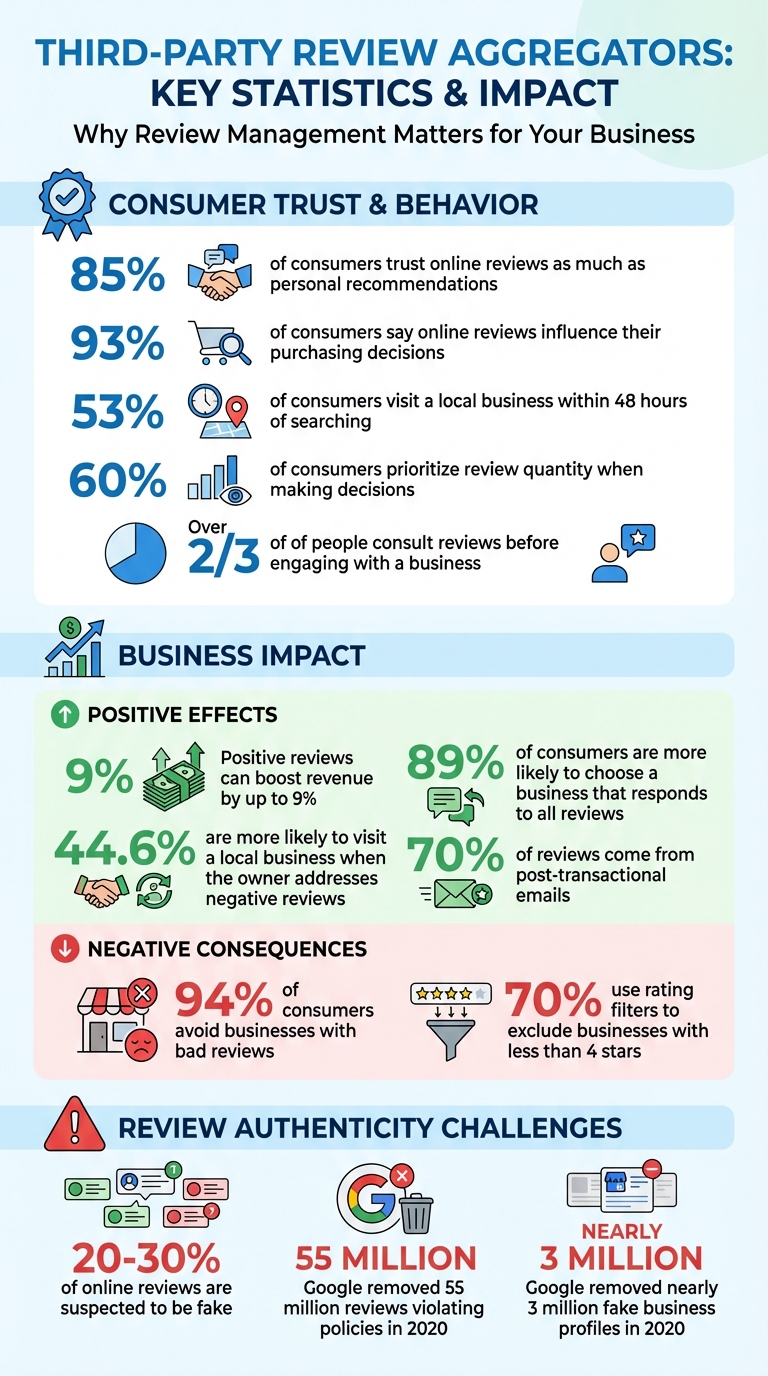
Third-Party Review Aggregators Impact on Business Performance Statistics
How Third-Party Review Aggregators Work
Review Collection and Organization
Third-party review aggregators gather reviews using API integrations with major platforms like Google Business Profile, Yelp Fusion, and Facebook Graph. These APIs provide structured data in formats like JSON or XML, making it easier to collect and organize reviews efficiently.
When official APIs aren’t available, some aggregators resort to extracting data directly from website HTML. This approach, while less reliable, can also run afoul of platform terms. For instance, Yelp’s API limits businesses to just three reviews per query, encouraging users to visit Yelp’s site for more information.
Once reviews are collected, they undergo a standardization process. For example, ratings from different scales – like a 10-point system – are converted into a common format, such as a 5-star rating. Similarly, varying date formats are unified through batch processing, ensuring consistency across the platform.
These steps lay the groundwork for verifying and moderating the reviews.
Verification and Moderation Processes
With as much as 20% to 30% of online reviews suspected to be fake, aggregators rely on multiple verification layers to ensure authenticity. Machine learning spam filters play a crucial role here, identifying patterns that suggest fraudulent activity. These can include repetitive language, unusual posting times, or bulk uploads indicative of bot-generated content.
Another method used is sentiment-rating cross-validation, which flags reviews where the tone of the text doesn’t align with the given rating. Duplicate detection systems are also in place to catch identical reviews posted on multiple platforms.
To complement automated systems, many aggregators employ human moderators. These reviewers manually inspect flagged content to ensure it aligns with platform guidelines and policies.
How Reviews and Ratings Are Displayed
Once reviews are verified, aggregators present them in ways that are easy for consumers to understand. Ratings are calculated using methods like simple averages, weighted averages, or Bayesian estimates to provide a balanced view. This ensures that newer, verified reviews aren’t overshadowed by older or sparse ratings.
The display typically includes star ratings, snippets of reviews, and sentiment labels (e.g., positive, negative, or neutral). Consumers can often sort and filter reviews by factors like date, rating, or helpfulness, allowing them to find relevant feedback quickly. Additionally, some platforms use rich snippets – star ratings displayed directly in search engine results – to enhance visibility and attract attention even before users click on a business profile.
sbb-itb-50c3429
Why Third-Party Review Aggregators Matter for Businesses
Building Customer Trust and Credibility
Third-party review aggregators play a key role in establishing trust with potential customers. These platforms leverage their reputation to enhance your business’s credibility. Considering that 85% of consumers trust online reviews as much as personal recommendations, and 93% admit online reviews influence their purchasing decisions, it’s clear how impactful they can be.
Aggregators present a mix of customer feedback, offering an unbiased perspective that polished marketing materials can’t replicate. This transparency helps build a sense of reliability and long-term trust. But it doesn’t stop there – actively responding to reviews strengthens this trust even further. By addressing concerns promptly and engaging with customers, you show that your business values their input and is committed to their satisfaction. This level of interaction sends a strong message to potential customers about your dedication to service.
All these efforts contribute to building credibility, which also boosts your visibility in local search results.
Impact on Local Search Rankings
Review aggregators do more than just build trust – they’re also a game-changer for your local online presence. Platforms like Google Business Profile rely heavily on high review volumes and positive ratings to determine which businesses appear in the coveted "Local Pack" (the top three listings displayed with a map for local searches).
Reviews also generate fresh, user-generated content that search engines love. Profiles on review aggregators can even provide valuable backlinks to your website. If you include review widgets with schema markup, your star ratings can show up as rich snippets in Google search results, grabbing attention and increasing click-through rates. Plus, customer reviews often include long-tail keywords, helping your business rank for specific, niche searches. Search engines also reward businesses that actively manage and respond to reviews, seeing it as a sign of reliability and engagement.
How Reviews Influence Sales Growth
The trust and visibility gained through review aggregators have a direct impact on sales. Businesses that actively manage their reviews can see revenue increases of up to 9%. Additionally, 53% of consumers visit a local business within 48 hours of searching, and 60% prioritize review quantity when making decisions. With over two-thirds of people consulting reviews before engaging with a business, your online reputation directly affects conversions.
On the flip side, negative reviews can be a dealbreaker. 94% of consumers avoid businesses with bad reviews, and 70% use rating filters to exclude businesses with less than 4 stars. These numbers highlight why maintaining a strong presence on review aggregators isn’t just helpful – it’s crucial for attracting and retaining customers.
Challenges with Third-Party Review Aggregators
Fake Reviews and Review Manipulation
While review aggregators can help build credibility, they also present opportunities for fraudulent practices that can tarnish a business’s reputation. Fake reviews often misrepresent the reviewer’s connection to the business, fabricate experiences, or violate platform guidelines outright.
The consequences of such practices go beyond reputation damage. For instance, in 2017, the Federal Trade Commission (FTC) penalized Sage Automotive Group with a $3.6 million settlement for deceptive advertising and fake online reviews. More recently, in August 2024, the FTC introduced stricter regulations banning the creation, purchase, or sale of fake reviews, including those generated by AI. Violators now face civil penalties.
Businesses should remain vigilant for warning signs like sudden spikes in review activity, reviewers posting from distant locations within a short period, or overly generic and excessively positive language. These patterns often indicate fraudulent activity. It’s also crucial to monitor any third-party SEO or reputation management firms you work with, as you’re legally accountable for their practices.
"Fake reviews not only harm your business reputation, they’re now a financial and legal liability." – Mel Attia, GatherUp
The challenges don’t end there – platform policies further complicate review management.
Dependence on Platform Policies
Every review aggregator operates under its own guidelines, which can shift without warning. For example, Google permits businesses to request reviews, while Yelp strictly prohibits solicitation. Yelp also uses automated filters to flag reviews it considers unreliable, relegating them to a "not currently recommended" section that doesn’t influence the overall star rating. In 2020, Google removed 55 million reviews that violated its policies and nearly 3 million fake business profiles. However, the success rate for addressing flagged content remains low.
Another challenge is the lack of control businesses have over how review snippets from third-party platforms appear on their Google Business Profile. If a business wants to remove a review, it must contact the original site directly – Google won’t intervene in such disputes.
The FTC’s 2024 ruling adds another layer of complexity by banning "review gating" (the practice of only soliciting positive reviews) and suppressing negative feedback. In one case, Fashion Nova faced a $4.2 million settlement in 2022 after it was found to be automatically posting only four- and five-star reviews while withholding lower ratings.
"For Google, their biggest weakness is combating fake reviews. They are beyond terrible at it and even the most obvious cases that get reported by a human… get missed." – Joy Hawkins, Owner, Sterling Sky
A final hurdle is the limited access businesses have to customer data on these platforms.
Limited Access to Customer Data
When it comes to third-party review platforms, businesses don’t own the reviews or the customer data – they’re at the mercy of the aggregator’s rules. Feedback is scattered across platforms like Google, Yelp, and niche industry sites, making it tough to get a full picture of customer sentiment without specialized tools.
"The sharing and access to that review is based on the rules imposed by the third-party review site. All the benefits go to the third-party site, not your company or the brand(s) you represent." – Mark Claypool, Author
This fragmented approach also creates challenges in verifying whether a reviewer was an actual customer or linking feedback to specific transactions. Some platforms even limit how businesses can respond to reviews. Adding to the frustration, these third-party sites often outrank a business’s own website in search results, directing traffic to the aggregator’s platform instead.
How to Manage Third-Party Review Aggregators
Taking control of your presence on third-party review platforms might seem daunting, but it’s entirely possible with the right strategy. By claiming your profiles, staying engaged, and leveraging customer feedback, you can improve your operations and build trust with your audience.
Setting Up and Optimizing Profiles
Start by claiming your business listings on major platforms like Google and Yelp. This ensures you have control over your profiles and can keep your information accurate. Make sure your business name, address, and phone number (NAP) are consistent across all platforms – this not only improves search engine visibility but also reassures potential customers.
Add high-quality visuals, such as your logo and a few photos that represent your business well. Complete every field with details like your unique selling points, company history, services, and even an owner biography. Instead of trying to manage every platform, focus on one or two key sites that matter most to your audience. Choose one platform to actively request reviews from customers. For a technical boost, consider adding review widgets with schema markup to your website – this can help star ratings show up directly in Google search results as rich snippets.
Once your profiles are optimized, shift your attention to monitoring and responding to reviews to further enhance your reputation.
Monitoring and Responding to Reviews
Make it a habit to check reviews daily or weekly. Using reputation management tools can simplify this process by consolidating reviews from multiple platforms into one dashboard, ensuring no feedback slips through the cracks.
When replying to reviews, personalize your responses. Thank customers by name and mention specific details from their review. For negative feedback, acknowledge the issue and offer a clear solution. As Solomon Thimothy, Founder of Clickx, suggests: "Always go the extra mile by replying to positive reviews with a thank you". This level of engagement matters – 89% of consumers are more likely to choose a business that responds to all reviews, and 44.6% are more likely to visit a local business when the owner addresses negative reviews.
The effort pays off, too. Businesses that actively manage their online reviews can see revenue increases of up to 9%.
Using Reviews in Your Reputation Management Strategy
Reviews aren’t just for marketing – they’re a goldmine of insights that can help you improve your business. Use them as a tool for operational analysis. Feedback categorization tools can group comments by themes like "pricing", "service quality", or "staff behavior", making it easier to spot areas that need attention.
Incorporate reviews into your marketing efforts by embedding them on your website, sharing them on social media, or even featuring them in search ads. To gather more feedback, include review request links or QR codes on business cards, brochures, email signatures, and at checkout counters. Automated systems that send review requests via email or SMS right after a transaction can be highly effective – 70% of reviews come from post-transactional emails.
For businesses with multiple locations or numerous platforms to manage, services like Review Overhaul can centralize monitoring, automate responses, and fine-tune Google Business Profiles. This approach ensures consistent branding while freeing up your time to focus on what really matters: engaging with your customers and improving their experience.
Conclusion
Third-party review aggregators have reshaped how people research businesses and decide where to spend their money. The numbers don’t lie – these platforms play a huge role in influencing customer behavior, making them a must-have tool for businesses aiming to build trust and draw in new customers.
To stay ahead, businesses need to actively manage their presence on these platforms. This means keeping profiles up to date, responding to customer feedback, and incorporating reviews into marketing strategies. Engaging with reviews doesn’t just improve your reputation – it can also lead to increased revenue. Responding promptly to feedback shows customers you care, while showcasing reviews on your website can strengthen trust.
Treat these platforms as active tools, not just passive spaces. Claim your listings, ensure your NAP (Name, Address, Phone Number) details are consistent, and aim to respond to feedback within a week. Analyzing review trends can also help pinpoint areas for improvement while turning positive feedback into a marketing advantage.
For businesses juggling multiple locations or dealing with scattered feedback, centralized solutions can make a big difference. Tools like Review Overhaul help streamline efforts, ensuring no review gets overlooked. Investing in proper review management leads to better search rankings, increased conversions, and stronger customer relationships – all of which contribute to long-term growth.
FAQs
Which review sites should my business prioritize first?
When it comes to boosting your online visibility and influencing consumer decisions, it’s essential to focus on platforms that hold the most sway. Here are some key players to prioritize:
- Google: As the go-to search engine, Google directly impacts local search rankings and visibility on Google Maps. A strong presence here can make or break how easily customers find you.
- Yelp: Particularly important for hospitality and service industries, Yelp reviews often shape customer perceptions and influence decisions.
- Facebook: With its massive user base, Facebook offers a unique combination of social proof and targeted reach, making it a powerful tool for engagement and visibility.
- TripAdvisor: For businesses in travel and tourism, TripAdvisor is a must. It’s a trusted source for travelers seeking recommendations and reviews.
Focusing on these platforms can help you build a solid reputation and draw in more customers.
How can I tell if a review is fake or manipulated?
To identify fake or manipulated reviews, start by examining the source. Reviews from verified buyers or reputable platforms are generally more reliable. Pay attention to unusual patterns, such as overly generic language, repetitive phrasing, or a flood of reviews posted within a short time. These can be red flags.
You can also look for inconsistencies in the details provided. If a review praises a product without mentioning specifics, or if multiple reviews seem suspiciously similar, dig deeper. For more in-depth advice, consult trusted resources like the FTC or consumer guides, which offer practical tips for spotting deceptive reviews.
How fast should I respond to new reviews?
Responding to new reviews quickly – ideally within 24 to 48 hours – demonstrates that you’re actively engaged with your audience. It’s a simple yet effective way to manage your online reputation while fostering trust and loyalty among your customers.
