
Are you a dedicated doctor, pouring all your energy into excellent patient care, only to feel helpless when a negative online review surfaces? You know that one bad comment can unfairly tarnish your hard-earned reputation, quietly driving potential patients to other clinics. This disconnect between your real-world expertise and your online image is frustrating and costly.
You’re not alone in this struggle. Many physicians feel their practice is vulnerable, defined by a handful of anonymous voices online. The constant worry about what patients might find when they search for you is a heavy burden, distracting you from what you do best: caring for people.
The New Digital Front Door to Your Practice
The reality is, your online presence is now the front door to your clinic. A staggering 77% of patients begin their search for a new physician by reading online reviews. They are making decisions about your practice before they even think to call your office.
This is where the real problem lies. If you continue to let your online reputation drift, you’re accepting a future where:
- You lose new patients to competitors with better online ratings.
- A few negative voices unfairly define your professional image.
- You miss out on the practice growth and peace of mind a stellar reputation provides.
The stakes are high. Continuing down this path means constantly losing customers and revenue, while taking control leads to sustainable growth and the confidence that your online presence reflects your true quality of care.
A Guide to Take Back Control
Feeling powerless against online critics is a common struggle, but there is a clear path forward. You don’t have to become a marketing expert to fix this. With a trusted guide and a simple plan, you can transform this vulnerability into your greatest strength.
At Review Overhaul, we provide a straightforward, 3-step process to help you manage your digital narrative. We empower you, the hero of this story, to build an online reputation that accurately showcases the exceptional care you provide every day. This proactive approach ensures your clinical excellence shines through, attracting the patients you deserve.
A Simple 3-Step Plan to Reclaim Your Reputation
Feeling overwhelmed by managing countless review sites is understandable. Your time is best spent with patients, not navigating the complexities of the internet. The good news is that taking control of your online reputation doesn’t require endless hours—it just requires a simple plan.
This isn’t about adding another job to your plate. It’s about implementing a proven system that works for you, turning online chaos into a powerful asset for your practice. This is the plan that will build trust and bring the right patients through your door.
Your Simple Plan for a Stronger Reputation
Effective online reputation management for doctors is built on a clear, 3-step process. Think of it as a clinical workflow for your digital presence: methodical, efficient, and designed for a busy physician like you.
Our simple plan includes:
- Step 1: Reputation Audit: First, we help you understand exactly where you stand. We’ll map out your current digital footprint, identify what patients are saying, and pinpoint any inconsistencies that are costing you trust.
- Step 2: Profile Optimization: Next, we guide you in perfecting your most important online profiles. We ensure every listing, from Google to healthcare directories, accurately reflects your expertise and commitment to patient care.
- Step 3: Feedback System: Finally, we help you establish a simple, ethical process for generating positive reviews and managing all feedback. This includes responding to comments—positive and negative—in a professional, HIPAA-compliant way.
This structured plan puts you in the driver’s seat. You’ll stop reacting to bad reviews and start proactively shaping a narrative of trust and authority.
The infographic below highlights how crucial online engagement is for building the trust that wins new patients.
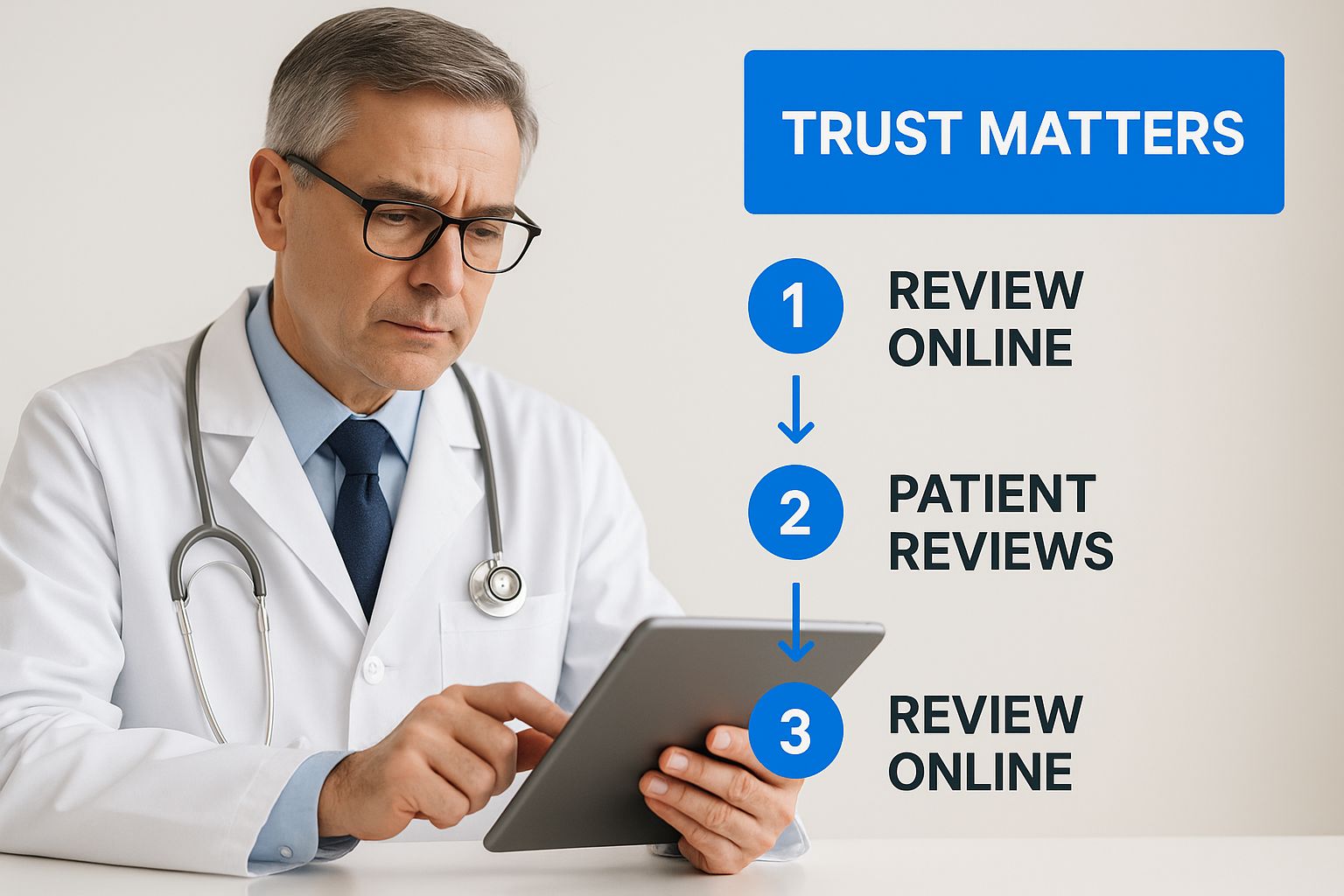
A doctor who actively manages their online presence is seen as more trustworthy—a key factor for anyone choosing a new physician.
What Success Looks Like for Your Practice
Following this simple plan leads to a tangible result: a better reputation that drives more sales and practice growth. When potential patients search for you, they will find a consistent, professional, and reassuring online presence that makes choosing you an easy decision.
The choice is clear. You can continue losing patients and revenue to competitors, or you can take control and gain the peace of mind that comes from owning your narrative. For a deeper look at the impact this can have, see our post on how online reputation management can transform your business.
Building a Five-Star Foundation

To build a reputation that lasts, you must start with a rock-solid foundation. This means perfecting your most visible online listings. Think of this as the digital equivalent of ensuring your clinic is professional, welcoming, and easy to find.
When a potential patient searches for you, they need a complete and reassuring picture of your practice. Any missing information or outdated photos can plant a seed of doubt at the worst possible moment.
Master Your Google Business Profile
When a patient looks for a doctor, their journey almost always starts on Google. This makes your Google Business Profile (GBP) your single most important digital asset. Optimizing it is essential for effective online reputation management for doctors.
A half-finished profile suggests a lack of attention to detail, which is the last impression you want to give. A fully optimized profile, on the other hand, signals professionalism and builds immediate trust.
Here’s what a best-in-class GBP includes:
- Precise Name & Credentials: Use your full professional title (e.g., Dr. Jane Smith, MD) for clarity.
- Specific Practice Category: Choose the most specific category, like “Cardiologist” or “Family Practice Physician.”
- Detailed Service Menu: List all specific services you provide to appear in targeted searches.
- High-Quality Photos: Include a professional headshot, clear photos of your clinic, and pictures of your friendly staff.
Remember, patients are forming an opinion long before they ever step into your office. A complete profile makes it easy for them to choose you with confidence.
Ensure Consistency Across All Directories
After Google, patients often turn to healthcare directories like Healthgrades, Vitals, and Zocdoc to validate their choice. Inconsistency across these sites is a major red flag that can cost you patients.
Every detail, from your phone number to the insurance plans you accept, must be identical everywhere. This consistency also signals to search engines that you are a credible, authoritative practice, which can boost your local search rankings. This is a core component of the reputation management strategies for healthcare providers we recommend.
Showcase Positive Patient Stories
A strong foundation isn’t just about data; it’s about showcasing the human side of your practice. Positive reviews are the social proof that turns claims into trust.
To cultivate this powerful social proof, you need a proactive, ethical system. It’s crucial to learn how to ask for testimonials effectively to build a library of positive stories. These patient narratives will become one of your greatest assets, providing the peace of mind that comes from a reputation built to last.
Turn Patient Feedback Into Your Greatest Asset
Every patient review is a gift, offering a direct window into the patient experience at your practice. For doctors looking to build trust, mastering review management is one of your most powerful tools for growth.
Ignoring the online conversation allows others to control your narrative entirely. A structured approach, however, shows prospective patients you are a responsive, caring, and professional physician who truly listens.
The Art of Responding to Positive Reviews
When a patient leaves a positive review, they’re handing you a high-impact marketing tool. A gracious, HIPAA-compliant response amplifies that positive sentiment.
Your response must never confirm that the reviewer is a patient or mention any specifics about their care. A simple, warm, and general reply is always the best approach.
A Solid Example of a Positive Review Response:
“Thank you for taking the time to share your kind words. We are dedicated to providing all our patients with compassionate and professional care, and we are so glad to hear about positive experiences like yours. Your feedback is truly valued.”
This type of response expresses gratitude, reinforces your practice’s values, and shows prospective patients that you are engaged and value feedback.
A Framework for Navigating Negative Feedback
A negative review can feel like a personal attack, but a defensive public reply almost always does more harm than good. A calm, strategic, and empathetic response can neutralize the situation and rebuild trust.
Key Takeaway: The primary goal is not to win an argument. It’s to demonstrate professionalism to the hundreds of prospective patients who will read your exchange.
Your response should always aim to move the conversation offline as quickly and smoothly as possible.
Here is a HIPAA-compliant de-escalation framework:
- Acknowledge and Empathize: Start by acknowledging their frustration. “We are sorry to hear your experience did not meet your expectations.”
- State Your Commitment: Briefly reiterate your practice’s commitment to patient satisfaction.
- Take It Offline: Provide a direct, private line of communication. “Please contact our practice manager, [Name], at [Phone Number] so we can address your concerns directly.”
This approach stops a public back-and-forth and shows you take concerns seriously.
Proactively Build Your Wall of Positive Proof
A few negative reviews can disproportionately tank your overall rating. The most effective defense is a strong offense: a consistent flow of new, positive reviews.
Proactively and ethically encouraging satisfied patients to share their feedback is a core part of online reputation management for doctors. This means creating a simple, automated system to ask for feedback from everyone.
Effective methods include:
- Post-Appointment Emails or Texts: A day after a visit, send an automated message thanking the patient and inviting them to share their experience.
- In-Office Signage: Use a QR code at the checkout desk linked directly to your preferred review platform.
- Empower Your Staff: Train your front-desk team to say, “We’d love to hear about your visit today online.”
By consistently asking for feedback, you ensure your online profile accurately reflects the quality of care you provide. This is further explored in our guide on harnessing customer feedback for business growth.
Advanced Strategies for Protecting Your Reputation

Once your foundation is solid, it’s time to build a protective shield around your reputation. This means embracing sophisticated tools and strategies to proactively shape your professional narrative.
Your time is best spent on patient care, not playing digital watchdog. The goal is to build a system that works in the background, alerting you to small issues before they become a crisis.
Leveraging AI for Monitoring
The sheer volume of online feedback is impossible to manage manually. AI-powered platforms can scan dozens of review sites and social media mentions in real time. We know that roughly 75% of patients check online reviews before choosing a doctor.
These AI tools use natural language processing (NLP) to understand the sentiment behind reviews. This gives you a bird’s-eye view, spotting recurring themes—like long wait times or praise for your staff—and turning comments into actionable insights to improve your practice.
By using AI to monitor sentiment, you transform raw feedback into structured data. This allows you to address systemic issues within your practice, turning patient criticism into a catalyst for operational improvement and growth.
Navigating a Reputation Crisis
Even with perfect preparation, a crisis can erupt. When it does, the first rule is to stay calm and execute a pre-determined plan. A panicked, defensive reaction will only add fuel to the fire.
Immediate Actions During a Crisis:
- Pause and Assess: Don’t fire off an immediate reply. Get a clear picture of the problem first.
- Centralize Communication: Designate a single point person to handle all public statements.
- Craft a Holding Statement: Issue a brief statement acknowledging the situation, confirming you’re investigating, and reiterating your commitment to patient care.
- Move Conversations Offline: Guide the conversation to a private channel, like a phone call or dedicated email.
This structured approach demonstrates professionalism and accountability to potential patients watching from the sidelines.
Proactively Shape Search Results with Content
One of the most powerful moves in online reputation management for doctors is to control what patients see when they search for you. You can do this by creating and promoting positive, high-value content that you own.
This strategy effectively pushes negative or irrelevant search results down the page, where they are rarely seen. This content can include:
- Patient education articles on your blog.
- Professional insights shared on LinkedIn.
- Guest posts on respected health websites.
- Short, educational videos answering common patient questions.
This approach actively builds your authority and reinforces your credibility. For a closer look at these tactics, you can explore these proven strategies to improve online reputation. To learn more, take a look at our guide on understanding the importance of online reputation management.
Frequently Asked Questions
When managing an online reputation, physicians often have the same questions. The concerns are less about if they should be doing this, and more about how to handle it ethically and effectively.
How Do I Handle a Factually Incorrect Negative Review?
It’s frustrating when a review is just plain wrong. Never engage in a public debate or try to correct the reviewer’s facts in your reply. This can escalate the conflict and put you at risk of a HIPAA violation.
Instead, post a brief, professional public response acknowledging the comment without confirming details. At the same time, flag the review on the platform where it was posted—Google, Yelp, or Healthgrades—for violating their content policies.
Is It Ethical to Ask My Patients for Reviews?
Yes, it is completely ethical to ask patients for reviews, as long as you never offer incentives. This is a major violation of terms of service for every reputable review site and destroys credibility.
The best approach is to create a neutral system for requesting feedback from everyone. Use simple language like, “Your feedback is valuable and helps us improve our services. We’d appreciate you taking a moment to share your experience.”
How Much Time Should I Dedicate to This Weekly?
The time commitment for online reputation management for doctors isn’t as daunting as it seems. For most practices, about 1-2 hours per week is a realistic goal for ongoing maintenance.
This time should be focused on:
- Checking for new reviews on your critical profiles.
- Replying to all new reviews quickly.
- Reviewing your Google Business Profile for any user-suggested changes.
A dedicated reputation management tool can make this process much more efficient, pulling all your reviews into one place.
You shouldn’t have to carry the stress of managing your online presence alone. At Review Overhaul, we are the trusted guide with the expertise and tools to help you protect and build your professional reputation, so you can focus on your patients. Let us handle the complexities of your digital story.
Schedule your free reputation audit today and see how we can help your practice thrive.
