That sinking feeling when you see a bad review is real. For a small business owner, it's not just a comment; it's a direct hit to your bottom line. You've poured everything into your business, but a few negative voices online are costing you customers and revenue.
Those bad reviews are a constant source of stress, creating an invisible wall that turns good people away before they even give you a chance. You know you're losing business, but fixing it feels overwhelming. The good news is, you don't have to stay stuck.
Reclaim Your Brand With a Simple Plan
At Review Overhaul, we've guided countless business owners just like you through this exact struggle. We provide a simple, 3-step plan that puts you back in control of your narrative. Our process is designed to turn your reputation into your strongest asset.
Here's how we help you fix your online reputation and start winning again:
- Step 1: Get Your Free Reputation Audit. We'll uncover every piece of damaging content so you know exactly what you're up against.
- Step 2: Launch Your Custom Action Plan. We'll help you respond to, remove, and suppress negative content effectively.
- Step 3: Build Your Positive Presence. We'll implement a system to consistently generate positive reviews, creating a lasting shield for your brand.
What Success Looks Like for You
Imagine logging in and seeing a wave of 5-star reviews instead of dreading what you might find. Picture new customers walking in, telling you they chose you because of your amazing online feedback. This isn't a fantasy; it's the result of taking control.
A strong, positive reputation means:
- More customers choosing you over the competition.
- Increased revenue and sustainable business growth.
- Peace of mind, knowing your online presence reflects the quality of your work.
You've built a great business. It's time your online reputation matched it.
Don't Just Take Our Word For It
We've helped businesses across industries transform their online presence from a liability into a growth engine.
| The Real Cost of a Negative Reputation |
| :— | :— | :— |
| Problem Area | Direct Business Impact | Long-Term Consequence |
| Damaging Search Results | Loss of 74% of potential customers who won't buy if the first page has negative content. | Your brand becomes permanently associated with negativity, making recovery much harder. |
| Negative Online Reviews | 93% of consumers check reviews before buying; negative ones directly deter them. | Erosion of customer trust, making it difficult to attract new clients and retain existing ones. |
| Poor Star Ratings | A single-star drop can lead to a 5-9% decrease in annual revenue. | Reduced visibility on platforms like Google Maps and a perception of low quality. |
| Unanswered Complaints | Customers feel ignored, leading to public criticism and lost loyalty. | A reputation for poor customer service that can take years to overcome. |
The data paints a stark picture. It's why 84% of global executives now rank brand and reputation risk as their top concern. Studies also show that up to 80% of a company's market value comes from intangible assets like brand equity—something your reputation directly shapes. If you want to dive deeper, you can read more about the impact of these reputation management statistics and see how they play out for businesses like yours.
Your Path to Recovery
This struggle doesn't have to define your business. You built this company from the ground up, and that same grit and determination are exactly what you need to reclaim your online reputation. Moving from a place of reacting to negative feedback to proactively controlling your brand’s story is a powerful journey.
Here’s what that transformation looks like in practice:
- From Reactive to Proactive: Instead of dreading the next bad review, you’ll have a system in place to consistently generate positive feedback from your happy customers.
- Restoring Customer Trust: You'll learn to turn negative experiences into public displays of exceptional customer service, winning back trust and impressing onlookers.
- Driving Measurable Growth: A stronger, more positive reputation directly translates into more leads, better conversion rates, and, ultimately, increased revenue.
The good news is that there’s a clear path forward. It all starts with understanding the real-world impact of your online presence and committing to a straightforward plan to fix it for good.
A Proven Framework to Reclaim Your Brand

When you're facing a reputation crisis, it’s easy to feel overwhelmed. I’ve seen it countless times with business owners who pour everything into their work, only to be sideswiped by negative feedback. But here’s the good news: the solution isn't some complex, endless battle. It’s about having a structured approach.
We break the journey to fix your online reputation into three clear stages: Audit, Action, and Amplify. This methodical plan gives you a proven path forward, taking the guesswork out of the equation and replacing anxiety with a concrete strategy. It’s designed to put you back in the driver's seat of your brand's story.
The Audit Phase: Uncovering the Full Picture
Before you can start fixing the damage, you have to know exactly what you’re up against. The 'Audit' phase is a deep dive into your digital footprint, where we meticulously search for and document every piece of negative content out there.
This isn't just about a quick Google search. It means digging into the corners of the internet—review sites, social media threads, industry forums, and even obscure blogs where your business might get a mention. The goal here is to create a complete inventory of every challenge you're facing. Only then can you build a precise, targeted response.
The Action Phase: Taking Decisive Steps
Once you have that clear picture, it’s time to move into the 'Action' phase. This is where we roll up our sleeves and work to neutralize the negative content we found. You’ll get the tools and strategies needed to systematically tackle damaging reviews and other harmful posts.
This stage involves a few key moves:
- Crafting Professional Responses: Learning how to respond to a negative review can turn a detractor into a fan. It's an art form that shows you listen and care.
- Strategic Removal Tactics: Some content, like fake reviews or defamatory statements, violates platform rules. We identify these and start the process to get them taken down.
- Direct Engagement: Sometimes, the best move is to take the conversation offline. Reaching out to an unhappy customer to genuinely resolve their issue often leads to them updating or removing their negative post on their own.
It's all about taking direct, strategic action instead of reacting emotionally. This visual breaks down what that process looks like.
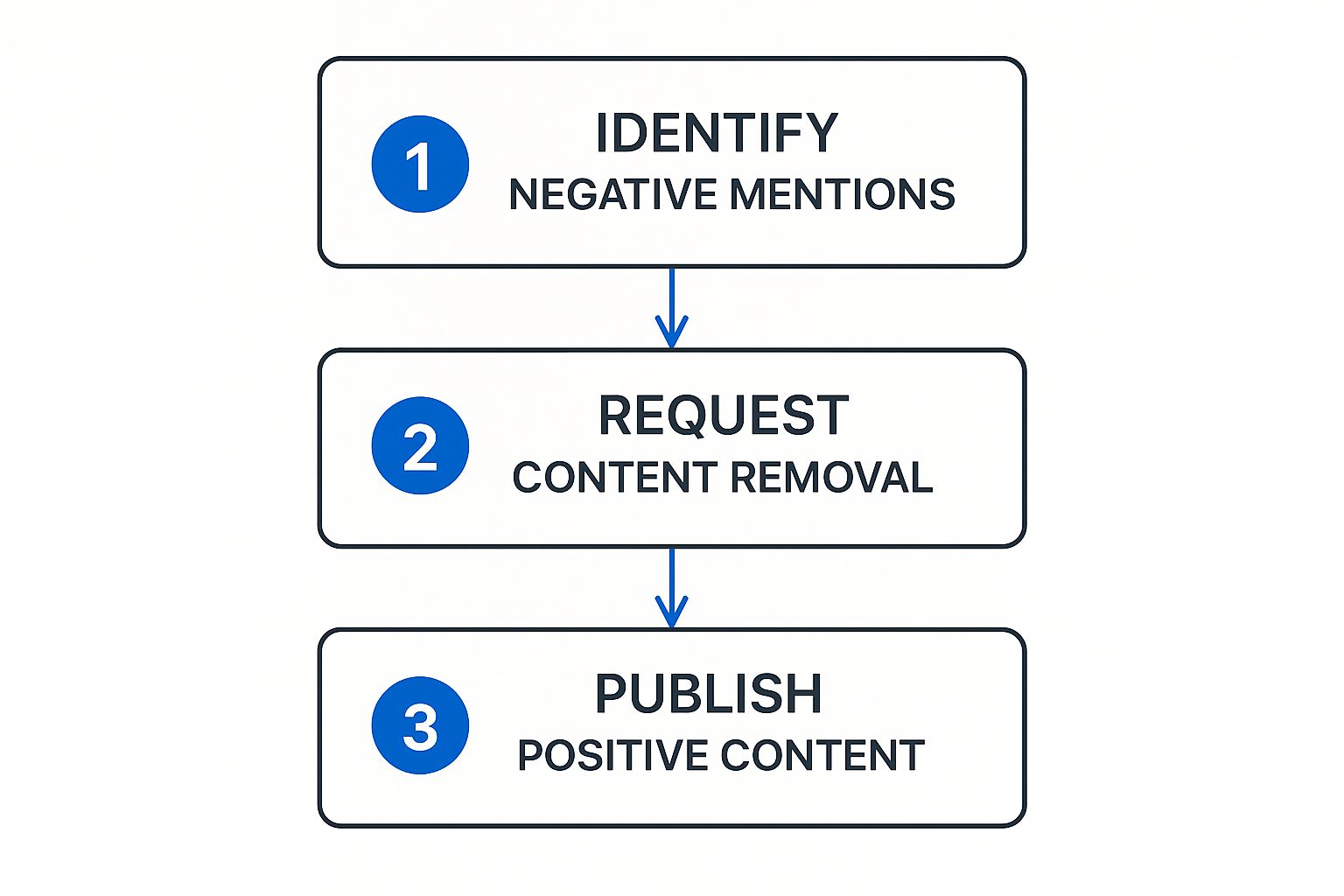
As you can see, it's a cycle: identify the problem, work to remove what you can, and then proactively build a positive presence to drown out the rest.
The Amplify Phase: Building a Positive Future
Finally, we shift from defense to offense in the 'Amplify' phase. Fixing past damage is only half the job. The real key to long-term success is building a resilient, positive online presence for the future. This is where you start to actively shape the conversation around your brand.
This final stage is all about building a strong foundation of positive content that shows what your business is truly about. We’ll focus on generating a steady stream of authentic, positive reviews from your happy customers and creating content that highlights your expertise. For more in-depth techniques, you can explore our detailed guide on effective reputation management strategies for businesses.
By consistently amplifying positive voices, you create a kind of digital "firewall" that protects your brand from future attacks. It's this proactive work that brings lasting peace of mind.
Of course, a core part of reclaiming your brand’s standing involves implementing effective strategies for building customer trust. This framework doesn't just help you manage feedback; it strengthens the fundamental relationship you have with your customers. By following this proven path—Audit, Action, and Amplify—you move from a defensive crouch to a position of strength, ensuring your online reputation finally reflects the quality and dedication you bring to your work every single day.
Auditing and Assessing Your Online Footprint

Before you can start fixing your online reputation, you have to know exactly what you’re up against. That nagging feeling you get from a few bad reviews isn't enough to build a strategy on. What you need is a clear, data-driven picture of your digital footprint. This initial audit is the bedrock of your entire recovery plan—it’s how you turn that vague anxiety into a list of concrete actions.
The goal here is to systematically uncover every corner of the internet where people are talking about you. This goes far beyond the usual suspects like Google and Yelp. Think niche industry forums, private social media groups, and local blogs. A solid starting point is a thorough website review; using a complete website audit checklist can help make sure nothing important gets missed.
Mapping Your Digital Presence
First things first, you need to create a master list of every platform where your business is mentioned. I like to think of this as mapping out your brand’s territory online. Kick things off with the big, obvious review sites, but then dig deeper to find those less-visible mentions that can still do damage.
This discovery phase is absolutely critical. You can't manage a conversation you don't know is happening, so this methodical search ensures your efforts are laser-focused right from the start.
Here's how I suggest you begin:
- Broad Search: Start with simple Google searches for
"[Your Business Name]"and follow up with variations like"[Your Business Name] reviews". - Social Media Search: Go through Facebook, X (formerly Twitter), Instagram, and even LinkedIn for any mentions or tagged posts.
- Industry-Specific Sites: Don't forget the platforms that matter in your field. This could be TripAdvisor for a hotel or Avvo if you’re a law firm.
Setting Up Real-Time Monitoring
Once you have a baseline, the next move is to set up an early warning system. You need to know about new mentions the moment they appear, not stumble upon them weeks later. Being proactive like this allows for a rapid response, which I've found is one of the most powerful tools for managing customer sentiment.
Setting up alerts is surprisingly simple and incredibly effective. A free tool like Google Alerts can be configured to email you anytime your business name pops up in new content. It’s a straightforward way to keep a real-time pulse on your reputation.
An effective monitoring system transforms reputation management from a reactive, crisis-driven task into a proactive, strategic business function. It allows you to address issues before they escalate and amplify positive feedback as it occurs.
This shift toward proactive management is reflected across the industry. The online reputation management (ORM) market, valued at $4.5 billion, is projected to soar to $17.4 billion by 2032. This incredible growth shows just how seriously businesses are taking their digital presence.
Analyzing and Categorizing Feedback
Now that you have a clear view of your online mentions, it's time to analyze them. Let's be honest: not all negative feedback is created equal. You have to categorize what you’ve found to prioritize your responses intelligently.
This step helps you separate legitimate customer complaints—which need a thoughtful, human response—from malicious attacks or fake reviews that should be challenged and removed. Breaking it all down gives you the clarity to build a real strategy. For a deeper look at this, our guide on how to improve your online reputation is a great resource.
I’ve found that a simple framework for sorting feedback works best. Try organizing mentions by their severity and type.
| Feedback Category | Description | Recommended First Step |
|---|---|---|
| High-Severity Legitimate | A genuine customer complaint detailing a significant service failure that could deter many potential customers. | Draft an immediate, empathetic public response and initiate direct outreach to resolve the issue offline. |
| Low-Severity Legitimate | A minor complaint or constructive criticism from a real customer, such as a slow response time or a small mistake. | Respond publicly, thanking them for the feedback and explaining the steps you are taking to improve. |
| Potentially Fake or Malicious | A review that contains false information, personal attacks, or seems to come from a non-customer. | Do not engage publicly. Document the evidence and flag the review for removal according to the platform's policies. |
| Positive Mentions | Positive reviews, comments, or articles that praise your business, products, or services. | Engage with a thank-you message and consider sharing the positive feedback on your own channels to amplify its reach. |
By the end of this audit, you'll have moved from a state of reactive worry to proactive control. You’ll be armed with the precise information needed to take targeted, effective action and begin reclaiming your narrative.
Taking Action on Negative Content

Once you've mapped out your online footprint, it’s time to roll up your sleeves and engage directly with the negative content. This is where you move from analysis to action, actively turning the tide on damaging feedback.
Think of this not as damage control, but as an opportunity. A public complaint gives you a public stage to showcase just how seriously you take customer satisfaction. A professional, thoughtful response can impress not only the unhappy customer but also the dozens of potential clients reading the exchange. It's about solving the problem, not winning the argument.
Responding To Criticism With Professionalism
Seeing a harsh review can sting. The first instinct for many is to get defensive, but a strategic, empathetic response is always more powerful. The key is to acknowledge the customer's frustration, take ownership where it's due, and clearly outline how you'll make it right. This simple act shows everyone that you're listening and you care.
A quick reply also stops a single negative comment from festering and becoming the definitive story about your business. Remember, your audience isn't just the reviewer; it's every single prospect who sees that review and wonders how you handle things when they go wrong.
Crafting the perfect reply takes practice. For a deep dive into specific templates and strategies, our guide on how to respond to negative reviews is an invaluable resource for handling even the toughest feedback.
Transforming Negatives Into Positives
Believe it or not, a well-handled complaint can turn a detractor into a loyal advocate. When customers feel genuinely heard, they are often willing to give you a second chance. The process starts by taking the conversation offline to resolve the specifics of their problem directly and personally.
Once you’ve found a solution, you'll be surprised how many customers are willing to update or even remove their original negative review. This is the ideal outcome—it neutralizes a bad comment and replaces it with a story of redemption and stellar service. This is how you fix your online reputation, one customer at a time.
A single negative review can have a significant financial impact. Research indicates that just one adverse review can cost a business approximately 30 customers, underscoring the urgency of addressing negative feedback swiftly and effectively.
Consumer trust in online reviews has soared. Today, 85% of consumers value them as much as a personal recommendation. What’s more, 92% of potential customers won't even consider a business with less than a four-star rating. These figures from a study on online reputation management statistics by ReputationX show why positive, authentic reviews are non-negotiable for growth.
Handling Fake Or Malicious Reviews
Unfortunately, not all negative feedback is genuine. Malicious reviews from competitors, disgruntled ex-employees, or internet trolls are a frustrating reality. These require a completely different strategy.
The golden rule is to never engage publicly with a review you suspect is fake. A public back-and-forth only gives it credibility and keeps it visible. Instead, your mission is to quietly document the evidence and report it through the platform’s official channels.
Here are the essential steps to follow:
- Document Everything: Screenshot the review and the reviewer’s profile. Note any red flags, like a lack of other reviews or vague, non-specific complaints.
- Check Platform Policies: Get familiar with the review site's terms of service. Most have clear policies against fake content, defamation, or harassment.
- Submit a Removal Request: Use the platform’s flagging tool to submit a detailed removal request. Clearly explain why the review violates their policies, and attach the evidence you gathered.
Effective Responses to Negative Reviews
Responding to negative feedback is an art. Getting it right reinforces your brand's integrity, while a poor response can make a bad situation much worse. This table offers a quick guide to navigating common complaint scenarios with professionalism.
| Scenario | What Not to Do | What to Do Instead |
|---|---|---|
| A customer complains about slow service. | Post a defensive reply blaming external factors or questioning the customer's patience. | Apologize for the delay, thank them for their feedback, and briefly explain steps being taken to improve service speed. |
| A review contains false information. | Accuse the reviewer of lying in a public comment and start an argument. | Do not engage publicly. Document the inaccuracies and report the review to the platform for violating content policies. |
| A customer is unhappy with a product. | Offer a generic, automated-sounding response that doesn't address their specific issue. | Empathize with their frustration, offer a direct contact (name, email, or number) to resolve the issue, and propose a refund or replacement. |
By taking this measured, strategic approach, you can manage all forms of negative content effectively. This positions your business not as a victim of online criticism, but as a proactive organization dedicated to quality and customer care.
Building a Resilient Online Reputation for the Future
Fixing negative reviews is one thing, but the real work begins when you shift from defense to offense. The ultimate goal isn't just to clean up a mess; it's to build a powerful, positive online presence that consistently brings in new business and protects your brand from future problems. This final phase, which I call Amplification, is all about proactive growth.
This is where we build your roadmap to a lasting, positive digital footprint. It's about putting systems in place to generate a steady stream of glowing reviews from your happiest customers. It also means creating and promoting high-value content that naturally pushes any lingering negativity down in search results, giving you long-term control over your brand's story.
Creating a System for Positive Reviews
The best way to drown out a few negative comments is with an overwhelming wave of positive ones. But hope isn't a strategy. You need a repeatable system that encourages satisfied customers to share their great experiences. A consistent flow of four and five-star reviews is the strongest reputational shield you can have.
Timing is everything. You have to identify the perfect moment to ask for that review. It could be right after a successful project wraps up, following a fantastic customer service call, or after a customer makes a repeat purchase. You want to make the request when their positive feelings are at their absolute peak.
Simple, automated campaigns can handle the heavy lifting. I’ve seen these methods work wonders:
- Email Campaigns: A day or two after a transaction, send a polite, personalized follow-up email. Thank them for their business and include a direct link to your preferred review site.
- SMS Campaigns: If you have mobile numbers, a quick text with a review link often gets incredibly high open and response rates.
- In-Person Requests: Train your team to mention leaving a review at the end of a great interaction. A small card with a QR code that links straight to your Google or Yelp profile makes it effortless.
The idea is to remove every possible barrier. Most happy customers are willing to help you out; they just need a gentle, well-timed nudge.
Suppressing Negativity with Positive Content
While you're building up your review count, you also need to focus on creating positive, brand-owned assets that you control completely. This content is your long-term solution for pushing any remaining negative search results so far down the page that no one will ever find them. Search engines love fresh, high-quality content, and you can absolutely use that to your advantage.
Think bigger than just your website's homepage. Creating a variety of content that puts your expertise and quality on display is crucial. This strategy does more than just fix your online reputation—it establishes your business as a trusted leader in your field.
A proactive content strategy is the most reliable way to control your brand's narrative in search results. By consistently publishing valuable, optimized content, you create a digital buffer that protects your reputation and actively showcases your strengths.
Start by developing a few core types of content that show off what makes your business great. You can then promote these assets across your social media channels and through email newsletters to maximize their reach and impact.
Content Strategies That Build a Strong Reputation
To truly build a positive online presence, you need a diverse mix of content that tells your story and proves your value. We're not just talking about writing a few blog posts; this is about creating a rich digital ecosystem around your brand. For a deeper dive, you can explore some essential online reputation management best practices that the most successful businesses rely on.
Here are a few powerful content types I always recommend focusing on:
- Customer Success Stories or Case Studies: Show, don't just tell. Detail exactly how you solved a tough problem for a client. These real-world stories provide powerful social proof and are far more convincing than generic claims.
- Expert Blog Posts: Write articles that answer the common questions your customers are already asking. This positions you as a helpful authority and builds trust long before they're even ready to buy.
- Positive Press and Media Mentions: If a local news outlet or industry blog features your business, share that story everywhere. Endorsements from a third party carry incredible weight and credibility.
- Community Involvement: Showcase your company’s local sponsorships, charity work, or participation in community events. This demonstrates that your business cares about more than just its bottom line.
By consistently applying these amplification strategies, you're doing more than just repairing past damage. You are building a durable, positive reputation that will define your brand for years to come, ensuring your online presence is a true reflection of the value you provide every single day.
Stop Losing Customers to Bad Reviews
You can either continue to let negative reviews define your business and cost you money, or you can take control and build a reputation that drives growth. The choice is yours.
Don't wait another day. Schedule your free reputation audit now and take the first step toward the peace of mind you and your business deserve.
