
Managing online reviews for multiple locations can feel overwhelming, but it’s critical for protecting your brand’s reputation and attracting customers. Here’s why it matters:
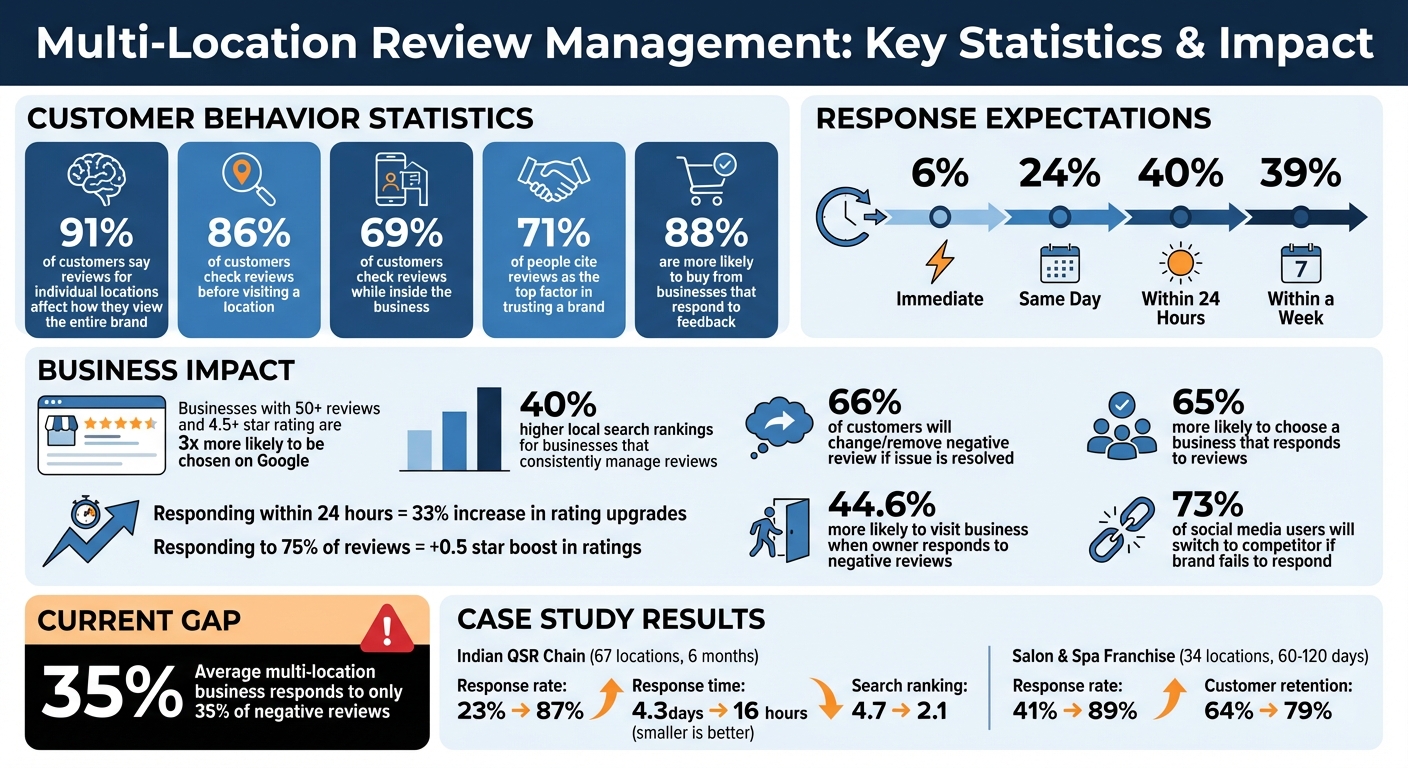
- 91% of customers say reviews for individual locations affect how they view the entire brand.
- Businesses with 50+ reviews and a 4.5+ star rating are three times more likely to be chosen on Google.
- 86% of customers check reviews before visiting a location, and 69% do so while inside the business.
To stay ahead, you need a clear strategy to monitor, respond to, and address reviews across all platforms and locations. Key steps include:
- Centralizing review management with a unified dashboard to track and respond efficiently.
- Assigning clear roles for corporate and local teams to ensure consistency and speed.
- Setting response policies to handle issues quickly, especially for negative reviews.
- Tracking patterns to identify recurring problems and fix them.
- Using real-time alerts to act on negative feedback immediately.
Responding to reviews within 24 hours can boost ratings and customer trust. A thoughtful approach to managing feedback not only improves your reputation but also drives better business outcomes.
Multi-Location Review Management Statistics and Impact
Reviews to revenue: Reputation management for multi-location businesses
sbb-itb-50c3429
Centralized Review Monitoring and Management
Handling reviews for multiple locations can feel like juggling too many balls at once. Logging into separate accounts for platforms like Google, Yelp, Facebook, and TripAdvisor eats up time, increases the risk of missing reviews, and slows down response times. Centralizing review management into one system simplifies the process, giving you full control and ensuring your brand voice stays consistent across all locations.
Set Up a Unified Dashboard
A unified dashboard pulls reviews from all platforms into one place, so you don’t have to waste time switching between accounts. The most effective dashboards can link multiple Google Business Profiles and other review platforms under a single login. Many even come with AI tools that suggest responses tailored to the tone and sentiment of the review. Advanced sentiment analysis tools can also help you spot recurring complaints – like slow service or cleanliness issues – across your locations.
Look for dashboards that let you filter reviews by location, rating, or topic, and that send real-time alerts for negative feedback. Some platforms also provide performance analytics, allowing you to compare how different locations stack up. Bonus features like syncing business information (name, address, phone number) across all locations and bulk verifying new listings can save even more time.
By centralizing your review management, you can streamline tasks and assign roles more effectively.
Assign Team Roles and Responsibilities
Breaking up review management tasks between corporate and local teams creates a balance of consistency and efficiency. Corporate teams can oversee the big picture by tracking all reviews through the centralized dashboard. They handle crisis-level feedback (like 1–2 star reviews), monitor brand-wide sentiment trends, develop response templates, and provide ongoing training. Local managers, on the other hand, focus on the day-to-day: responding to reviews within 24–48 hours, personalizing templates with location-specific details, escalating unusual situations to corporate, and proactively asking satisfied customers for reviews.
Here’s how this approach paid off for two businesses:
- An Indian quick-service restaurant chain with 67 locations adopted this model for six months. Their response rate jumped from 23% to 87%, average response time shrank from 4.3 days to just 16 hours, and their local search ranking improved from 4.7 to 2.1.
- A salon and spa franchise with 34 locations saw their response rate climb from 41% to 89% in just 60 days. Over four months, customer retention also increased from 64% to 79%.
"Corporate maintains consistency and catches patterns. Local teams provide speed and context. Neither operates in isolation." – Pramila Khilari, SEO Specialist
This division of responsibilities ensures a well-coordinated review management strategy across all locations.
Create a Multi-Location Response Policy
A clear response policy helps maintain professionalism and consistency across every branch. Start by defining your brand voice in a style guide that outlines formatting, vocabulary, and core values. Set a 24-hour deadline for initial responses – since 40% of customers expect a reply within that timeframe, and 24% expect one the same day. Include a list of dos and don’ts to ensure responses stay polished and professional.
For more serious reviews, like those involving legal threats or safety concerns, establish a crisis escalation plan. Local managers should have a direct line to senior leadership for immediate action. Regularly audit responses across all locations to ensure compliance with your guidelines and identify areas where additional training might be needed.
Detection and Tracking of Negative Reviews
Once you’ve centralized your review management, the next step is to stay on top of negative feedback. Acting quickly is key – statistics show that 6% of customers expect an immediate response, 24% expect one within the same day, and 39% expect one within a week. Failing to respond in time can hurt your reputation and send the wrong message to potential customers about how much you value their input.
Enable Real-Time Alerts
Set up email notifications in your Google Business Profile to stay updated on new reviews. Simply log into the account linked to your Business Profile, go to the "Notifications" section, and turn on the "Customer reviews" alert. This ensures you’re notified as soon as a review is posted.
To streamline the process, use AI-driven sentiment analysis tools to label reviews as positive, neutral, or negative. This allows you to focus on the most pressing issues quickly. Implement a triage system to organize reviews into categories like "New", "Assigned", "In Progress", and "Resolved". Give priority to low-rated reviews (1 or 2 stars), particularly those that raise serious concerns about safety, refunds, or legal matters.
Track Patterns and Recurring Complaints
AI tools can also help identify trends in customer feedback. For example, a quick-service restaurant chain with 19 locations used sentiment analysis to flag a surge in "food quality" complaints at three specific branches. After investigating, they discovered a supplier had been delivering subpar ingredients to those locations. The issue was resolved in just one week.
Use tagging and filtering features to group reviews by themes like "wait times", "cleanliness", or "staff behavior." This makes it easier to spot recurring issues and address them effectively. Additionally, compare performance across locations to identify branches that are struggling or excelling. Best practices from top-performing locations can often be applied across the board.
Monitor Brand Mentions Beyond Review Sites
Not all feedback comes through traditional review platforms. Social media, forums, and map apps are increasingly popular venues for negative comments, especially among Millennials and Gen Z. In fact, 73% of social media users say they’d switch to a competitor if a brand fails to respond to their complaints online.
To stay ahead, use social listening tools to track keywords, hashtags, and mentions related to your brand on platforms like X (formerly Twitter), Instagram, TikTok, and online forums. For instance, Xbox Support uses a dedicated X account to address customer complaints separately from its main marketing handle. Multi-location businesses can also benefit from creating branch-specific social media pages. Freddy’s Frozen Custard & Steakburgers, for example, manages individual Facebook pages for each of its locations, making it easier to monitor and respond to local feedback.
"Receiving real-time feedback helps us pinpoint and resolve client pain points in a timely manner." – Migs Bassig, ReviewTrackers
How to Respond to Negative Reviews
Once you’ve identified negative reviews, the next step is crafting responses that rebuild trust. Here’s why it matters: 85% of consumers consider how businesses respond to negative reviews when deciding where to spend their money, and 97% of people who read reviews also check out the business’s replies. A well-thought-out response doesn’t just address one unhappy customer – it shows everyone else how you handle challenges.
Respond Quickly and With Empathy
Timing is everything. Responding to a negative review within 24 hours can result in a 33% increase in rating upgrades. Start by carefully reading the feedback to understand the issue without letting personal biases creep in. Use the AAAI Framework to guide your response:
- Acknowledge their experience.
- Offer a genuine Apology.
- Explain the Action you’re taking to resolve the issue.
- Extend an Invitation to continue the discussion privately.
Avoid defensive or canned responses. For instance, instead of saying, "We’re sorry you feel that way", try something more specific like, "We’re sorry to hear about your experience with [specific issue]." Whenever possible, address the reviewer by name and maintain a warm, professional tone. This reassures both the reviewer and anyone else reading that you’re serious about customer feedback.
For sensitive topics, it’s best to take the conversation offline.
Handle Sensitive Issues Privately
Certain issues are better handled out of the public eye. After acknowledging the complaint in your initial response, guide the conversation to a private channel. Provide a direct phone number or email address, and sign off with a real name and title instead of something generic like "The Management Team". This personal touch reminds customers they’re dealing with real people, not a faceless entity.
For example, you could write: "Please contact us at [email] or [phone number] so we can address this directly. Ask for [Manager Name], who will personally assist you." After resolving the matter offline, take time to analyze the issue and implement changes to prevent it from happening again. This extra effort pays off, as 44.6% of consumers are more likely to visit a local business when the owner responds to negative reviews.
Personalize Responses and Own Up to Mistakes
Once sensitive matters are handled privately, craft a tailored public response to leave a lasting impression. Avoid generic templates – they’re easy to spot and leave customers feeling overlooked. Instead, reference specific details from the review, such as a long wait time, a cleanliness issue, or a staff interaction. If you operate multiple locations, mention the specific branch involved and any relevant staff members to show you’re addressing the issue locally.
Take full responsibility without making excuses. Wrap up your response by reaffirming your commitment to high standards: "This is not the level of service we strive to provide." End on a positive, forward-thinking note with a professional sign-off, such as "Sincerely, The [Business Name] Team". Remember, 65% of consumers are more likely to choose a business that responds to reviews, so every thoughtful reply is a chance to regain trust and attract new customers.
Escalation and Prevention Strategies
Not every negative review tells the whole story. In fact, about 4% of online reviews are fake. Knowing how to handle these situations – whether escalating issues, encouraging follow-up feedback, or preventing repeat problems – can safeguard your brand and improve your overall ratings. Here’s how to tackle these challenges effectively.
Report Fake or Spam Reviews
Spotting fake reviews requires a sharp eye. Look for telltale signs like overly generic language, vague but harsh negativity, repetitive phrases, or profiles with no review history. Local SEO expert Mike Blumenthal humorously illustrates the odd patterns of fake reviews:
"She will, of course, be educated at the mortuary school in Illinois and will have visited a dentist in Austin after having reviewed four other dentists… Oh, and then she will have bought her engagement ring in Israel… And all of this has taken place in the period of a year, right?"
Most platforms offer tools to report suspicious reviews. For instance, Google’s "Flag as inappropriate" and Yelp’s "Report Review" options let you take quick action. On Google, you can use the Reviews Management Tool to monitor your report’s progress and submit appeals if necessary. Facebook also allows reporting through its "Reviews" tab, but only for reviews with text. If Google denies your initial report, you get one chance to appeal – so gather strong evidence, such as screenshots or proof of fake accounts, before proceeding. A reverse image search can also help confirm if a reviewer’s profile picture is a stock photo or stolen from elsewhere.
Request Positive Reviews After Resolving Issues
Once you’ve addressed a customer’s complaint, don’t stop there – turn that resolution into a chance for positive feedback. Research shows that over 66% of customers will change or remove a negative review if their concerns are resolved. A friendly follow-up might sound like this: "We’re happy we could resolve your issue. If you’re satisfied with how we handled it, we’d appreciate it if you could update your review or share your experience."
This approach works wonders for trust. Seventy-one percent of people say reviews are their top factor in trusting a brand, and 88% are more likely to buy from businesses that actively respond to feedback. By focusing on solutions that naturally encourage a five-star update, you not only repair relationships but also create fresh, keyword-rich content that boosts your visibility on search engines.
Conduct Regular Process Audits
To prevent recurring problems, regular audits are key. Consolidating reviews from all locations into one dashboard lets you identify trends – like frequent complaints about wait times or staff behavior. Monthly audits can reveal what’s working and what needs improvement. Use sentiment analysis to dig deeper into patterns, and ensure your team’s responses align with your brand’s tone and values.
Share these insights with location managers to guide staff training and operational changes. A response playbook can be invaluable here, offering pre-approved templates and guidelines for handling different scenarios with a personal touch. Regular audits also help you catch fake or spam reviews early, minimizing their impact on your reputation.
For businesses with multiple locations, centralized tools like Review Overhaul’s unified dashboard can make these tasks much easier. By organizing all your review data in one place, you’ll streamline your efforts to address issues and improve customer satisfaction.
Conclusion
Handling negative reviews effectively across multiple locations is a powerful way to build trust on a larger scale. With 71% of customers citing reviews as the top factor in trusting a brand and 91% stating that reviews of a local branch influence their view of the entire company, every response you make carries weight. Yet, the average multi-location business responds to just 35% of negative reviews, leaving a significant gap between customer expectations and current practices.
Centralized monitoring and prompt responses are critical steps to closing this gap. A centralized system helps avoid overlooked complaints that could snowball into brand-wide issues. With a unified dashboard, businesses can maintain consistency across locations and identify patterns before they escalate. Responding within 24 hours, as expected by 40% of customers, shows your commitment to addressing concerns quickly.
The numbers speak for themselves: responding to 75% of reviews can boost ratings by +0.5 stars, and businesses that consistently manage reviews experience 40% higher local search rankings. Plus, over two-thirds of customers are willing to revise or remove negative reviews when their concerns are addressed promptly. This approach not only safeguards your revenue but also strengthens your reputation.
Regular audits are essential for refining your strategy. Monthly evaluations of response quality, sentiment trends, and adherence to brand voice ensure continuous improvement. A hybrid model – where local managers are equipped with the right tools under effective corporate oversight – strikes the perfect balance between speed and consistency. These practices lay a solid foundation for scaling review management across all locations.
Think of this as your roadmap. Start small, perfect your process, and expand gradually. Your reputation at every branch depends on it. To make this process seamless, consider using Review Overhaul’s advanced tools to centralize responses and build trust across all your locations.
FAQs
What’s the best way to manage reviews for dozens of locations in one place?
Managing reviews effectively across multiple locations can be challenging, but a centralized review management system makes it much easier. By pulling reviews from all your locations into one dashboard, you can streamline tracking, respond promptly, and ensure a consistent approach. Setting clear response guidelines – like aiming to reply within 24 hours – can further enhance your process. When you pair centralized oversight with tailored, local response strategies, you create a solid framework to safeguard your brand’s reputation everywhere.
Who should respond to negative reviews – corporate or each location?
Each location should reply to negative reviews in a way that’s personal, prompt, and fits the local situation. Doing this not only builds trust but also shows customers that their feedback matters and is taken seriously within their community.
When should we report a review as fake instead of replying?
When you suspect a review might be fake, look for signs like spammy behavior, the use of fake avatars, repetitive wording, or clear attempts to target competitors unfairly. These are red flags that the review isn’t authentic and could violate platform policies. Before reporting, double-check the platform’s guidelines to confirm it meets their criteria for removal.
