
Negative reviews can impact your business, but how you respond matters even more. Over 90% of consumers read reviews before making decisions, and 97% pay attention to how businesses reply. Responding effectively can build trust, retain customers, and even encourage reviewers to revise their feedback. Here’s how to handle negative reviews with professionalism:
- Thank the reviewer: Show appreciation for their feedback.
- Stay calm: Use a polite and professional tone.
- Apologize: Acknowledge their experience with sincerity.
- Take responsibility: Explain what went wrong without making excuses.
- Offer solutions: Provide actionable steps to resolve the issue.
- Move it offline: Shift detailed discussions to private channels.
- Learn and improve: Use feedback to refine your business processes.
Key Stats:
- 33% of customers update reviews positively after a response.
- Ignoring feedback can reduce customer advocacy by 37%.
- 62% of customers give second chances when concerns are addressed.
Your responses send a public message about your values and commitment to customer care. Ready to turn negative feedback into an opportunity? Let’s explore these strategies in detail.
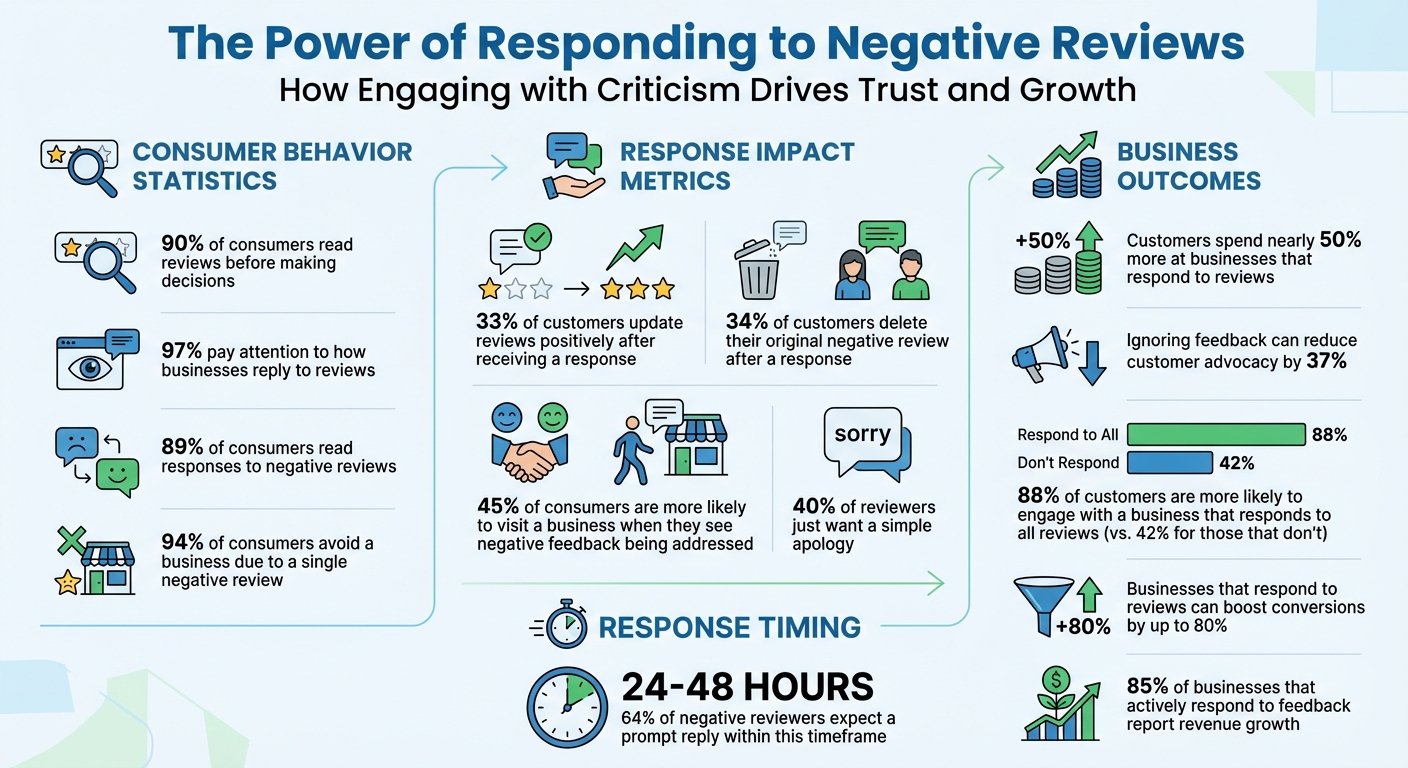
Impact of Responding to Negative Reviews: Key Statistics and Customer Behavior Data
1. Thank the Reviewer for Their Feedback
A Thoughtful and Professional Approach
Start by expressing gratitude – it helps ease any tension and signals that you’re open to constructive dialogue. Keep your response straightforward and genuine. Using "I" instead of "we" can make your reply feel more personal and accountable, showing that a real person is addressing the feedback. This sets a positive tone for a meaningful and actionable response.
Crafting a Response That Matters
Acknowledge specific points from the review to demonstrate that you’ve carefully read and considered their concerns. Aim to respond within 24 to 48 hours – this matters because 64% of negative reviewers expect a prompt reply. A timely response shows that you value their input and take the matter seriously.
Learning From Industry Examples
Practical examples help highlight the value of this approach. Take Savory Crust Gourmet Empanadas, for instance. When they received a one-star review about alleged food poisoning, CEO Geraldine Hernandez personally thanked the reviewer, investigated the issue, and even supported a related charity. This thoughtful response not only addressed the complaint but also earned public goodwill. Similarly, Southwest Airlines turned a system glitch into a learning moment by apologizing and compensating affected travelers, effectively protecting their reputation.
Using Feedback to Improve and Grow
Negative reviews can be a goldmine for identifying areas that need improvement. In fact, 85% of businesses that actively respond to feedback report revenue growth. Addressing customer concerns also helps retain existing clients, which is up to 25 times more cost-effective than acquiring new ones. By viewing criticism as an opportunity, you can turn challenges into lasting improvements.
sbb-itb-50c3429
2. Keep Your Response Calm and Professional
Professional Tone and Language
Responding to negative reviews is more than just damage control – it’s an opportunity to demonstrate your business’s values and professionalism. In fact, 97% of consumers who read reviews also pay attention to how businesses respond to them. This means your replies are not just for the reviewer but also for potential customers evaluating your brand. Here’s how to ensure your tone remains calm and professional.
Take a moment before responding to avoid letting emotions dictate your reply. Address the reviewer by name to make your response feel personal and avoid generic, copy-paste replies, which can come across as cold or insincere. Keep your response short and focused, steering clear of lengthy explanations that might sound defensive.
Actionable Response Elements
When crafting your reply, use "I" or "we" to take responsibility and add a human touch to your message. For instance, saying "We missed the mark on this" is much better than placing blame elsewhere with phrases like "Our staff member made a mistake." Data shows that nearly 40% of reviewers just want a simple apology, so acknowledging their experience is key.
No matter how unfair the review might seem, always maintain a polite and respectful tone. Yelp advises:
"If a reviewer believes you’re being ‘rude, condescending or disingenuous in any way, there’s a chance he or she could get angry and make the situation even worse’".
Remember, your response is being watched by two audiences: the original reviewer and countless potential customers who are gauging how you handle criticism. A measured and empathetic response not only addresses the issue at hand but also leaves a positive impression on those observing.
Industry Best Practices
Different industries call for different approaches when responding to reviews. For instance, in healthcare, it’s critical to avoid sharing any patient-specific information in public replies to maintain privacy and trust. In the hospitality sector, businesses that actively respond to reviews tend to receive 12% more feedback and experience an average rating boost of 0.12 stars. It’s also a good idea to have a colleague review your response to ensure your tone is appropriate and free of unintended missteps.
The numbers tell a clear story: 88% of customers are more likely to engage with a business that responds to all reviews, compared to just 42% for those that don’t. Moreover, businesses that actively engage with reviews see customers spending nearly 50% more than those that ignore feedback. Responding professionally isn’t just about managing criticism – it’s a powerful way to build trust and even boost your bottom line.
3. Apologize and Show Understanding
Actionable Response Elements
After expressing gratitude and maintaining professionalism, the next step is offering a heartfelt apology. Believe it or not, nearly 40% of reviewers expect an apology when they voice criticism. To make it meaningful, address the reviewer by name and acknowledge their specific complaint. This shows you’ve taken the time to understand their experience, rather than issuing a generic response.
When apologizing, use "I" or "we" statements to take responsibility. For instance, saying, "I apologize that we didn’t meet your expectations," feels much more genuine than, "I’m sorry you feel that way," which might come across as dismissive. Even if the issue wasn’t entirely your fault – like a late delivery caused by a third party or a supplier error – apologizing for the customer’s negative experience is key. At the end of the day, what matters most to the customer is how the situation impacted them, not the technical reasons behind it. These small but thoughtful steps can lay the groundwork for a stronger connection and a more effective resolution.
Industry Best Practices
The companies that excel in reputation management often have one thing in common: they respond quickly. A prompt apology signals to customers that they matter. And the payoff can be huge. Among businesses that address negative reviews, 33% of customers go on to leave a positive follow-up review, while 34% delete their initial negative post entirely.
In fact, over 70% of buying decisions are influenced by how customers feel they’re treated. Making someone feel heard and valued can turn even the harshest critic into a loyal supporter. As Crystal Horton, a Google Business Profile Product Expert, puts it:
"Over 70% of buying decisions are based on how a customer feels they are treated, so do your best to make all of your customers feel valued – even the unhappy ones".
4. Take Responsibility and Explain What Happened
Actionable Response Elements
After apologizing, it’s essential to explain what went wrong – without making excuses. Offer a clear and straightforward explanation that avoids technical jargon and connects with your audience on a human level. For instance, if a customer experienced an unusually long wait time, you could say something like, "We faced an unexpected staffing issue that day, but we’re now cross-training our team to prevent this from happening again." This shows you’re taking accountability while also addressing the root cause of the problem. Keep your explanation short and to the point. Overloading your response with too many details can come across as defensive, especially since 97% of consumers are more interested in seeing how you handle criticism than the specifics of what went wrong. For particularly sensitive matters, summarize your response publicly and invite the reviewer to discuss further in private. This approach not only acknowledges the feedback but also sets the stage for meaningful improvements.
Turning Criticism Into Growth Opportunities
Taking responsibility is just the first step. Use critiques as a way to identify and address gaps in your service. When you acknowledge mistakes publicly and outline your plan to fix them, you’re not just reassuring the reviewer – you’re also building trust through reputation management strategies with everyone who reads your response. A well-thought-out reply can even lead to positive follow-up feedback or encourage reviewers to revise their original comments.
"If you fix your mistakes, they [potential customers] will see that you are thorough and responsible, and that is certainly something to be valued as a business." – BrightLocal
Pay attention to recurring themes in your reviews. If you notice multiple customers highlighting the same issue – like a confusing checkout process or inconsistent service – that’s your cue to take action. Update your procedures, retrain your staff, or tweak your workflow as needed. Then, let your reviewers know about the changes you’ve made. This kind of transparency shows that their feedback truly matters and demonstrates to future customers that you’re dedicated to improving.
5. Provide a Solution or Next Steps
Actionable Response Elements
After taking responsibility for an issue, the next move is to offer a clear, actionable solution. Acknowledge the concern and provide a concrete plan to address it. For instance, if a customer highlights a billing mistake, you might say, "A full refund has been processed and will appear on your statement within 3-5 business days."
Align the compensation with the severity of the issue. For a minor inconvenience, a 20% discount on a future visit might suffice. However, more serious problems could require a partial refund or even a complimentary service. In May 2023, Hotel Santa Barbara set a great example. After a guest complained about an outdated room, they responded by offering a free upgrade to a larger, modernized room for their next stay. This approach not only resolved the issue but also helped rebuild trust with the guest.
Industry Best Practices
When addressing concerns, it’s often best to move detailed discussions offline. Publicly show your intent to resolve the issue, but provide a direct phone number or email for follow-up. This method demonstrates your commitment to resolving problems without engaging in lengthy public exchanges. For example, Snooze, an A.M. Eatery, tackled a 1-star review about long wait times by introducing their new online waitlist system to help prevent similar frustrations in the future.
"Compensatory action in your response to negative customer reviews could mean the difference between simply satisfying your customer and actually retaining them." – Stephanie Heitman, Associate Director of Content, LocaliQ
Research supports this strategy: 33% of customers who receive a response to a negative review go on to post a positive one, while 34% delete their original negative review entirely.
The Best Responses to Bad Reviews (& TOP MISTAKES to Avoid)
6. Take the Conversation Private
Once you’ve offered a solution publicly, it’s time to shift the discussion to a private channel.
Actionable Response Elements
After acknowledging the issue in a public forum, invite the customer to continue the conversation privately. Keep your public response short and professional to show others that you’re handling the situation seriously. Be sure to provide clear contact details, such as a phone number, email, or the contact information of a manager or owner.
For instance, you could say: "We’d like to look into this further and find a solution that works for you. Please reach out to [CUSTOMER SERVICE REP NAME] at [PHONE NUMBER] or email us at [CUSTOMER SERVICE EMAIL]". This gives the customer several ways to contact you and shows that their concern is being escalated to someone who can make decisions.
Industry Best Practices
Taking the conversation offline avoids lengthy public exchanges. A single, professional public reply not only protects the customer’s privacy but also safeguards your business’s reputation.
Stick to a one-response policy: post one concise, polite reply inviting the customer to continue the discussion privately, and then refrain from further public comments. Avoid arguing or sharing sensitive details publicly – this can come across as defensive and might even violate the customer’s privacy. Private communication channels allow you to thoroughly investigate the issue, provide tailored solutions, and maintain confidentiality. In fact, 88% of consumers are more likely to choose a business when they see the owner responds to all reviews, whether positive or negative. This professional approach can make a big difference.
"Taking the conversation offline… enables a deep dive into the situation and eliminates noise such as additional comments by other users." – LocaliQ
7. Use Reviews to Improve Your Business
Turning Criticism into Growth Opportunities
Negative reviews aren’t just complaints – they’re a window into areas where your business might need attention. When customers highlight issues like long wait times, unhelpful staff, or product flaws, they’re pointing out things you might not have noticed during internal checks. Instead of taking these comments personally, think of them as valuable data to help your business improve.
Start by tracking recurring patterns in customer feedback. For instance, if several reviews mention slow service or confusing product descriptions, these could be signs of a broader issue that needs to be addressed quickly. Keeping a log of complaints and how they’re resolved can help you identify trends and take proactive steps to improve your operations.
"We monitor these comments daily, and if we see any concerning trends, we share that with the rest of the team internally", says Drew Frey, Community and Advocacy Manager at Webroot.
Real-world examples show how businesses can turn criticism into opportunities. Vertbaudet, for example, noticed repeated complaints about maternity dress sizing. By adjusting their product line, they saw a 12% boost in sales for those items. Similarly, The Container Store acted on feedback about their shoe storage boxes, introducing a taller version with the tagline, "You asked and we listened." The result? A highly successful product launch. These examples highlight how listening to customers can lead to meaningful improvements and stronger overall reputation management for your business.
Actionable Response Elements
When you make changes based on customer feedback, it’s important to close the loop. Respond to the original reviewer, letting them know what adjustments you’ve made to address their concerns. This not only shows the reviewer that their input matters but also builds trust with future customers who see your commitment to improvement.
To ensure feedback leads to real progress, direct specific complaints to the right teams. For example, send product-related issues to development, shipping concerns to operations, and staff behavior complaints to HR. This targeted approach ensures that the feedback is handled effectively.
Keep in mind that 62% of customers are willing to give your business another chance if you resolve their issue. On the flip side, ignoring negative reviews can lead to a 37% drop in customer advocacy. Addressing feedback thoughtfully can make all the difference in retaining customer loyalty and driving growth.
Comparison Table
How you handle negative reviews can either strengthen your reputation or seriously harm it. With 97% of people who read online reviews also checking out how businesses respond, every reply becomes a reflection of your values and professionalism. Businesses that respond thoughtfully to reviews often see higher customer loyalty and spending, while ignoring or dismissing feedback can have the opposite effect. In fact, 94% of consumers admit that a bad review has deterred them from choosing a business entirely.
Here’s a breakdown of the differences between professional and dismissive approaches:
| Feature | Professional Response | Dismissive/Defensive Approach |
|---|---|---|
| Tone | Calm, empathetic, and genuine | Defensive, impolite, or overly emotional |
| Accountability | Acknowledges the issue and offers solutions | Shifts blame or gives excuses |
| Personalization | Tailors responses with the reviewer’s name and specific details | Uses generic, cookie-cutter replies |
| Privacy | Resolves the issue privately through direct contact | Engages in public arguments |
| Customer Trust | Builds trust by showing care and responsibility | Erodes trust, suggesting poor ethics |
| Outcome | Can boost conversions by as much as 80% | Risks turning a single review into a PR disaster |
| Customer Retention | 45% of customers are more likely to return when their review is addressed | Misses the chance to win back 40% of customers seeking an apology |
This comparison highlights how a professional response can improve customer relationships and enhance engagement.
"Negative reviews don’t kill businesses, but the way you respond to them, could." – Surefire Local
Responding thoughtfully shows customers you care, even when mistakes happen. A personalized, meaningful reply will always outshine a generic "thanks".
Conclusion
Negative reviews don’t have to harm your business – if you handle them the right way. Thoughtful responses can actually strengthen trust and show authenticity in your online reputation.
The numbers back this up: 89% of consumers read responses to negative reviews, and businesses that respond effectively often see customers spending nearly 50% more. Additionally, 45% of consumers are more likely to visit a business when they see negative feedback being addressed. Even better, 33% of customers who receive a response post a positive review, and 34% delete their original negative feedback.
"We value hearing from customers and need this constant feedback loop, whether it’s negative or positive, or we aren’t going to get better."
- Drew Frey, Community and Advocacy Manager, Webroot
The seven strategies outlined here go beyond simple damage control. They’re about growth – showing potential customers that your business takes problems seriously, fixes mistakes, and values feedback.
In a landscape where 94% of consumers avoid a business due to a single negative review, a thoughtful reply can turn doubt into loyalty and demonstrate a commitment to continuous improvement.
FAQs
How does responding to negative reviews help build customer trust?
Responding to negative reviews shows that you pay attention, care, and are willing to act. By addressing concerns directly, offering a genuine apology, and presenting a clear resolution, you show responsibility and understanding – qualities that help build trust with both the reviewer and potential customers.
People who read reviews often focus on how businesses handle criticism. A well-crafted response can reassure potential customers that you value their input and are committed to fixing problems. This openness not only softens the impact of a bad review but also showcases your dependability, which can inspire confidence and even lead to repeat business.
How should I handle a negative review by taking the conversation offline?
Start by acknowledging the reviewer publicly and expressing regret for their experience. A simple yet empathetic response can go a long way. For instance, you might say: "We’re sorry to hear about your experience. Please reach out to us at support@yourbusiness.com or call (555) 123-4567 so we can work together to make things right." This not only shows you care but also encourages further communication in a private setting.
Make sure to respond quickly, ideally within 24–48 hours. A timely reply demonstrates your commitment to resolving the issue. When you continue the conversation privately, keep the tone professional and stick to the point. Assign one person to handle the matter to avoid confusion and make the process seamless for the customer.
Once the problem is resolved, send a follow-up note to thank them for their patience. If it feels appropriate, you can politely ask if they’d consider revisiting their review. Internally, document the entire interaction. This helps track the resolution, ensures you deliver on promises, and provides valuable insights to prevent similar problems in the future.
How can businesses turn negative reviews into opportunities for growth?
Negative reviews, while often unwelcome, can serve as valuable opportunities to refine your business. They shed light on areas that may need attention – like slow service, miscommunication, or other operational hiccups – offering you the chance to address these issues head-on. By analyzing recurring patterns in the feedback and comparing them with your internal data, you can determine whether the problem is a one-off or part of a larger challenge that requires action.
Thoughtful responses to negative reviews can also go a long way in building trust. Start by acknowledging the feedback, then provide a clear solution and explain the steps you’re taking to resolve the issue. This approach shows accountability and reassures both the reviewer and potential customers that you’re serious about improving their experience.
Take these insights a step further by implementing meaningful changes. For instance, if multiple reviews point to long wait times, consider adjusting staff schedules or optimizing workflows. Monitor the impact of these adjustments over time, and use the results to highlight your commitment to improvement. In this way, criticism can become a stepping stone to earning customer loyalty and gaining a competitive edge.
